A 2026 meta-analysis of 14 studies reported small reductions in depression and agitation among people with dementia who used AI-based socially assistive robots, but it detected no effect on cognition or anxiety. Ten of the studies entered the quantitative analysis, and the authors called for larger trials with standardized outcomes.
A separate 2026 systematic review found a second constraint: speech recognition failure was the most consistently reported technical barrier across 40 studies of conversational AI in dementia care. Taken together, the evidence supports testing robots for narrow interaction tasks, not transferring clinical judgment or care responsibility to a machine.
Social support is different from physical assistance
Care robots cover several types of work. Physically assistive systems may help with carrying, lifting or movement, while socially assistive robots facilitate interaction or communicate directly with an older person. Companion robots fall mainly into the second group, although the categories can overlap.
The label describes the intended interaction, not the quality of the underlying software. A physical body, conversational interface or humanlike voice does not establish that a product can recognize an emergency, interpret a change in health or make a care decision.
The 2026 conversational AI review classified 24 of its 40 included studies as socially assistive robots, 12 as text chatbots, three as multimodal systems and one as a voice chatbot. Only eight studies were randomized controlled trials, and none of the randomized outcomes received an overall low risk-of-bias rating. The authors described the findings as directional rather than confirmatory.

Clinical evidence remains narrow
The 2026 meta-analysis reported standardized mean differences of -0.30 for depression and -0.26 for agitation. Those are group-level trial results, not a guarantee that a particular person or product will benefit. The same analysis found confidence intervals spanning no effect for cognition and anxiety.
The conversational AI review covered studies published from 2010 through March 2026. It found some positive results across cognitive, social and caregiver outcomes, but stronger claims were limited by small samples, nonrandomized designs and higher risk of bias. Evidence from one robot, interface or care setting cannot establish performance for another.
Deployment is also less extensive than product demonstrations may imply. A 2023 OECD report, citing 2021 national sources, said about 1 percent of long-term care providers in Japan and the United Kingdom used expensive equipment such as robots. That category is broader than companion robots and the figures are not a global adoption estimate.

Speech and handoff failures are deployment tests
Conversation length is a poor proxy for safe performance. A care organization needs to test recognition with the people and conditions in which the system will operate, including different languages, accents, speaking speeds, hearing or speech impairments, room noise, repeated questions and network interruptions. Results should record failed recognition and abandoned interactions, not only successful demonstrations.
A narrow task boundary makes the handoff visible. Scheduled prompts, guided activities or starting a family call can be separated from medication changes, assessments and responses to uncertain or urgent events. The deployment record should identify the person or team that receives an escalation, the information they receive and the fallback used when the robot or network fails.
World Health Organization guidance says humans should remain in control of healthcare systems and medical decisions, while AI should be evaluated for safety, accuracy and efficacy in well-defined uses. The WHO also calls for privacy, valid consent, transparency, accountability and review during actual use. Those principles place human oversight and an auditable handoff inside the system design rather than outside it.

Privacy and apparent personhood require explicit controls
Companion robots may collect voices, images, activity records and conversation histories in private spaces. Procurement documents should state which sensors are active, where processing occurs, which raw data and inferences are stored, how long records remain available and who can access or delete them. A mute control, a clear way to stop an interaction and a route to human support need to work without requiring a long conversation with the system.
A 2026 ethics review screened 1,518 publications, included 248 and identified at least 60 broad ethical issues affecting care recipients, care providers and society. Its categories included autonomy, privacy, discrimination, dependency, deception, trust and responsibility. The authors said implementation scenarios require contextual evaluation rather than a single judgment for every robot.
The review found that anthropomorphic or animal-like designs can create a pronounced deception risk for people with neurocognitive impairments, who may mistake a robot for a person or animal. A deployment can reduce that risk by identifying the system as a machine, avoiding claims of feelings or professional authority, preserving the ability to refuse interaction and documenting how consent and ongoing assent are handled under applicable local rules.
A pilot should measure the care process
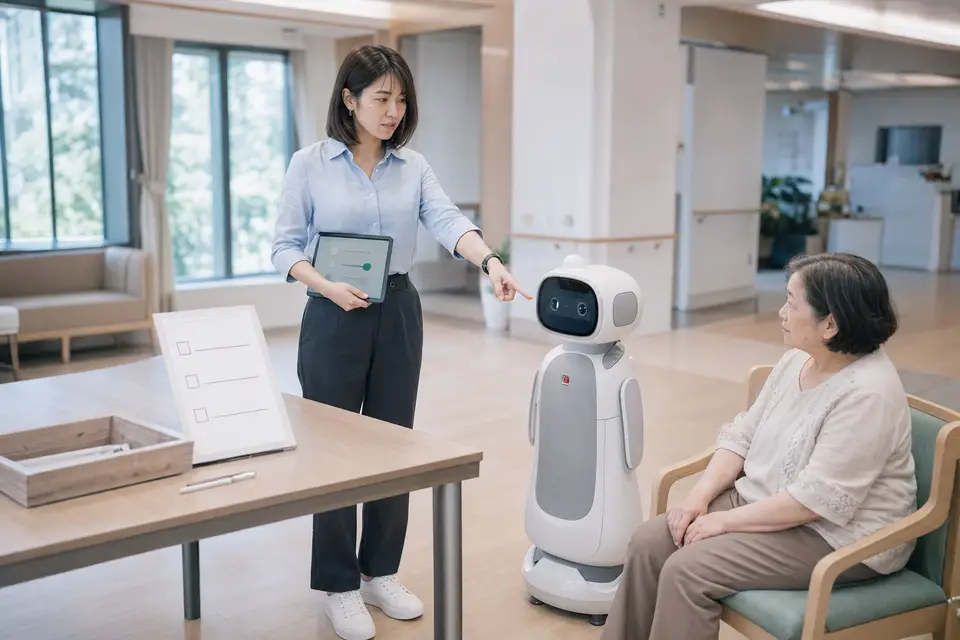
A useful pilot begins with a defined task and a comparison point. Measures can include completed prompts, failed recognition, false or missed alerts where alerts are offered, time from escalation to human response, staff workload, opt-outs and the number of interactions that required correction. Results should be separated by language, setting and relevant user needs so that an average does not conceal a group for whom the interface fails.
The evidence does not support treating companion robots as caregivers. A system may support a bounded interaction or communication task, while people retain clinical decisions and responsibility for care. APPI News could not find a published global count of companion-robot deployments in long-term care, and availability and regulatory status vary by product and country.
Frequently asked questions
Can an AI companion robot replace a caregiver?
No. The cited reviews do not establish that robots can assume clinical judgment, safety decisions or accountability for care, and the WHO says humans should retain control of medical decisions.
Do companion robots improve dementia outcomes?
The 2026 meta-analysis reported small reductions in depression and agitation across included trials. It detected no effect on cognition or anxiety, and the authors called for larger studies with standardized outcomes.
What should a long-term care provider verify before a pilot?
The record should define the task, test population, languages and conditions, data collection, access and retention, failure behavior, human escalation route and measures used to decide whether the pilot worked.
Sources and further reading
- Artificial Intelligence-based social assistive robots in dementia care: a systematic review and meta-analysis(The Gerontologist)
- Conversational AI in Cognitive and Social Training for People with Dementia: A Systematic Review(Healthcare via PubMed Central)
- Ethical aspects of the use of social robots in caring for older people: a systematic qualitative review(Medicine, Health Care and Philosophy)
- Beyond Applause? Improving Working Conditions in Long-Term Care(Organisation for Economic Co-operation and Development)
- WHO issues first global report on Artificial Intelligence in health and six guiding principles(World Health Organization)