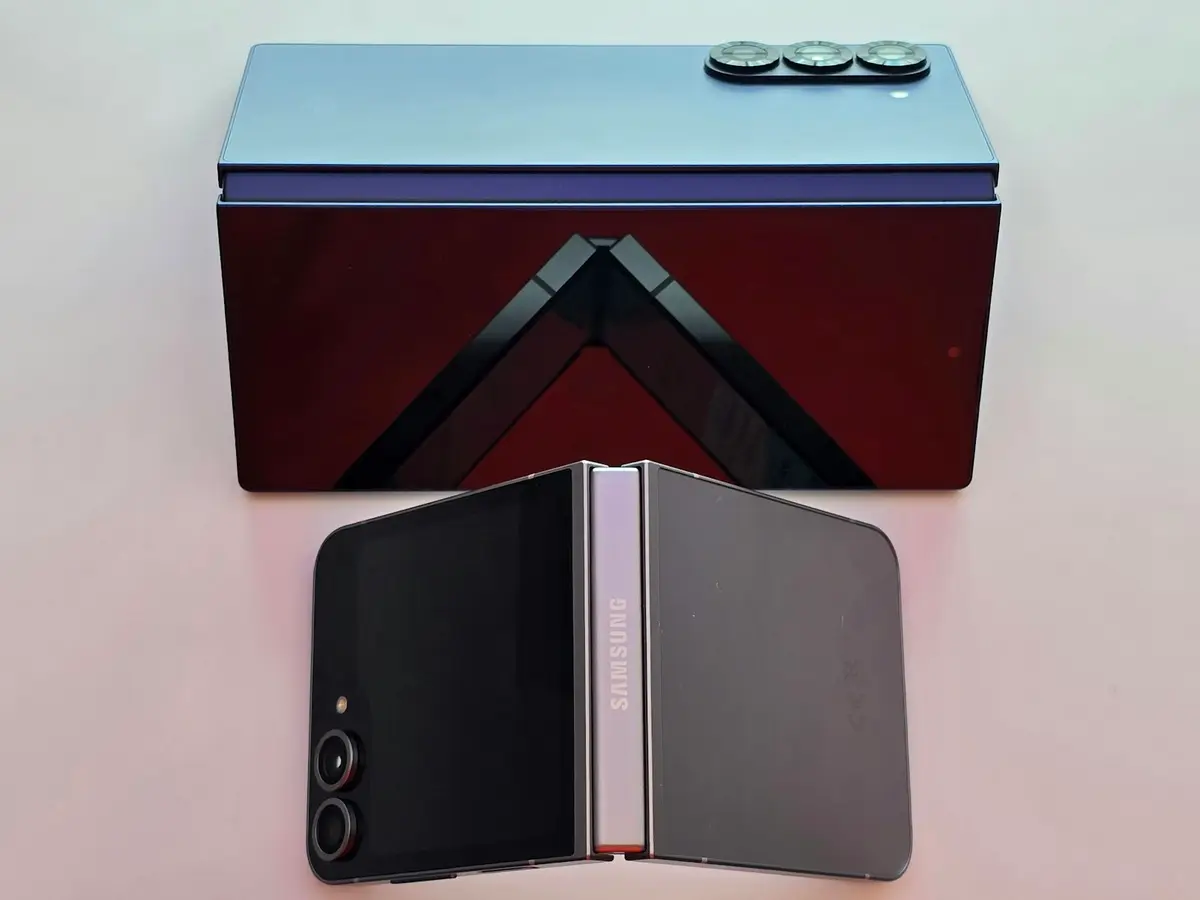
Foldable phones have two different origin stories. Motorola developed a hinged housing for a conventional hard display, while Royole and Samsung later put the folding action into the screen itself.
That distinction changes the answer to “who invented” the device. The patent record shows an early mechanical lineage; product announcements show a later race to make a flexible display, hinge and mobile operating system work as one device.

Motorola’s early phones folded the housing
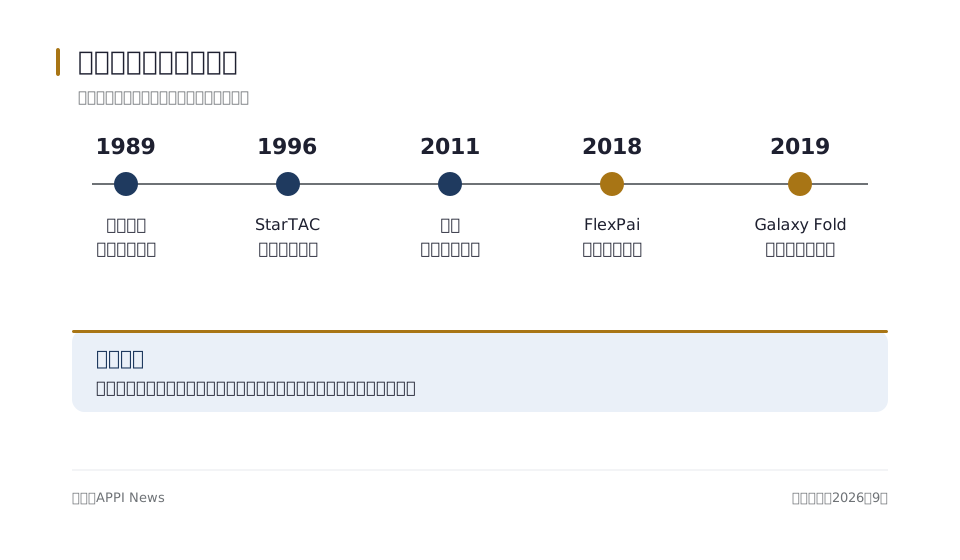
A Motorola patent filed in the United States in 1989 describes a radiotelephone with a movable housing element. Opening the element could activate the phone, reveal the keypad and control call functions. The patent’s display was not a flexible panel; the mechanical movement came from the case.
Motorola’s StarTAC, introduced in 1996, made that arrangement familiar to a mass market. Its two body sections closed around a conventional phone interior. In that sense, the StarTAC belongs to the history of flip phones and compact hinges, not to the later flexible-display category.
Flexible-display patents formed a separate technical line
Samsung Display’s US foldable-display patent was published in 2014 from a 2012 priority date. The document brings a flexible panel, a folding region, a protective layer and a support structure into one design intended for portable devices.
A patent is evidence of a technical proposal and its filing history. It is not a product launch record. Years can pass between a priority date, publication, engineering validation and retail availability, and a patent can describe several embodiments that never become a shipping phone.
Royole arrived first with a flexible-screen product claim
Royole announced the FlexPai on October 31, 2018, calling it the world’s first commercial foldable smartphone with a fully flexible display. The company described a phone that could be used folded or unfolded, with a tablet-sized viewing area when open.
That wording should be read as a company claim, not as an independently audited ranking of every prototype or regional sale. It does establish an important product milestone: a manufacturer publicly presented a flexible-screen phone before Samsung’s Galaxy Fold reached consumers.
Samsung turned the parts into a recognizable product category
Samsung said in July 2019 that it had extended the display’s protective layer and reinforced the device against external particles. Those changes followed the company’s February announcement and preceded the retail launch.
Samsung released the Galaxy Fold in South Korea on September 6, 2019, followed by selected markets including Singapore, the United Kingdom and the United States. The company paired a 7.3-inch internal display with a cover screen, App Continuity and multi-window functions.
The Galaxy Fold’s importance was therefore product integration. The hinge, flexible display, protective layers and Android software had to survive ordinary use together. Samsung did not erase Royole’s earlier commercial claim, but it gave the category a larger international launch and a more visible software model.
How this plays out outside Taiwan
For readers buying a foldable phone in another market, the invention timeline is less useful than the local sales and repair record. A flexible display is a costly part, and a phone that looks identical across countries may have different sellers, warranty documents, return routes and authorized repair options. The safest comparison starts with the official product page for the country where the purchase will occur, then checks the seller’s invoice, model number and repair terms.
In the United States, the Federal Trade Commission says a written warranty must be available for consumers to read before purchase. Its guidance also says buyers should check what the warranty covers, who handles claims, whether labor or shipping costs apply and what happens if the product is repaired or replaced. That matters for a foldable phone because a display defect, hinge issue and accidental damage may fall under different exclusions. The FTC’s warranty guide tells US buyers to keep the warranty and proof of purchase and to contact the seller when a product has a problem. A US buyer should therefore save the order record and ask whether service is handled by the retailer, the manufacturer or an authorized repair network before assuming that a promotional price includes the same support as a direct purchase.
The United Kingdom uses a different route for faulty goods. The UK government says customers can seek a full refund for faulty goods and gives online buyers a 14-day cancellation period for many distance purchases. The same guidance says a retailer may have to repair or replace an item after the customer has accepted it, and that a consumer can still have rights even after a manufacturer’s warranty ends. For a foldable phone, a buyer should distinguish a change-of-mind return from a fault claim, keep evidence of when the defect appeared and deal with the retailer named on the receipt. A manufacturer’s service promise can add convenience, but it does not replace the statutory route against the seller.
Australia also puts the first responsibility on the business that sold the product. The Australian Competition and Consumer Commission says a major problem can give a consumer a choice between a refund and replacement, while a minor problem normally requires a free repair. The ACCC specifically warns that repairs to electronic products such as mobile phones can lead to data loss and that refurbished parts or replacement devices may be used with notice. That is a practical check for a foldable-phone buyer: back up data, ask whether the repair will use a refurbished screen, and get the assessment and proposed remedy in writing. Buying from an overseas seller can make a remedy harder to enforce, even when the device is technically compatible with Australian networks.
Singapore’s Lemon Law gives another example of why an international history article cannot promise one global remedy. Singapore’s Ministry of Trade and Industry describes remedies including repair, replacement and price reduction for goods that fail to conform, while noting that a defect found after six months may require the consumer to show it existed at delivery. The official guidance also excludes damage caused by misuse or unauthorized repair. A Singapore buyer considering an imported foldable phone should check who the contracting seller is, whether local service is available and how the return process handles a screen that develops a line or hinge fault. The product’s launch country does not answer those questions.
These markets point to the same buying method: confirm the local model and price, read the seller’s return terms, locate an authorized repair channel and preserve proof of purchase. Foldable-phone history explains how the category formed; local consumer rules decide what happens when the hinge or display does not perform as promised.
What “first” means in this history
Motorola has the early claim for a phone that folds at the housing. Samsung Display’s patent record shows flexible-display engineering before a retail device. Royole has the 2018 company announcement for an early commercial flexible-screen phone, while Samsung’s Galaxy Fold marks a 2019 launch that combined the display, hinge and software in a globally visible product.
Those statements can all be true because they answer different questions. The history becomes misleading only when a flip-phone patent, a flexible-display patent and a mass-market launch are treated as the same event.
Frequently asked questions
Did Samsung invent the foldable phone?
Samsung did not invent the hinged phone housing. Motorola’s 1989 patent and the 1996 StarTAC came earlier. Samsung helped make flexible-screen phones a major commercial category with the 2019 Galaxy Fold.
Was Royole’s FlexPai the first foldable smartphone?
Royole’s October 2018 press release called FlexPai the world’s first commercial foldable smartphone with a fully flexible display. That is a company claim and does not prove that no earlier prototype existed or that FlexPai achieved the widest sales.
What is the difference between a flip phone and a foldable phone?
A classic flip phone folds its housing around a conventional display. A modern foldable phone uses a flexible display that bends with the hinge, often switching between a cover screen and a larger internal screen.
Why do local rules matter when buying a foldable phone?
Return periods, warranty claims, repair responsibilities and rules for defective goods depend on the purchase country and seller. A model launched in one market may not carry the same service terms in another.
Sources and further reading
- Communications device with movable element control interface, US5175759A(Google Patents)
- Foldable display device, US20140029212A1(Google Patents)
- Royole introduces FlexPai(Royole Corporation via PR Newswire)
- Galaxy Fold ready for launch starting from September(Samsung Global Newsroom)
- Samsung Galaxy Fold now available(Samsung Global Newsroom)
- Warranties(US Federal Trade Commission)
- Accepting returns and giving refunds: the law(UK government)
- Repair, replace, refund, cancel(Australian Competition and Consumer Commission)
- General advisory on Singapore’s Lemon Law(Singapore Ministry of Trade and Industry)