Researchers in South Korea and the United States reported two manufacturing advances for stretchable electronics in 2026. One kept liquid-metal conductors working under repeated strain, while the other put a dense computing array on a stretchable patch, but neither study tested a finished implant in people.
The work addresses two different parts of a soft electronic system: connections that carry signals and transistors that process them. Both could inform future wearable or implantable devices, although the published evidence remains at the component and prototype stage.
Liquid-metal paths survive repeated stretching
A Korea Advanced Institute of Science and Technology-led team reported a way to pattern liquid-metal particles on a silicon wafer and transfer the complete pattern into several polymers at cryogenic temperature. The Nature Communications paper, published on February 26, 2026, describes transfers of gallium-based liquid metals into six polymer substrates and patterned lines from 5 to 500 micrometers wide.
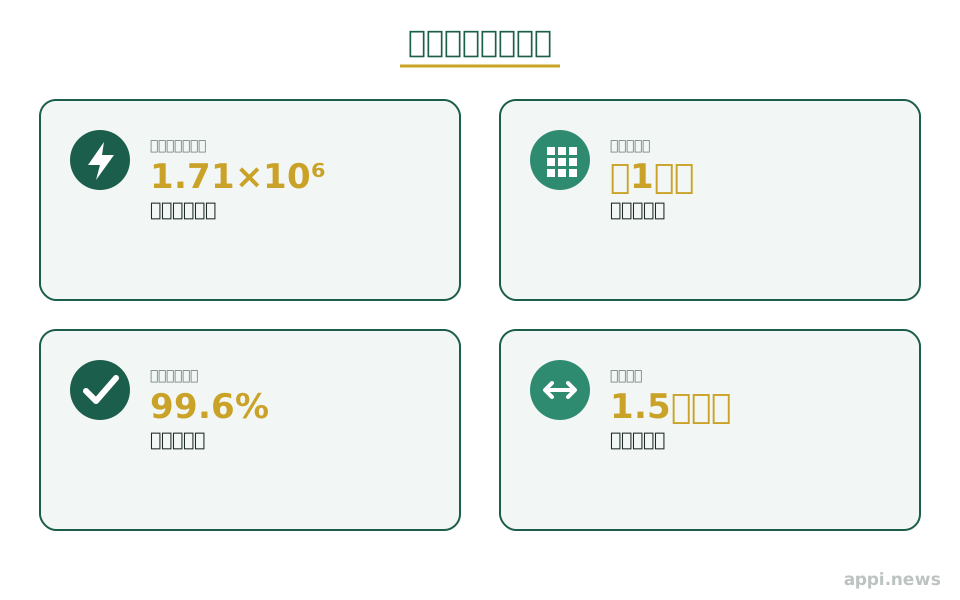
The particles form connected electrical paths inside the polymer after an initial stretching step breaks their oxide shells and lets neighboring particles join. The activated material reached an average conductivity of 1.71 million siemens per meter, about half the value of the bulk liquid metal used by the researchers.
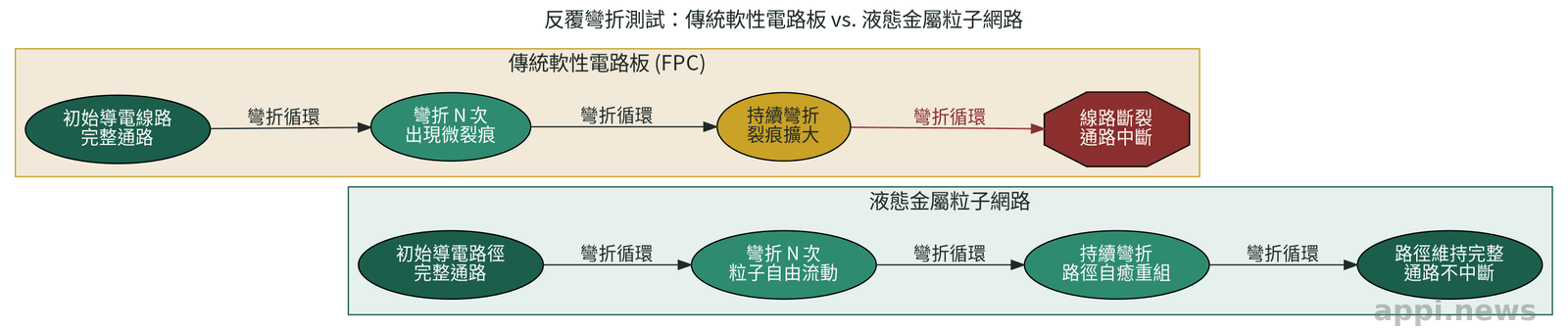
The team tested lines embedded in polydimethylsiloxane through 1,000 cycles at 50 percent and 70 percent strain. Resistance changed consistently across those cycles, and the paper also reports electrical stability after six months of storage. These are laboratory measures of an interconnect material, not service-life evidence for a medical product.
The prototype links circuits to skin sensors
The liquid-metal team used the process to make a 72-element pressure-sensor array that conformed to a human hand. It also assembled a skin-mounted prototype that recorded electrocardiogram and muscle signals and tested an electrochemical glucose sensor in controlled conditions. The paper presents these demonstrations as potential wearable applications rather than validated monitoring devices.
The same process joined rigid chips to stretchable liquid-metal interconnects in a small neuromorphic circuit. That integration matters because soft conductors still have to connect with conventional components for power, sensing or computation. The experiment did not combine all of those functions into a self-contained medical patch.
A separate array performs local computing
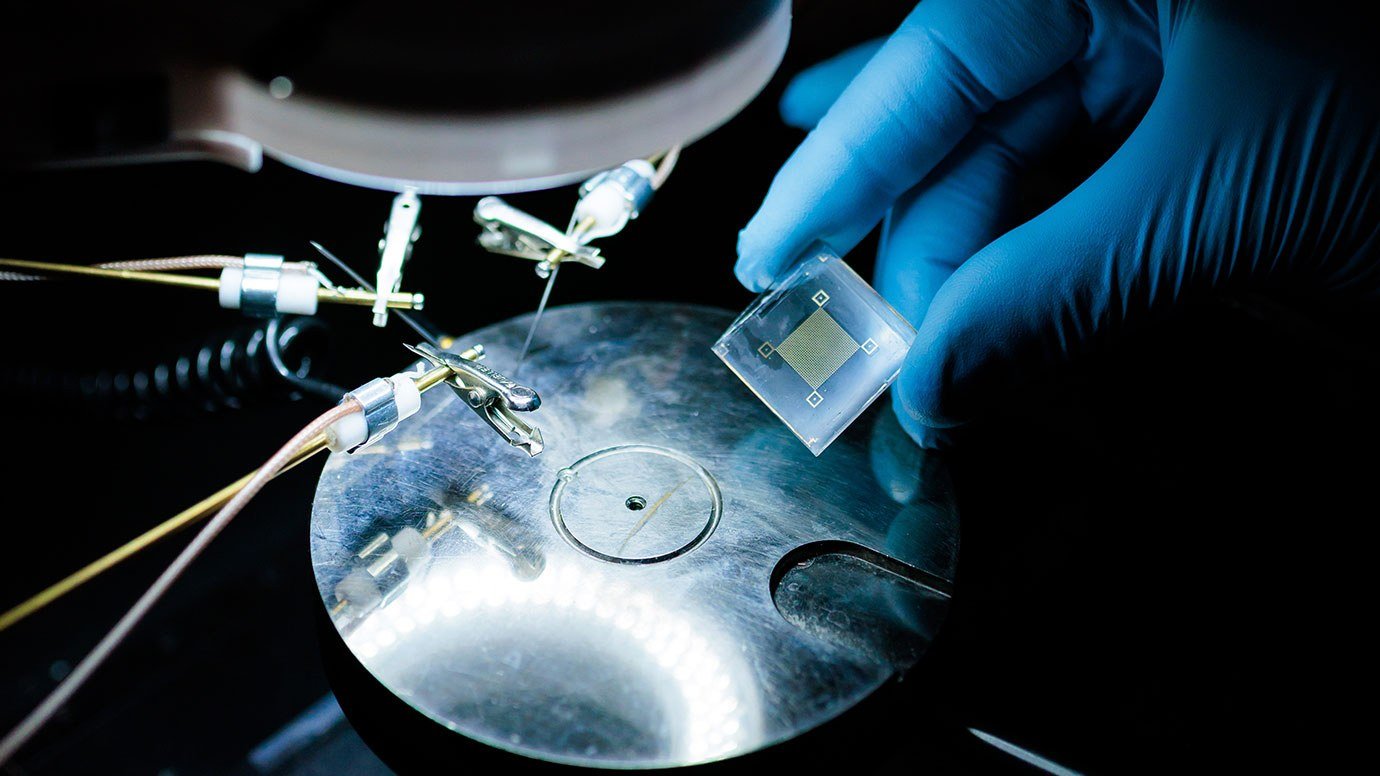
A University of Chicago and Argonne National Laboratory team took a different route. Its Nature Electronics paper, published on May 20, 2026, reports intrinsically stretchable organic electrochemical transistor arrays with densities of up to 10,000 devices per square centimeter.
Organic electrochemical transistors use electrical current and ion movement through an electrolyte to process and retain signals. The team patterned the gel-like electrolyte with ultraviolet light, allowing a larger and denser array than earlier prototypes.
The university says the array located electrical wavefronts in mapping data from a donor human heart with 99.6 percent accuracy while stretched beyond 1.5 times its original length. The calculation ran on the array in milliseconds instead of sending data to a remote server. The result measures agreement in a hardware-computing task; it is not a clinical diagnostic accuracy figure.
The studies solve different engineering problems
The liquid-metal work focuses on fabrication and electrically stable connections across soft substrates. The organic-transistor work focuses on local computation that can deform with a patch. Neither paper shows the two technologies operating together, so their reported figures should not be treated as the specifications of one device.
The distinction also separates flexible from stretchable electronics. A flexible circuit can bend around a surface, while a stretchable circuit must tolerate changes in length and shape. Repeated deformation can alter resistance, break interfaces or loosen connections between soft and rigid components, which is why the new studies test strain alongside electrical performance.
The research is related to other early-stage medical robotics and electronics projects, where technical feasibility precedes clinical evidence. A separate APPI News report on a humanoid robot tested in two pig surgeries likewise distinguishes an engineering demonstration from an authorized clinical system.
Implant use requires evidence beyond stretch tests
A component that touches tissue must be evaluated as part of a finished device for its intended use and exposure. ISO 10993-1:2025 sets out biological-safety evaluation within a risk-management process, taking account of material composition and the nature and duration of body contact. A conductivity result or a short prototype demonstration does not answer those biological questions.
Developers would also have to address packaging, power, heat, sterilization, mechanical fatigue and the stability of every interface over the proposed operating life. For an implanted product, failures that interrupt sensing or stimulation have different consequences from failures in a temporary laboratory patch.
The International Medical Device Regulators Forum published a final 2024 edition of its common principles for medical-device safety and performance. National and regional authorities apply their own legal pathways, so authorization in one market would not establish availability elsewhere.
Neither research paper reports a long-term human clinical trial of an implanted product using its platform. APPI News could not verify a marketed implant using either 2026 platform at the time of writing.
Frequently asked questions
Are liquid-metal circuits the same as conventional flexible circuit boards?
No. Conventional flexible circuits are designed to bend, while the material in the 2026 study was engineered to preserve connected conductive paths as the polymer stretched. The paper tested a new fabrication method and material structure, not a replacement circuit board ready for every device.
Did the stretchable computing array diagnose heart disease?
No. It ran pre-trained calculations on stored health data. The reported 99.6 percent figure concerned the location of electrical wavefronts in donor-heart mapping data, not diagnosis in a clinical trial.
Can either platform be implanted now?
The papers do not establish that. They report materials, circuits and prototype demonstrations. A finished implant would require device-level reliability, biological-safety and clinical evidence, followed by authorization in each market where it would be sold.
Sources and further reading
- Universal cryogenic transfer of liquid metal particles in polymers for wafer-scale stretchable integrated electronics(Nature Communications)
- A large-scale stretchable neuromorphic circuit for on-body edge computing(Nature Electronics)
- Stretchable AI patch computes on your body, no server required(University of Chicago News)
- ISO 10993-1:2025 — Biological evaluation of medical devices(International Organization for Standardization)
- Essential Principles of Safety and Performance of Medical Devices and IVD Medical Devices(International Medical Device Regulators Forum)