
Google updated its Play for On-device AI guide on August 14, 2026, documenting model-delivery rules that can target phones by installed random-access memory (RAM). The rules do not create a universal 16GB threshold, while Android and iOS memory documents point to background app retention as the more immediate difference.
The official documents reviewed for this guide do not designate 12GB as sufficient or 16GB as necessary. They explain operating-system behavior and developer controls, not a controlled comparison of otherwise identical phones. The source report's four-phone result is omitted because APPI News could not verify its raw data, firmware versions or full test procedure.

Background reloads are the first difference to test
Android keeps non-foreground app processes in a cache so it can reuse them when a user returns, but removes cached processes as memory runs low. A retained process can resume more quickly, while a removed process has to reload. The documentation does not promise that a given RAM capacity will retain a fixed number of apps.
Google says Android's low-memory killer removes background apps before foreground and system processes, and device manufacturers can change the mechanism's behavior. Two phones with the same advertised RAM can therefore manage the same app sequence differently. The memory used by each app also changes the point at which the system comes under pressure.
Apple says iOS can move a memory-intensive background app to solid-state storage, adding delay when it returns to the foreground, and that an app's memory limit depends on the device. Android and iOS implement memory management differently, but neither capacity label gives a guaranteed count of apps that will stay ready.

More RAM is capacity, not a general speed rating
The official pages describe memory pressure, caching and process termination. They do not provide evidence that changing an otherwise identical phone from 12GB to 16GB raises game frame rates or shortens the cold launch of one app. Either claim requires a controlled test of the exact models and software involved.
A repeatable workload is more useful than a generic count of opened apps. On both candidate phones, the comparison can open the same game or editing project, browser tabs, camera and messaging apps, switch through them in the same order, and then record which apps retain their state. Matching software versions and settings are necessary so the test measures more than a RAM label.

AI support must be checked on the exact phone
Google's Android AI overview says on-device AI uses local storage, RAM and battery, requires compatible Android hardware, and can vary with operating-system and hardware support. Installed RAM is therefore one input, not an eligibility list. A 16GB specification cannot show whether a particular feature runs locally, uses a cloud model or is supported on that phone.
Google Play's beta delivery guide lets developers target model variants by device RAM, gives devices with at least 6GB as one example, and caps each AI pack at 1.5GB of compressed download size. The 6GB figure is a distribution example rather than a general runtime minimum, while 1.5GB describes a download package rather than RAM use. The exact phone's product page and feature-support list still have to establish compatibility.

How this plays out outside Taiwan
The same RAM decision can produce a different shopping result in each market because manufacturers do not sell every configuration everywhere. Google’s US Pixel 10 specifications page lists a 12GB model and prices in US dollars, while its UK page lists 12GB configurations and prices in pounds. Those pages are useful examples of why a review from another country cannot supply the price or stock answer for a buyer elsewhere.
In the United Kingdom, the Google Store page separates storage choices from RAM: the listed Pixel 10 options pair 128GB or 256GB of storage with 12GB of RAM. The page also shows a local warranty term and asks for a UK delivery address at checkout. A buyer comparing 12GB and 16GB should therefore record the exact storage, color, seller and delivery country, not copy a headline price from a US review or assume that a higher-RAM variant is sold through the UK store.
The UK example also adds a purchasing check that is separate from memory performance. The UK Government’s Consumer Rights Act 2015 guidance says consumers can seek a repair or replacement when goods are faulty after the first 30 days, while the short-term right to reject a faulty item applies within 30 days. That rule concerns the transaction and the seller’s obligations; it does not create a RAM standard, guarantee a future software feature or change how Android manages background processes. Keep the invoice and the product page showing the advertised memory if a delivered phone does not match the listed configuration.
Singapore illustrates the importance of checking local inventory before converting currencies. The Google Store Singapore configuration page lists the Pixel 10 at SGD 1,199 for 128GB and SGD 1,339 for 256GB, and asks the buyer to enter a postal code to check delivery. The page also says that some features are not available in all areas. A Singapore buyer can use that page to establish the local price and the storage options, then open the exact model’s feature list to see whether a desired on-device function is supported.
That check matters because storage and RAM are not interchangeable. More storage holds more photos, games and model packages; it does not give an app more working memory. A local offer may bundle storage, trade-in credit, a carrier plan or a protection plan, so the apparent premium for 16GB may not be a RAM-only price difference. Compare the cash price, storage, financing total and any required service separately before assigning value to the extra capacity.
Australia provides another concrete comparison. Google’s Australian phone comparison lists models with 12GB and 16GB RAM, but the configurations belong to different phone tiers rather than to one universal upgrade path. That makes a direct test especially important: a 16GB model may also have a different processor, display, storage speed, camera system or thermal design. If those parts change, a faster result cannot be credited to RAM alone.
Australian buyers should also separate a phone fault from a mobile-service complaint. The Australian Competition and Consumer Commission says the Australian Consumer Law can give consumers rights to ask for a repair, replacement or refund when a product or service fails a consumer guarantee, with the remedy depending on whether the problem is major or minor. The ACCC page directs service-provider disputes to the Telecommunications Industry Ombudsman. Neither body publishes a rule saying that 12GB or 16GB is the correct capacity, so the useful evidence remains the advertised specification and a repeatable app-reload test.
For buyers in the United States, the Google Store page is a practical source for the local configuration and price, but it should not be treated as a global catalog. Apple’s US iPhone technical-specification pages show storage capacity and feature support without presenting a consumer RAM comparison, so an iPhone buyer cannot use an Apple RAM number to line up directly with an Android listing. In any country, the reliable sequence is to check the manufacturer’s local product page, confirm the exact model number and RAM, check the seller’s return and warranty terms, and then test the workload that matters.
Prices and promotions expire, and stock can change by delivery address. Save the product page or order confirmation on the purchase date, and ask the seller to identify the RAM configuration in writing if the listing uses vague terms such as “AI-ready” or “up to 16GB.” That evidence helps distinguish a genuine 12GB-versus-16GB choice from a package whose higher price comes from storage, trade-in conditions or a carrier contract.
Extra memory does not extend software support
RAM capacity does not set the period for operating-system or security updates. A device's published support policy, release notes and required-app compatibility must be checked separately from its other hardware specifications. Those checks belong beside RAM when the phone is intended for long-term use.
Paying for 16GB buys usable margin only when the phone's workload or a supported local model can use it. It does not prove that future AI features will arrive, that the manufacturer will extend updates or that an aging battery will remain serviceable. Vendor commitments and local repair terms need their own evidence.

A conditional rule for choosing 12GB or 16GB
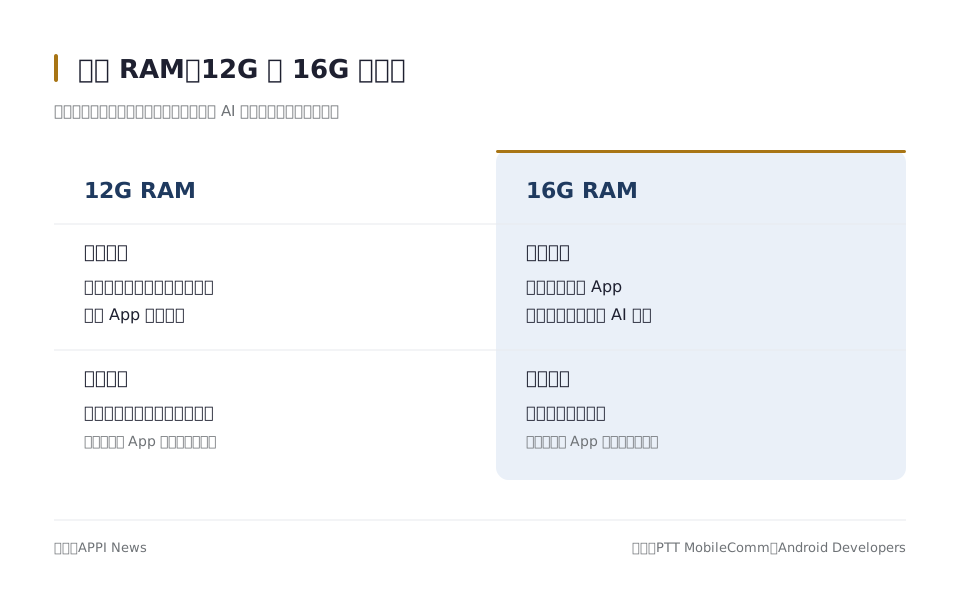
The 12GB option can be the stronger value when it costs less, the exact model supports the required features and a repeatable workload does not force needed apps to reload. That is a conditional purchasing judgment, not a claim that 12GB covers every user, app set or phone.
The 16GB option has a clearer use when a matched test shows disruptive reloads on the 12GB model, or when official documentation for an intended on-device feature lists a higher memory requirement. An “AI phone” label by itself does not meet the second condition.
If neither distinction appears in testing or official support information, the extra 4GB has no verified benefit for that buyer's current use. Price, storage capacity, software-support period and repair terms can then decide which phone offers more measurable value.
Frequently asked questions
Is 12GB enough for ordinary phone use?
The official documents reviewed here do not set a universal threshold. A 12GB model is the defensible choice when it supports the required features and retains the apps used in a repeatable real-world test.
Will 16GB improve gaming frame rates?
Not on the evidence cited in this guide. The official documentation explains process retention and memory pressure but provides no 12GB-versus-16GB frame-rate benchmark, so that claim requires testing of the exact phone and game.
Does on-device AI require 16GB?
Google publishes no universal 16GB requirement in the documents reviewed here. Its tools let developers target models by RAM, while actual availability also depends on the device, operating system and model deployment.
How can two RAM options be compared before purchase?
Run the same demanding apps in the same order on both versions and note which ones reload or lose state. Confirm the exact model's update commitment and AI support separately, because neither is guaranteed by installed RAM.
Sources and further reading
- Overview of memory management(Android Developers)Explains cached app processes, faster switching and process removal under memory pressure
- Memory allocation among processes(Android Developers)Explains Android low-memory process priorities and manufacturer control over low-memory behavior
- Reducing your app's memory use(Apple Developer Documentation)Explains iOS memory limits, background storage transfers and foreground-return delays
- Play for On-device AI (beta)(Android Developers)Documents RAM-based model targeting, a 6GB delivery example and AI pack size limits
- Find the right AI/ML solution for your app(Android Developers)Describes on-device AI resource use and compatibility limits
- Google Pixel 10 specs and features(Google Store US)Lists a US Pixel 10 configuration with 12GB RAM and US dollar pricing
- Google Pixel 10 specs and features(Google Store UK)Lists UK Pixel 10 configurations with 12GB RAM and pound pricing
- Discover the new Google Pixel 10(Google Store Singapore)Shows Singapore dollar prices for Pixel 10 storage variants and delivery checks
- New Google Pixel 10 smartphones(Google Store Australia)Compares Australian Pixel models with 12GB and 16GB RAM configurations
- Consumer Rights Act 2015(UK Government)Explains UK remedies for faulty goods, including the 30-day short-term right to reject
- Problems with your mobile service(Australian Competition and Consumer Commission)Explains Australian Consumer Law remedies for faulty mobile products and services
- iPhone technical specifications(Apple US)Shows consumer-facing iPhone storage and feature specifications without a RAM comparison