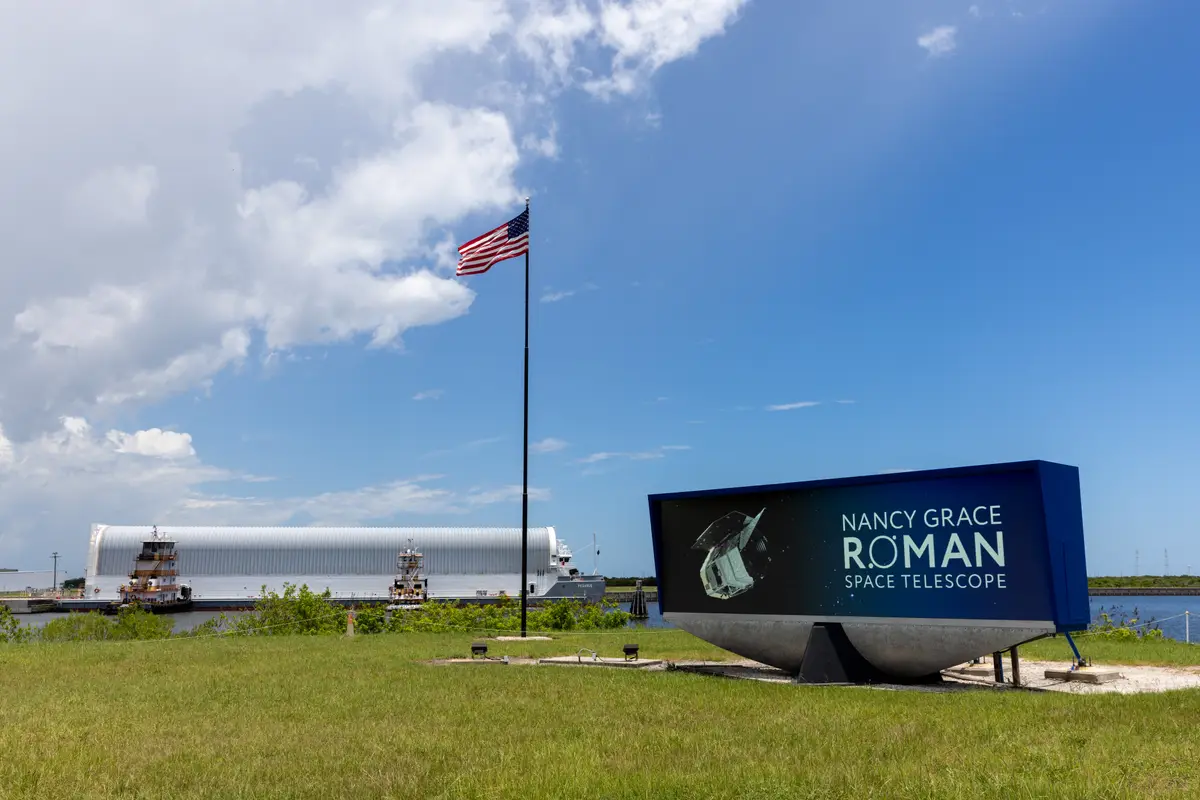
NASA's Nancy Grace Roman Space Telescope lifted off from Kennedy Space Center in the US state of Florida at 7:26 a.m. EDT (11:26 UTC) on August 30, 2026, aboard a SpaceX Falcon Heavy and separated from the rocket's upper stage 31 minutes later. The observatory then began a journey of about three months to the second Sun-Earth Lagrange point, known as L2, roughly 1.6 million kilometers from Earth.
NASA said ground controllers received telemetry seven minutes after launch and confirmed deployment of Roman's solar panels and lower instrument sun shade one hour and 23 minutes into the flight. The agency expects to release the first images in early 2027 after cruise operations, instrument activation, calibration and testing.
The deployment status in this report comes from NASA's account of the spacecraft telemetry; APPI News could not independently inspect that telemetry. Roman has not yet returned calibrated science images, so its performance in routine survey operations remains untested.
A wide camera changes the scale of a space survey
NASA describes Roman's Wide Field Instrument (WFI) as a 300-megapixel camera that detects visible and infrared light and uses 18 detectors. The agency says it will have sensitivity and resolution similar to Hubble's cameras while covering about 100 times more sky in one image and surveying up to 1,000 times faster. Those comparisons describe field of view and survey speed, not an across-the-board measure of which telescope is more capable.
Roman is designed to collect large, consistent samples of galaxies, stars and transient events rather than concentrate most of its time on individual targets. A wide survey can identify objects for closer study by Roman or other observatories, while repeated images can show how brightness and position change over time.
Dark matter will be mapped through its gravitational effects
NASA's cosmology plan says Roman will measure millions of galaxy shapes to build weak-lensing maps of dark matter and will combine those observations with galaxy redshifts and Type Ia supernova measurements. Foreground mass slightly distorts light from more distant galaxies, allowing astronomers to infer where matter is concentrated across a large survey.
The telescope therefore will not photograph dark matter itself. Its surveys are intended to test how large-scale structure grew and how the expansion rate of the universe changed, placing tighter limits on models of dark matter, dark energy and gravity.
A larger sample can reduce some statistical uncertainty, but it does not guarantee an identification of dark matter particles or the cause of cosmic acceleration. The strength of later results will depend on calibration, control of systematic errors and comparison with observations from other facilities.
Roman will search for exoplanets in two ways
NASA plans to use the WFI for a microlensing survey of the inner Milky Way and estimates that the program could find more than 1,000 exoplanets. Microlensing records a temporary change in a background star's light caused by the gravity of a foreground system, so the survey detects a planet's effect rather than taking a direct picture of it.
Roman's separate Coronagraph Instrument is a technology demonstration that uses masks, detectors and deformable mirrors to suppress a star's glare and directly image large gaseous planets and surrounding disks. NASA says the initial targets will include Jupiter-size planets around Sun-like stars. The instrument is meant to test methods for later observatories; NASA does not describe the baseline demonstration as a search for images of Earth-like planets.
The data system is built for a 1.4-terabyte daily stream
NASA's ground-system plan calls for Roman to downlink about 1.4 terabytes of science data each day, using Ka-band links that can operate at up to 500 megabits per second. The Space Telescope Science Institute will process and archive WFI images, while other centers will handle microlensing, spectroscopy and coronagraph data.
The 1.4-terabyte figure is a planned daily volume, not a result measured during regular science operations. Transmission schedules, commissioning results and observation plans will determine the volume that reaches the ground on a given day.
NASA's published mission material says Roman data are to be nonproprietary and available through the Mikulski Archive for Space Telescopes (MAST). Public access will still follow transmission and processing, and researchers will need calibrated products and documentation before drawing conclusions from the observations.
NASA said machine learning, artificial intelligence and citizen-science projects will help screen the expected data stream and flag findings for astronomers. These systems will support triage; the agency's account says astronomers will examine the flagged observations.
Commissioning comes before the first survey results
Roman's near-term schedule includes two mid-course corrections, activation of the WFI and a sequence of instrument calibrations and tests. NASA expects the cruise and commissioning period to last about three months and the first images to follow in early 2027, but it has not announced a date for the first science data release.
NASA manages the mission with US research centers and contractors, while the European Space Agency, the Japan Aerospace Exploration Agency, France's Centre National d'Études Spatiales (CNES) and Germany's Max Planck Institute for Astronomy have contributed to the project. Their participation does not change the immediate test sequence: the spacecraft must reach its operating orbit and complete commissioning before its planned surveys begin.
Sources and further reading
- NASA's Dark Universe-Seeking Nancy Grace Roman Space Telescope Launches(NASA)
- NASA's newest space telescope launches on a quest to explore the hidden universe(The Associated Press)
- Roman's Wide-Field Instrument (WFI) Poster(NASA Science)
- About Roman(NASA Science)
- Cosmology with Roman(NASA)
- Coronagraph(NASA Science)
- Ground Systems(NASA Science)