
A 2022 systematic review of gastrodin for migraine reports 1,332 participants across 16 randomized controlled trials in its abstract, while the study description in the full article reports 1,670 participants. Both sources concern gastrodin for migraine, not dried tianma tuber, powder, food or every multi-ingredient formula sold under the same name.
An artificial intelligence (AI) health-search system has to preserve that conflict rather than silently select one total. It also needs to keep the plant, a purified constituent, a finished product and a mixed formula as separate evidence objects before generating a statement about benefit or risk.
When headache needs urgent assessment
The United Kingdom National Health Service advises immediate emergency help for a headache that starts suddenly and is extremely painful, or one accompanied by a seizure, weakness or numbness, speech or balance problems, confusion, vision loss, a stiff neck with very high temperature, or a recent head injury. Local emergency services should be used; searching for tianma or waiting for an AI response should not delay assessment.
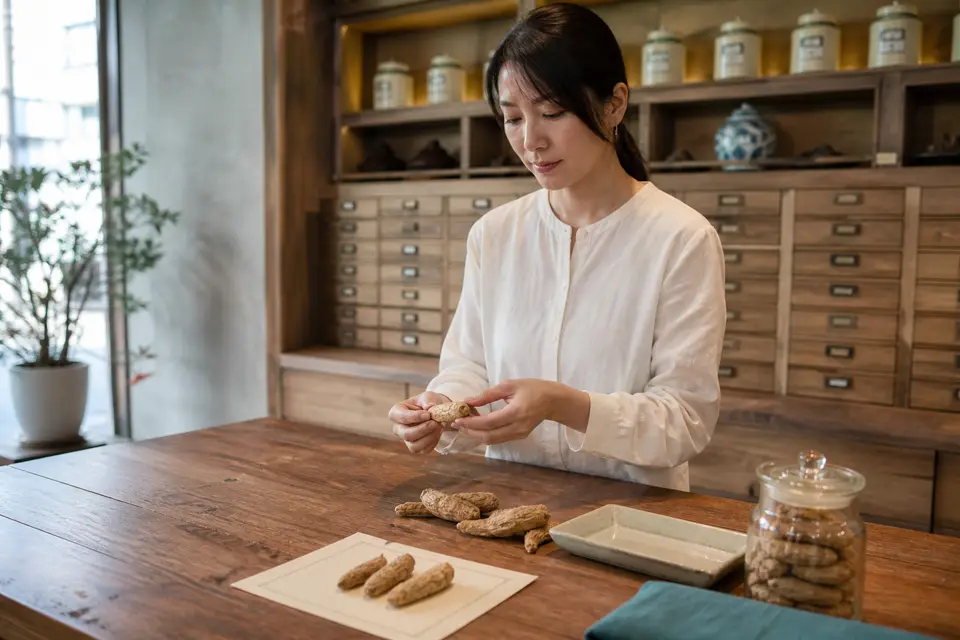
Tianma and gastrodin are different evidence objects
The 2022 review identifies Gastrodia elata as the source plant and gastrodin as one of its main bioactive components. That relationship does not make the terms interchangeable in a clinical claim.
An evidence record for tianma needs the scientific name and plant part. A record for gastrodin needs the formulation and route, while a mixed formula needs its full ingredient list. A consumer product also needs a label, manufacturer, market and version because products sharing a common name may not have the same composition.
The intervention in a human trial must match the product named in the generated answer. Evidence from gastrodin added to conventional migraine care cannot be assigned to dried tuber, powder, a food preparation or a formula containing several ingredients. Traditional use can be reported as history, but it cannot be converted into a modern treatment finding.

The published trial record has internal conflicts and weak evidence
The full text says all included randomized trials were conducted in China, involved 40 to 240 participants and lasted eight to 56 days. It describes gastrodin used mainly alongside conventional migraine treatment, so the comparison does not isolate the effect of every gastrodin formulation.
The authors reported favorable pooled outcomes, but their own Grading of Recommendations Assessment, Development and Evaluation (GRADE) table rated the evidence low or very low and found no high-quality evidence. The paper attributes the downgrades to trial limitations, heterogeneity, small samples or event counts and publication bias.
Only five included articles reported notable adverse reactions, and the pooled estimate did not establish a clear difference between groups. A short trial record with incomplete adverse-event reporting cannot establish long-term safety for all tianma or gastrodin products.
Five fields keep the evidence attached to the claim
A retrieval system can prevent source mixing by requiring five fields before it drafts an answer. Missing or conflicting fields should produce an unresolved result, not a confident completion.
| Field | What the record must retain | What it prevents |
|---|---|---|
| Identity | Scientific name, plant part, constituent or full formula | Treating tianma, gastrodin and a mixed product as synonyms |
| Form and route | Dried tuber, powder, extract, capsule, tablet or injection | Transferring evidence between unlike preparations |
| Study scope | Population, comparison, outcome and follow-up period | Turning a narrow trial result into a broad treatment claim |
| Source version | Abstract, full text, publication date and cited passage | Hiding the 1,332-versus-1,670 participant conflict |
| Jurisdiction | Exact product, country, regulator and status date | Presenting an ingredient record as worldwide authorization |
APPI News's five-control medical AI framework separates intended use, evidence, interoperability, human control and monitoring. A tianma search tool needs the same boundary: retrieval can locate passages and conflicts, while a clinician or pharmacist handles product-specific judgments.

An ingredient identifier is not product approval
The US Food and Drug Administration substance registry lists Gastrodia elata tuber under Unique Ingredient Identifier (UNII) 08F85I5YAV and explicitly says that a UNII does not imply regulatory review or approval. The entry establishes an identity for database use; it does not authorize a finished product or a health claim.
An AI system that turns that registry hit into “FDA approved” has reversed the source. Authorization and availability must be checked for the exact formulation in the country where it is supplied. APPI News could not verify a single regulatory status covering tianma herbs, foods, supplements and gastrodin products in every market.
How this plays out outside Taiwan
The same search result can mean different things once the product category and market are added. A dried tuber, a capsule labeled as a supplement, a registered herbal medicine and an isolated gastrodin product can enter different regulatory systems. An AI record therefore needs the exact label and country before it reports that an item is legal to sell or approved. Retail price is also a property of a dated listing for a specific product and pack size, not of the ingredient name; APPI News did not find an official source that provides one cross-market price for tianma or gastrodin.
In the United States, a tianma capsule offered as a dietary supplement does not pass through drug-style premarket approval. The US Food and Drug Administration says it does not approve dietary supplements before marketing, often does not know when products enter the market and cannot maintain a complete national product list. The manufacturer or distributor carries the initial responsibility for safety and compliant labeling. A US retail listing, facility registration or ingredient identifier therefore cannot be converted into approval of the finished product.
For a US availability check, the US National Institutes of Health Dietary Supplement Label Database catalogs label images, ingredient forms, amounts and statements, and includes both on-market and off-market records. A useful search record keeps the database identifier, exact product name, manufacturer, formula, market flag and access date. If a seller presents gastrodin as an approved drug instead, Drugs@FDA is the official database covering most prescription and nonprescription human drugs approved by the US agency since 1939. No match in one database alone does not establish that a product is illegal or unavailable because the category may be wrong or the relevant label may be absent.
In the United Kingdom, the product claim determines which official record matters. The United Kingdom's Medicines and Healthcare products Regulatory Agency (MHRA) says a traditional herbal medicinal product needs a Traditional Herbal Registration (THR) before marketing, limits that route to minor conditions that do not require medical supervision and requires marketing authorization for claims about major conditions. The same guidance says some herbal products are classified as food supplements or cosmetics instead of medicines. An AI system should retain the THR or product-license number, registered wording and formulation rather than attach one UK status to every product containing Gastrodia elata.
The MHRA publishes a dated list of herbal medicines that currently hold a THR, giving readers and automated systems a direct route for checking a named UK medicine. A THR is not a finding of clinical efficacy: UK advertising guidance requires claims to say that use is based exclusively on long-standing tradition and bars claims that a traditional herbal medicine is clinically proven. The defensible output is that a named formulation holds a named registration, not that the United Kingdom has approved tianma in every form. If the name is absent, the record should say it was not found in the dated list checked rather than infer that no differently named food supplement or practitioner preparation exists.
Australia places a visible identifier on medicines entered in its national register. Australia's Therapeutic Goods Administration (TGA) says registered or listed medicines display an AUST R, AUST L or AUST L(A) number; AUST L medicines have not undergone an efficacy assessment, while AUST R and AUST L(A) medicines have. A tianma check should capture the number from the label and keep it with the exact product, sponsor and formulation. Calling an AUST L entry proof that a product works would misstate what the Australian identifier establishes.
The Australian Register of Therapeutic Goods (ARTG) is the public database for therapeutic goods that can be legally supplied in Australia and includes product, formulation, sponsor and manufacturer details. Its public summary allows an AI system to compare the label number with the registered record instead of searching only for an ingredient. The TGA also identifies separate access pathways for goods outside the ARTG, so a failed ordinary-register search should be reported as an unresolved market check, not proof that access is impossible. An overseas e-commerce page, meanwhile, establishes only that a seller posted an offer; it does not establish Australian regulatory status, current domestic stock or a comparable local price.
The register also supplies a product-level example. ARTG entry 524356, dated March 11, 2026, lists Gastrodia elata with six other ingredients in Gastrodia Sleep Support Capsules. That record applies to one multi-ingredient Australian product and cannot establish the status or evidence for dried tianma, purified gastrodin or another formula.
Singapore draws a further distinction between a traditional formula and a purified constituent. Singapore's Health Sciences Authority (HSA) defines a Chinese Proprietary Medicine (CPM) as a finished product such as a capsule or tablet with active ingredients documented for use in traditional Chinese medicine, and excludes products containing a chemically defined isolated constituent as an active ingredient. A multi-herb tianma tablet and an isolated gastrodin product therefore cannot automatically be routed to the same Singapore category. For CPM, the HSA requires product-listing approval and a dealer's license for local import, wholesale, manufacture or assembly.
The HSA Infosearch page provides separate public lists for Chinese Proprietary Medicines, notified health supplements and traditional medicines, licensed dealers and therapeutic products. A Singapore search should use botanical and product names, then match the formulation and responsible dealer instead of treating any hit for tianma as a status for gastrodin. The HSA says health supplements are not subject to agency approval or dealer licensing before import, manufacture or sale, although companies may submit a voluntary product notification and remain responsible for safety, quality and labeling. Presence on the voluntary-notification list is therefore not equivalent to CPM product-listing approval.
A Singapore enforcement alert shows why the purchase market needs its own field. On March 18, 2026, the HSA said a tianma-labeled product bought in Malaysia contained five undeclared potent medicines; the agency reported dizziness and a drop in blood pressure in an older user and said it knew of no local suppliers. This case concerns one tested product and does not establish the composition or risk of every tianma item.
These four markets show why a country field alone is insufficient. The minimum record includes product category, exact name and formula, official database, identifier, regulator's status wording, source version, access date and a dated seller listing for any price or stock statement. APPI News could not verify one price or availability status covering all tianma and gastrodin products in the United States, the United Kingdom, Australia and Singapore as of September 6, 2026. When a match remains uncertain, the generated answer should name the database and date searched, then stop at “could not verify” instead of inferring approval or unavailability.
WHO guidance requires controls around generated health answers
The World Health Organization (WHO) said on January 18, 2024, that large multimodal models can produce false, inaccurate, biased or incomplete health statements and can encourage automation bias. Its guidance contains more than 40 recommendations and calls for well-defined tasks, accuracy, reliability, oversight and post-release assessment.
For a tianma query, the audit record can retain the user's wording, retrieved passages, source URLs, access dates, source versions, model version and generated output. It can also record who reviewed the answer, which claims were rejected and whether a correction reached earlier users.
APPI News has separately mapped how intended use, source data, human review, version history and incidents form a traceable responsibility record. Source display alone is insufficient if the system loses the version, omits a conflicting passage or lets a generated answer enter a clinical workflow without review.

Contraindication searches need the exact label and medicine list
APPI News could not find an international clinical guideline that gives one contraindication list or one medicine-separation interval for dried tianma, gastrodin products and multi-ingredient formulas. A generated answer should mark that gap and request product-specific review rather than repeat a universal interval.
The US National Center for Complementary and Integrative Health says dietary supplements can interact with medicines or pose risks for some medical conditions and surgery, and that many have not been tested in pregnancy, breastfeeding or children. That is general supplement guidance, not evidence of a tianma-specific interaction; it identifies why the exact product label and complete medicine list matter.
Pregnancy and breastfeeding
The gastrodin meta-analysis excluded pregnant participants, and the US supplement guidance says many supplements have not been tested during pregnancy or breastfeeding. The cited evidence therefore does not establish benefit or safety for either group, and product-specific decisions belong with a clinician.
Children and adolescents
The meta-analysis also excluded children and adolescents. Adult migraine findings cannot establish pediatric benefit, safety or product suitability, so a health-search system should not transfer the adult result to these age groups.
Chronic conditions, regular medicines and surgery
General supplement guidance warns that medical conditions, medicines and planned procedures can change risk. A product-specific review needs the complete ingredient label, medicine list, medical conditions and planned procedure rather than the word “tianma” alone.
What an AI answer can establish
Does the 2022 paper establish that dried tianma treats dizziness?
No. It evaluates gastrodin for migraine, mainly as an addition to conventional treatment, and does not test every dried herb, powder, food or formula.
Can the abstract be summarized without checking the full text?
No. The participant totals conflict, and the low-to-very-low evidence rating appears in the full paper rather than the abstract summary.
Does a US FDA ingredient record mean a product is approved?
No. The registry itself says its identifier does not imply regulatory review or approval, and finished-product status must be checked by country.
Can AI set one safe interval between tianma and other medicines?
The sources reviewed for this report do not support a universal interval across products and medicine combinations. The system can organize labels and citations, but it cannot replace a product-specific interaction assessment.
A publishable system output needs separate labels for traditional use, human evidence, product information and national regulatory records. It also needs an unresolved state when sources disagree or the relevant market cannot be verified.
Sources and further reading
- Effectiveness of gastrodin for migraine: A meta-analysis — PubMed record(PubMed)
- Effectiveness of gastrodin for migraine: A meta-analysis — full text(Frontiers in Neurology)
- WHO releases AI ethics and governance guidance for large multi-modal models(World Health Organization)
- Using Dietary Supplements Wisely(US National Center for Complementary and Integrative Health)
- Headaches(United Kingdom National Health Service)
- Gastrodia elata tuber substance record(US Food and Drug Administration)
- Questions and Answers on Dietary Supplements(US Food and Drug Administration)
- Dietary Supplement Label Database(US National Institutes of Health Office of Dietary Supplements)
- About Drugs@FDA(US Food and Drug Administration)
- Apply for a traditional herbal registration(United Kingdom Medicines and Healthcare products Regulatory Agency)
- Herbal medicines granted a traditional herbal registration(United Kingdom Medicines and Healthcare products Regulatory Agency)
- Advertise your medicines(United Kingdom Medicines and Healthcare products Regulatory Agency)
- AUST numbers on medicine labels(Australian Therapeutic Goods Administration)
- About the Australian Register of Therapeutic Goods(Therapeutic Goods Administration (Australia))
- Gastrodia Sleep Support Capsules (ARTG ID 524356)(Therapeutic Goods Administration (Australia))
- Regulatory overview of Chinese proprietary medicines(Singapore Health Sciences Authority)
- Infosearch(Singapore Health Sciences Authority)
- Regulatory overview of health supplements(Singapore Health Sciences Authority)
- Three people experienced adverse effects after taking products with banned or potent medicinal ingredients(Health Sciences Authority (Singapore))