
The American College of Rheumatology recommends against starting urate-lowering medicine for most people who have high uric acid but no gout attacks or tophi. Treatment decisions change after recurrent attacks, joint damage, kidney stones or other clinical findings.
Hyperuricemia describes a blood-test result; gout is an inflammatory arthritis caused by urate crystals. A result above a laboratory reference range can support an assessment, but it does not show by itself that crystals have formed or that future joint pain is inevitable.
A hot, swollen joint may need urgent assessment
A first episode of sudden, severe joint pain needs clinical assessment because gout can resemble an infection or another form of arthritis. The United Kingdom's National Health Service advises urgent help when sudden joint pain and swelling are worsening or occur with a high temperature, chills, nausea or inability to eat because these can signal a joint infection.
The United Kingdom's National Health Service says a new rash with blisters or ulcers after starting allopurinol needs immediate medical care. Children, pregnant or breastfeeding people, and anyone with kidney or liver disease or taking other medicines should have gout treatment selected by a clinician rather than applying general adult guidance to themselves.
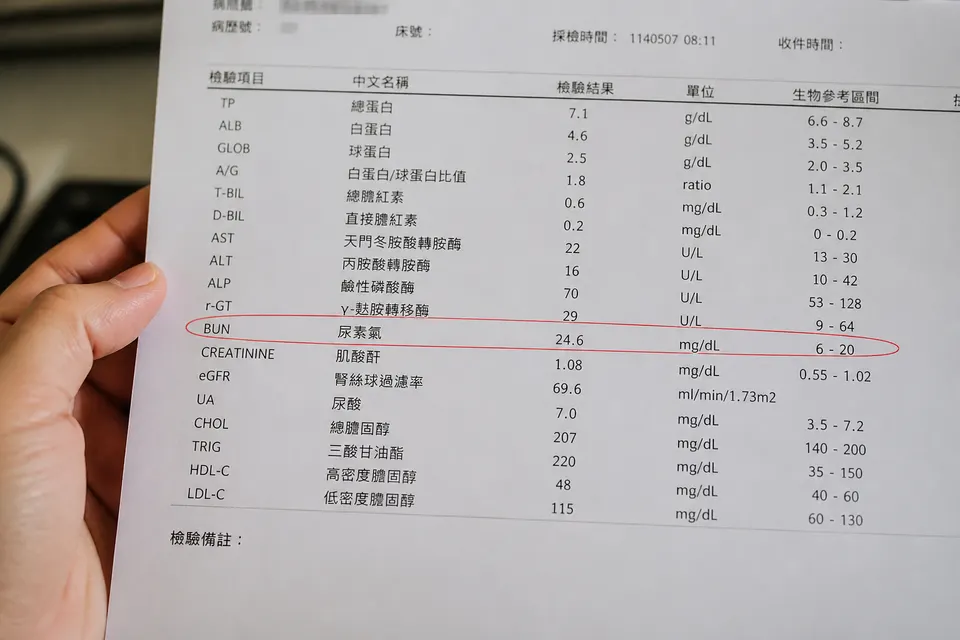
A blood result is not the same as gout
Urate can crystallize when its concentration is high enough, but crystal formation and inflammation do not occur in every person with an elevated result. The 2020 guideline from the US-based American College of Rheumatology (ACR) defines asymptomatic hyperuricemia as serum urate of at least 6.8 mg/dL without a previous gout attack or subcutaneous tophi.
The ACR conditionally recommends against starting allopurinol, febuxostat or probenecid for asymptomatic hyperuricemia. A conditional recommendation means the balance of benefits and harms is close or the evidence is uncertain; it is not a declaration that treatment is never appropriate.
Symptoms and history change the calculation. The ACR strongly recommends urate-lowering treatment when gout has produced one or more tophi, imaging damage attributable to gout or frequent attacks, defined as at least two a year. After a first attack, it conditionally favors treatment when chronic kidney disease is at stage 3 or worse, serum urate exceeds 9 mg/dL or kidney stones are present.
Treatment targets apply after a treatment decision
For people with gout who start urate-lowering therapy, the ACR favors adjusting treatment against repeated blood tests to keep serum urate below 6 mg/dL. That target belongs to a monitored treatment plan; it does not turn every result above 6 mg/dL into an instruction to begin medicine.
Starting or adjusting treatment can temporarily trigger more attacks, so the guideline pairs initiation with anti-inflammatory prevention selected by a clinician. Drug choice, approved uses and access to monitoring vary by country, and kidney function, other medicines and previous reactions can alter the plan.
People already prescribed urate-lowering medicine should not stop it on their own during an attack. The United Kingdom's National Health Service warns that suddenly stopping allopurinol can worsen gout and says it should be stopped only on a clinician's advice.
Genetic screening is targeted, not universal
Allopurinol can rarely cause a severe hypersensitivity reaction, and the HLA-B*5801 allele raises that risk. The ACR conditionally recommends testing before allopurinol for people of Southeast Asian descent, including Han Chinese, Korean and Thai people, and for African American people; it conditionally recommends against routine testing in other groups.
This is a prescribing decision, not a consumer genetic test recommendation. Testing access and clinical practice differ across countries, while a person's ancestry, kidney function and treatment alternatives require individual assessment.
Diet affects risk but does not explain every case
A 2018 systematic review and meta-analysis linked alcohol, fructose, red meat and seafood with higher risks of gout and hyperuricemia, while soy foods and dairy products showed inverse associations. High-purine vegetables were not associated with hyperuricemia and showed an inverse association with gout.
Those pooled findings do not establish that tofu or soy milk prevents gout, but they do not support treating soy foods as equivalent to organ meat or seafood. The included evidence was observational, so unmeasured differences between people may explain part of the associations and the results cannot supply a universal diet.
The ACR conditionally advises people with gout to limit alcohol, purines and high-fructose corn syrup, and advises weight loss for those who are overweight or obese. The guideline says dietary changes usually produce only small changes in serum urate, even though food and drink can trigger attacks.

What to take from an elevated result
A clinician can interpret an elevated uric acid result alongside previous joint attacks, tophi, kidney stones, kidney function and medicines that may raise urate. A sudden red, hot and swollen joint still needs assessment rather than self-diagnosis, particularly during a first episode or when fever or systemic illness is present.
For people without symptoms, the ACR guideline supports restraint rather than automatic medication. For confirmed gout, repeated attacks or complications can justify long-term treatment, with the drug and target chosen under clinical supervision.
Frequently asked questions
Does high uric acid mean gout?
No. Hyperuricemia is a blood-test finding, while gout requires the clinical problem caused by urate crystals. A blood result contributes to diagnosis but does not establish it alone.
When is urate-lowering medicine considered?
The ACR strongly recommends it for gout with tophi, gout-related imaging damage or at least two attacks a year. It conditionally recommends against routine treatment for asymptomatic hyperuricemia, while individual decisions can differ with kidney disease, stones and other findings.
Should allopurinol be stopped during a gout attack?
Not without clinical advice. Sudden interruption can worsen gout, and the clinician managing the prescription should decide whether any change is needed.
Are tofu and soy milk major gout triggers?
The cited male cohort did not associate purine-rich vegetables or total protein with new gout cases. That finding is broader than soy alone and does not prove that every plant food has the same effect in every population.
Do supplements lower uric acid?
The ACR conditionally recommends against adding vitamin C specifically for gout management. Evidence for a supplement should be assessed separately from evidence on diet, and a supplement should not replace clinical evaluation or prescribed treatment.
Sources and further reading
- 2020 American College of Rheumatology Guideline for the Management of Gout(American College of Rheumatology via PubMed Central)
- Gout(United Kingdom National Health Service)
- Side effects of allopurinol(United Kingdom National Health Service)
- Dietary factors and risk of gout and hyperuricemia: a meta-analysis and systematic review(Asia Pacific Journal of Clinical Nutrition via PubMed)