
A 2025 systematic review found that all six included studies, covering 689 children aged six or younger with global or nonspecific developmental delay, reported improvement in at least one developmental domain. The review included no randomized controlled trials and rated the certainty of evidence low to very low. Those findings do not establish that any one program will produce the same result for an individual child.
A separate 2024 policy report shifts attention from detection to the handoffs that follow it. The joint report from the World Health Organization (WHO) and UNICEF distinguishes point-in-time screening from continuous developmental monitoring and defines comprehensive assessment as the step that can establish a diagnosis, describe functioning, identify family needs and connect families to services.
A screening result identifies risk, not a diagnosis
A standardized developmental screening questionnaire or checklist looks for skills below those expected at a given age across language, movement, cognition, behavior and emotion. It does not determine the cause, decide which services are needed or describe a child's full developmental profile.
A clinical report from the US-based American Academy of Pediatrics says concerns identified through surveillance or screening should lead to further developmental and medical evaluation, referral when indicated and earlier follow-up visits. The report treats surveillance, screening and diagnostic evaluation as separate parts of ongoing care.
WHO guidance published in 2024 places growth and developmental review within regular, scheduled well-care contacts for children and adolescents. National schedules and service entry points differ, so the screening timetable used in one country should not be presented as a global rule.
Loss of acquired skills calls for urgent assessment
Queensland Health guidance in Australia classifies acute deterioration in function, major loss of previously acquired skills, sudden weakness, slurred speech or seizures as emergency referrals. These changes call for urgent medical assessment through the local emergency route rather than waiting for the next screening or referral appointment.
An isolated concerning screen without an acute loss of function is a different situation. It still needs a documented next step, but whether that step is repeat screening, developmental assessment or specialty evaluation depends on the child's findings and the services available where the child lives.
Follow-up has more than one handoff
A workable pathway starts with developmental monitoring, uses validated screening when indicated and continues to assessment and individualized support. Each transition needs a named destination, a responsible service and a way to confirm that the referral was received.
The WHO-UNICEF report says a comprehensive assessment can include developmental history, caregiver concerns, structured tools, observation of family interaction, the home environment, social support and links to early-intervention services. Depending on the child's profile, the professionals involved may work in medicine, psychology, hearing, speech and language, motor development, education or social support.
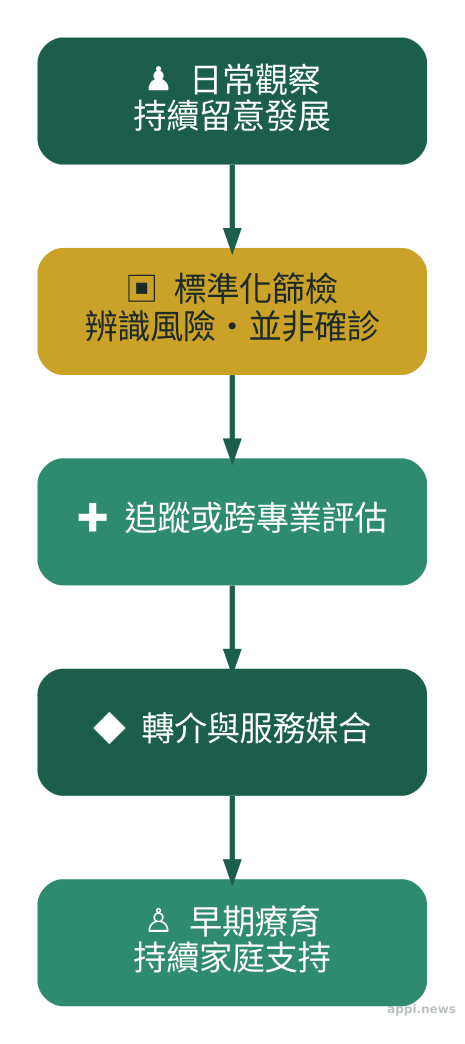
Assessment and support can proceed in parallel where the local system allows. The report says suitable developmental support should begin once a need is established rather than waiting for every laboratory test, consultation or place in a formal program.
Regional data show where referrals can break
In the selected European and Central Asian systems covered by the report's survey, the usual wait for a comprehensive developmental assessment ranged from a few weeks to three months. That range describes the covered systems at the time of data collection, not a current global benchmark.
Situation analyses cited for Serbia and North Macedonia estimated that about 15 percent to 24 percent of children expected to receive a comprehensive assessment did not receive one. The regional report also described weak feedback between primary care and early-intervention services and problems tracking referral outcomes.
A referral therefore cannot be counted as completed care. Travel, cost, work and caregiving duties, language, accessibility and fragmented agency rules can affect whether a family reaches the next service, but the report does not provide one international rate for each barrier.
Six records make the next step traceable
The WHO-UNICEF and American Academy of Pediatrics process descriptions point to six pieces of information that can travel with a child across services. They record what happened and what comes next; they are not a home diagnostic tool.
- Observed change: the specific skill or behavior, its setting and frequency, and whether a previously acquired skill was lost.
- Screening record: the date, tool, age at screening and result, using a copy of the original report when available.
- Clinical decision: whether the plan is monitoring, repeat screening, comprehensive assessment or another medical evaluation.
- Referral record: the receiving service, referral date, contact details and expected response date.
- Interim support: the support offered while assessment or formal services are pending and who will review progress.
- Access barriers: transport, cost, scheduling, language, accessibility or caregiving constraints that the service needs to address.
Recording those fields can make a missed handoff visible, but it does not shift coordination entirely onto families. The WHO-UNICEF report calls for feedback from referral services, contact with families when appropriate and health-information systems that record referrals and their outcomes.
Early-intervention evidence remains uneven
The six programs in the 2025 systematic review ranged from multidisciplinary rehabilitation to parent-mediated and community-based services. The authors used a narrative synthesis because program design and outcome measures differed, and most included studies had a moderate or high risk of bias.
The study population also matters: the review covered children already described as having global or nonspecific developmental delay, not an unselected group with concerning screening results. Its findings cannot establish the benefit, content or preferred intensity of services for every child who has one concerning screen.
Early intervention should therefore not be described as guaranteeing that a child will reach the same developmental trajectory as peers. Comprehensive assessment is intended to identify the child's and family's needs, after which goals and locally available support can be matched to that profile.
Program performance starts after the screening count
The WHO-UNICEF framework calls for health-information systems to record children monitored, identified risks, delays or disabilities, referrals and referral outcomes. A raw count of completed screens cannot show whether families reached assessment or support.
Those fields would allow policymakers to examine time to assessment, the share of referrals completed, services begun, continued participation and reported access barriers. This is an inference from the report's monitoring framework; the report does not prescribe a single global scorecard.
Comparable national data remain limited. APPI News could not find a current international dataset showing how many children with a concerning developmental screen complete assessment and enter support across countries at the time of writing.
Known risks can justify a different route
The US-based American Academy of Pediatrics says children with known high-risk conditions may need closer developmental monitoring, intervention when indicated or direct referral rather than waiting for a routine screen. A clinical team may set an individualized pathway for a child born preterm or already followed for a genetic, neurological, hearing, vision or chronic health concern.
General screening schedules are designed for broad populations and should not delay a condition-specific follow-up plan. A normal screening result also does not override a clinician's concern when a child has lost skills or developed new neurological signs.
Sources and further reading
- Effectiveness of Early Intervention Programs for Young Children with Global Developmental Delay: A Systematic Review(Galen Medical Journal)
- Monitoring children’s development through primary health care in Europe and Central Asia(UNICEF Regional Office for Europe and Central Asia and WHO Regional Office for Europe)
- Improving the health and wellbeing of children and adolescents: guidance on scheduled child and adolescent well-care visits(World Health Organization)
- Promoting Optimal Development: Identifying Infants and Young Children With Developmental Disorders Through Developmental Surveillance and Screening(American Academy of Pediatrics via PubMed)
- Development delay in children under six years(Gold Coast Health, Queensland Government)