
Taiwan's national health insurer is targeting older adults who use three or more sleeping medicines for extended periods. The review combines prescription oversight with sleep assessments, while evidence links some sedative combinations to fall-related hospital admissions.
The measure applies only in Taiwan and does not set a treatment rule for other health systems. The medicines available, their approved uses and the rules governing prescriptions differ by country.
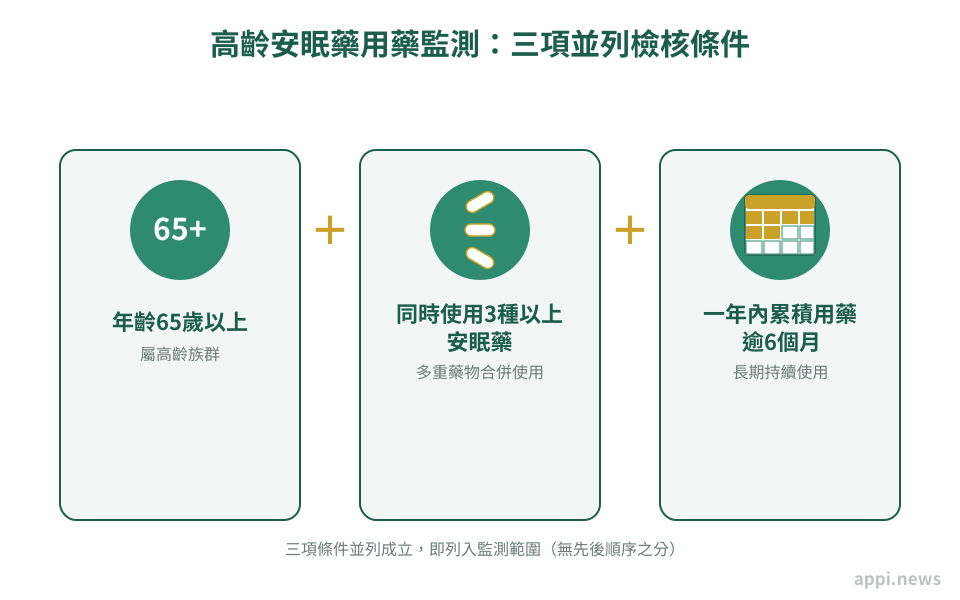
The review uses three screening conditions
Taiwan's National Health Insurance Administration said its review covers people aged 65 or older who use at least three long- or short-acting sleeping medicines and receive them for more than six months within a year. The agency administers Taiwan's single-payer health insurance system and said it developed the screening conditions with medical societies and other clinical groups.
The same announcement said insurance claims from 2021 through 2025 recorded about 1.9 million people using sleeping medicines each year. About 40 percent were aged 65 or older. These figures describe reimbursed use in Taiwan and are not estimates for other countries.
The insurer linked the program to an existing chronic-disease initiative that offers a lifestyle questionnaire, sleep assessment, counseling and referral through Taiwan's health-insurance app. Its June 8, 2026 announcement did not identify every medicine covered, publish patient-level review outcomes or show that the program had reduced injuries.
Breathing problems or unresponsiveness need emergency help
The US National Library of Medicine lists extreme drowsiness, loss of alertness, slow or labored breathing and coma among possible signs of diazepam overdose. A person who has taken more medicine than prescribed and cannot be awakened, has collapsed, has a seizure or is breathing slowly or with difficulty needs immediate help through the local emergency service or poison center.
Taiwan data link several sedative patterns to fall injuries
A 2017 nested case-control study used Taiwan's national health-insurance database to identify 2,238 older adults admitted for fall-related injuries from 2003 through 2012. Researchers matched each patient with four people of the same age and sex in the same index year, then compared recorded benzodiazepine and Z-drug exposure.
Current benzodiazepine use was associated with adjusted odds of fall-related hospital admission of 1.32 compared with non-use, while the estimate for current Z-drug use was 1.24. The adjusted odds were 1.61 for two or more benzodiazepines, 1.65 for one benzodiazepine with a Z-drug, and 1.58 for two or more benzodiazepines with a Z-drug.
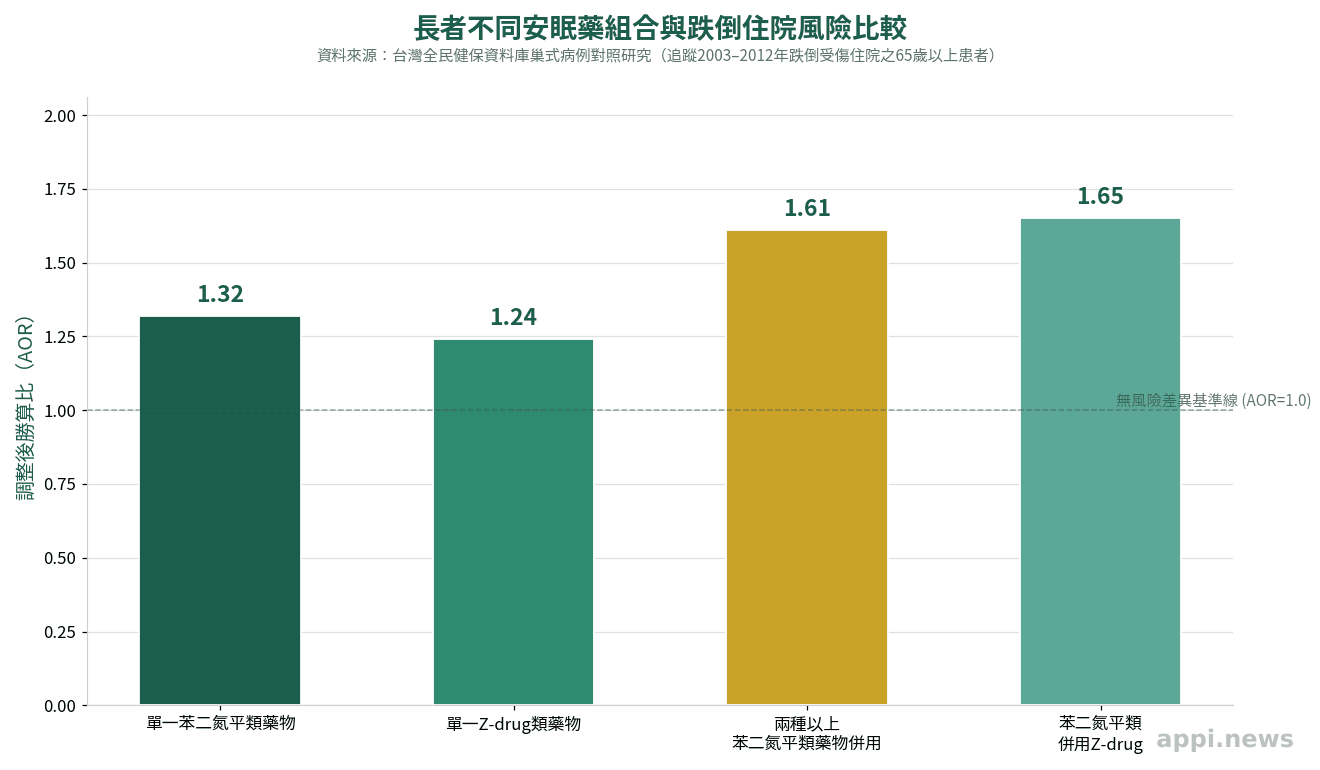
Odds ratios compare groups; they do not state an individual's absolute chance of falling. The study was observational and used records that ended in 2012, so it cannot establish causation or show whether the same estimates apply to current prescribing.
Medication review extends beyond a pill count
The World Health Organization's medication-safety report calls for a person-centered review of polypharmacy, with patients involved and supported by a multiprofessional team. A count of medicines can identify people for review, but it cannot determine on its own whether a prescription is appropriate.
A useful review needs an accurate list of prescription medicines, nonprescription products and supplements, including items obtained from different clinics or pharmacies. Clinicians and pharmacists can then check the reason for each medicine, duplicate therapy, interactions and symptoms that may be adverse effects.
People aged 65 or older, those with chronic illness and those taking other medicines may have different risks from the same sedative regimen. Children and people who are pregnant or breastfeeding are outside the population studied in the Taiwan falls analysis and need a clinician to assess any sleeping medicine rather than applying these results directly.
Stopping is a clinical decision, not an automatic response
A 2018 evidence-based guideline recommends offering slow tapering to adults aged 65 or older who take benzodiazepine receptor agonists. The recommendation applies when those medicines are used for insomnia alone or when conditions contributing to insomnia are being managed; it does not cover other sleep disorders or untreated anxiety, depression, or physical or mental illness that may be worsening sleep.
The guideline supports a planned conversation, not abrupt self-directed discontinuation. A prescriber or pharmacist needs to consider the medicine, duration of use, other treatment and the reason it was started before agreeing on any change.
Taiwan's screening policy may focus attention on high-use combinations, but the published announcement does not show how reviewers distinguish justified from avoidable combinations in individual cases. Its effect on prescribing, sleep outcomes and fall injuries will require outcome data that were not available in the announcement.
Sources and further reading
- Taiwan National Health Insurance Administration strengthens management of multiple sleeping medicines(Taiwan Ministry of Health and Welfare)
- Association of benzodiazepine and Z-drug use with the risk of hospitalisation for fall-related injuries among older people(BMC Geriatrics)
- Medication safety in polypharmacy: technical report(World Health Organization)
- Deprescribing benzodiazepine receptor agonists: Evidence-based clinical practice guideline(Canadian Family Physician)
- Diazepam overdose(US National Library of Medicine)