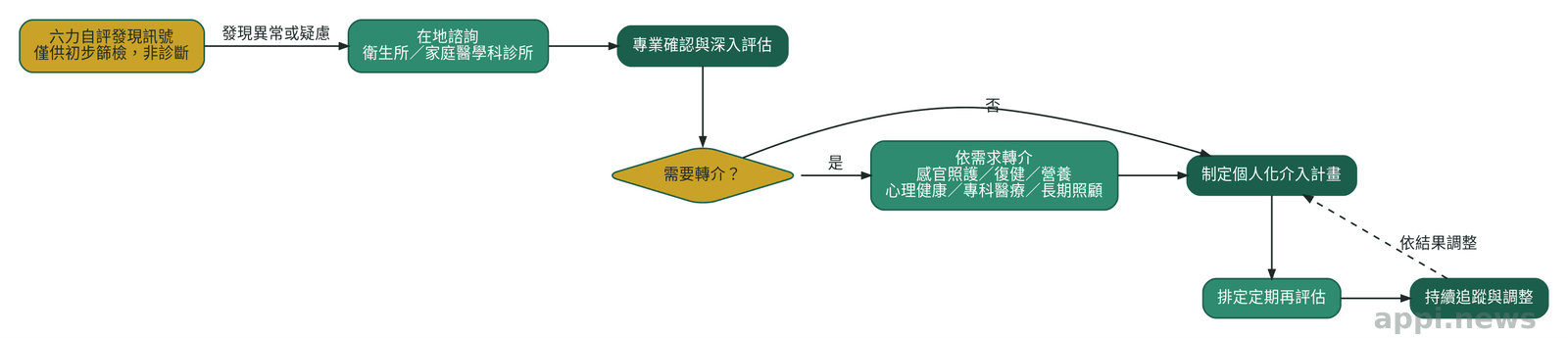
The World Health Organization published its second-edition Integrated Care for Older People handbook on September 22, 2025. The guidance places a basic assessment of six areas at the start of a pathway that continues through in-depth assessment, a personalized care plan, and implementation and monitoring.
The sequence defines the screen's limited role: it identifies possible loss of capacity rather than a disease. A result in one area does not explain its cause, and an unflagged result does not rule out every functional problem.
The screen covers six parts of daily capacity
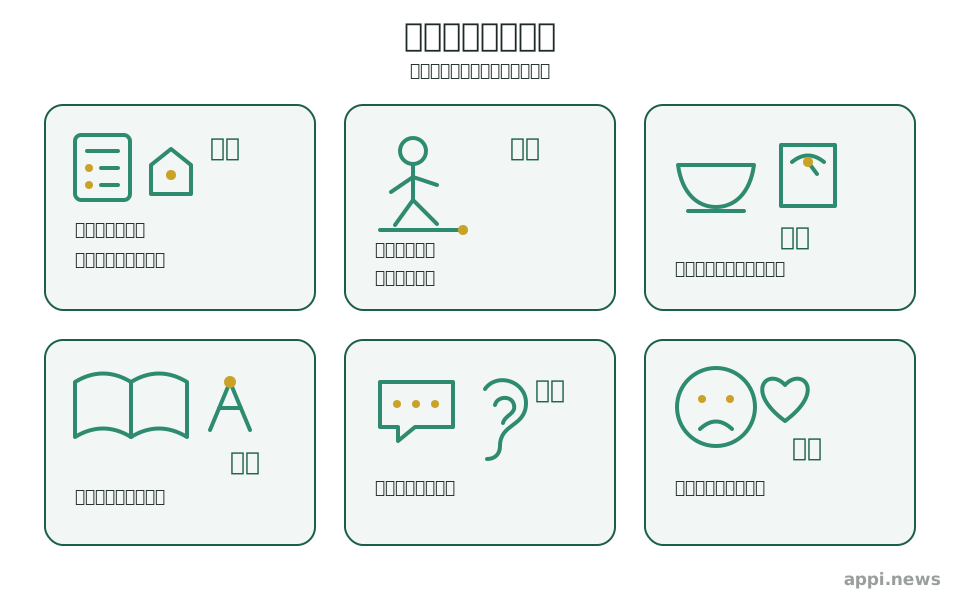
Integrated Care for Older People (ICOPE) organizes intrinsic capacity into cognition, mobility, vitality, vision, hearing and psychological capacity. WHO sometimes groups vision and hearing together as one sensory domain, which is why technical papers may refer to five domains while public-facing material lists six areas.
The screen uses short questions and tasks to look for possible changes in those areas. Vitality includes appetite and unintentional weight loss, while psychological capacity includes low mood and loss of interest. These observations concern function in daily life; they do not name the condition behind a change.
Assessment and monitoring follow the initial result
The 2025 handbook sets out four stages: basic assessment, in-depth assessment, development of a personalized care plan, and implementation and monitoring. It also says the care pathways must be adapted to local conditions, including the available health and social care services.
WHO's 2017 guidelines put older adults' needs and preferences at the center of care and call for coordination across services. Counting completed screens therefore measures reach, but it does not show whether flagged results led to assessment, support or continued monitoring.
WHO pilots tested readiness across different health systems
WHO's implementation pilot developed country case studies with partners in Andorra, China, France and India, and all four provided ICOPE screening to older participants. The program also received responses from 260 health and care workers in 29 nominated member states and 259 service- and system-level respondents in 35 nominated member states.
Those surveys examined feasibility, coordination and system readiness. They were not multinational trials of whether the screen itself preserved function, and they did not establish one referral model for every country.
A Spanish study found uneven performance by domain
A 2023 cross-sectional study compared the ICOPE screen with detailed reference assessments in 207 community-dwelling adults aged 70 or older from five rural and urban areas of Catalonia, Spain. The participants had a high degree of independence, and the researchers used a convenience sample.
Sensitivity was 88.9 percent for cognition but ranged from 43.8 to 56.9 percent for most other domains. Specificity ranged from 68.2 to 96 percent. The screen flagged at least one area in 70 percent of participants, compared with 79 percent under the detailed reference assessments.
The researchers described the overall performance as fair and recommended external validation in other populations. Their results show why the same screen can miss some changes while flagging others that a fuller assessment does not confirm.
Taiwan's adapted version produced a different evidence set
Taiwan's locally adapted questionnaire, the Integrated Care for Older People Screening Tool for Taiwanese (ICOPES-TW), covers the WHO capacity domains and adds medication and life-goal items. That design is not interchangeable with every other ICOPE screen.
A 2024 study tested ICOPES-TW in 1,235 older adults recruited from community, outpatient and inpatient settings in southern Taiwan. The total score had moderate correlations with measures of daily activity, quality of life and frailty, but overall internal consistency was low, with a Cronbach's alpha of 0.55.
The researchers called the findings initial psychometric evidence. Their convenience sample was largely composed of relatively healthy participants, and the cross-sectional design could not establish prediction over time, test-retest reliability or responsiveness to change.
Screening evidence supports a narrow conclusion
The WHO pathway and the two validation studies support using a brief result as an entry point to fuller assessment. They do not show that one self-screen diagnoses disability, identifies the cause of a change or delays functional decline on its own.
For health systems, the four-stage sequence makes follow-through part of the intervention rather than an optional addition. Comparable data on referral completion and long-term functional outcomes under the second-edition pathway were not available across countries at the time of writing, so its impact cannot be summarized with one global rate.
Sources and further reading
- Integrated care for older people (ICOPE): guidance for person-centred assessment and pathways in primary care, 2nd ed(World Health Organization)
- Integrated care for older people: guidelines on community-level interventions to manage declines in intrinsic capacity(World Health Organization)
- ICOPE implementation pilot programme(World Health Organization)
- Identification of decreased intrinsic capacity: Performance of diagnostic measures of the ICOPE Screening tool in community dwelling older people in the VIMCI study(BMC Geriatrics)
- Assessing intrinsic capacity in Taiwan: Initial psychometric properties of the Integrated Care for Older People Screening Tool for Taiwanese (ICOPES-TW)(BMC Geriatrics)