Hong Kong Polytechnic University (PolyU) on August 20, 2026, presented a 10-item screen intended to identify social vulnerability among older adults in community and primary-care settings. The test covers resources, participation, connections, relationships and self-management, but its validation data come from 234 adults in Hong Kong.
A paper published online on June 3, 2026, reported acceptable model fit and strong internal consistency for the shorter scale. Its authors called for independent, longitudinal and cross-cultural validation before clinical use.
Urgent health changes need an emergency route
A social-risk screen cannot assess an acute medical problem. The World Health Organization (WHO) says chest pain or discomfort, difficulty breathing, sudden weakness on one side, new trouble speaking or seeing, loss of balance, a severe unexplained headache, fainting or unconsciousness require immediate medical care.
Local emergency numbers and access routes differ by country. The SF-10 research concerns scheduled assessment of social vulnerability, so its score cannot replace urgent assessment or a clinical evaluation.
Social frailty is broader than loneliness
A 2017 scoping review of 42 studies described social frailty as a continuum in which a person is at risk of losing, or has lost, resources needed to meet basic social needs. The authors’ model also included social activities, social behavior and self-management.
WHO defines social isolation as the objective state of having too few roles, relationships and interactions, while loneliness is distress caused by a gap between the connections a person has and those they want or need. Living alone can contribute to isolation, but it does not by itself establish loneliness or social frailty.
Social connection also has structural, functional and qualitative dimensions. A screen can therefore ask whether support exists and whether relationships remain usable, rather than treating household size as a complete measure.
The shorter scale performed better in one Hong Kong sample
The researchers used a three-phase scale-development process and administered an initial 15-item Social Frailty Index to 234 community-dwelling adults aged 60 or older. PolyU said two rounds of co-design workshops involved 40 older adults, family caregivers, social workers, occupational therapists, nurses and doctors.
The 15-item version failed the study’s model-fit test, while the 10-item version achieved acceptable fit and strong internal consistency. Those findings show how the items behaved within the study sample; they do not establish prediction of future health, service use or response to an intervention.
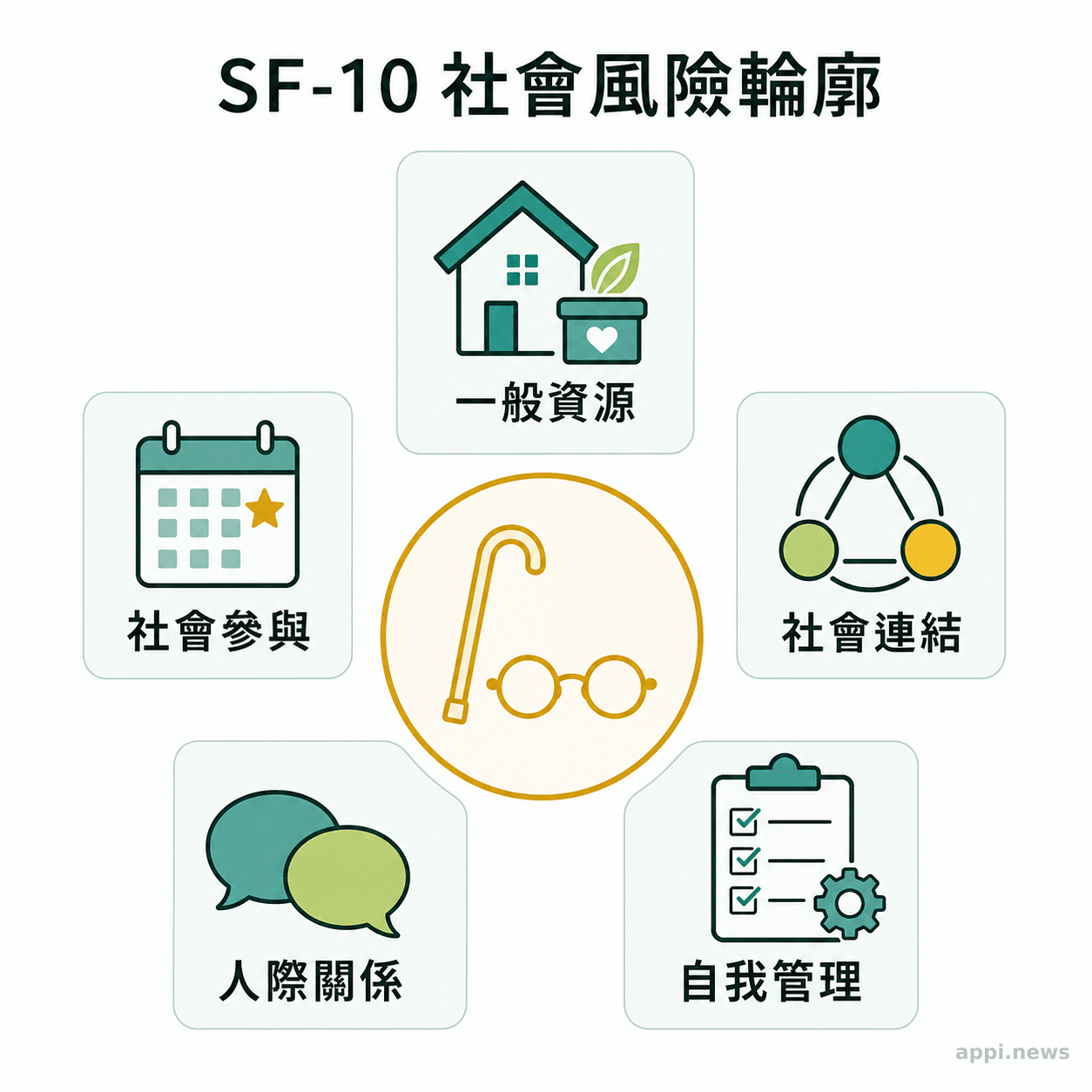
SF-10 retained items covering general resources, social participation, social connections, interpersonal relationships and self-management. The authors said the total score could identify overall social vulnerability and that domain-level results might guide tailored assessment and referral, while warning that subscale interpretation needs more validation.
The accessible abstract does not report a threshold that services can apply across countries. APPI News could not verify a validated cross-country cutoff as of August 26, 2026.
PolyU said social workers in nongovernmental organizations and community clinics had adopted the tool. The announcement did not name those organizations or provide adoption totals, referral completion rates or outcomes, and APPI News could not find those data in a published source.
ICOPE places screening inside a broader care pathway
WHO’s 2025 Integrated Care for Older People (ICOPE) handbook describes locally adaptable primary and community care pathways that detect declines in intrinsic capacity, identify social care and support needs, and develop a personalized care plan. SF-10 is narrower: it focuses on social vulnerability rather than the wider assessment and planning process.
WHO’s basic ICOPE assessment covers cognition, mobility, vitality, vision, hearing and psychological capacity before a fuller assessment. Neither an ICOPE signal nor an SF-10 score establishes a diagnosis, explains the cause of a change or decides access to a country’s long-term care benefits.
The distinction matters because a screening result and an administrative eligibility decision answer different questions. Health and social care entry points, benefit rules and the professionals responsible for follow-up vary by jurisdiction.
A completed referral matters more than a sent form
The ICOPE pathway continues from basic screening through in-depth assessment, a personalized care plan, implementation and monitoring. It offers a transferable principle for SF-10 programs: services need to record whether a person reached the next step, not only whether a questionnaire was completed.
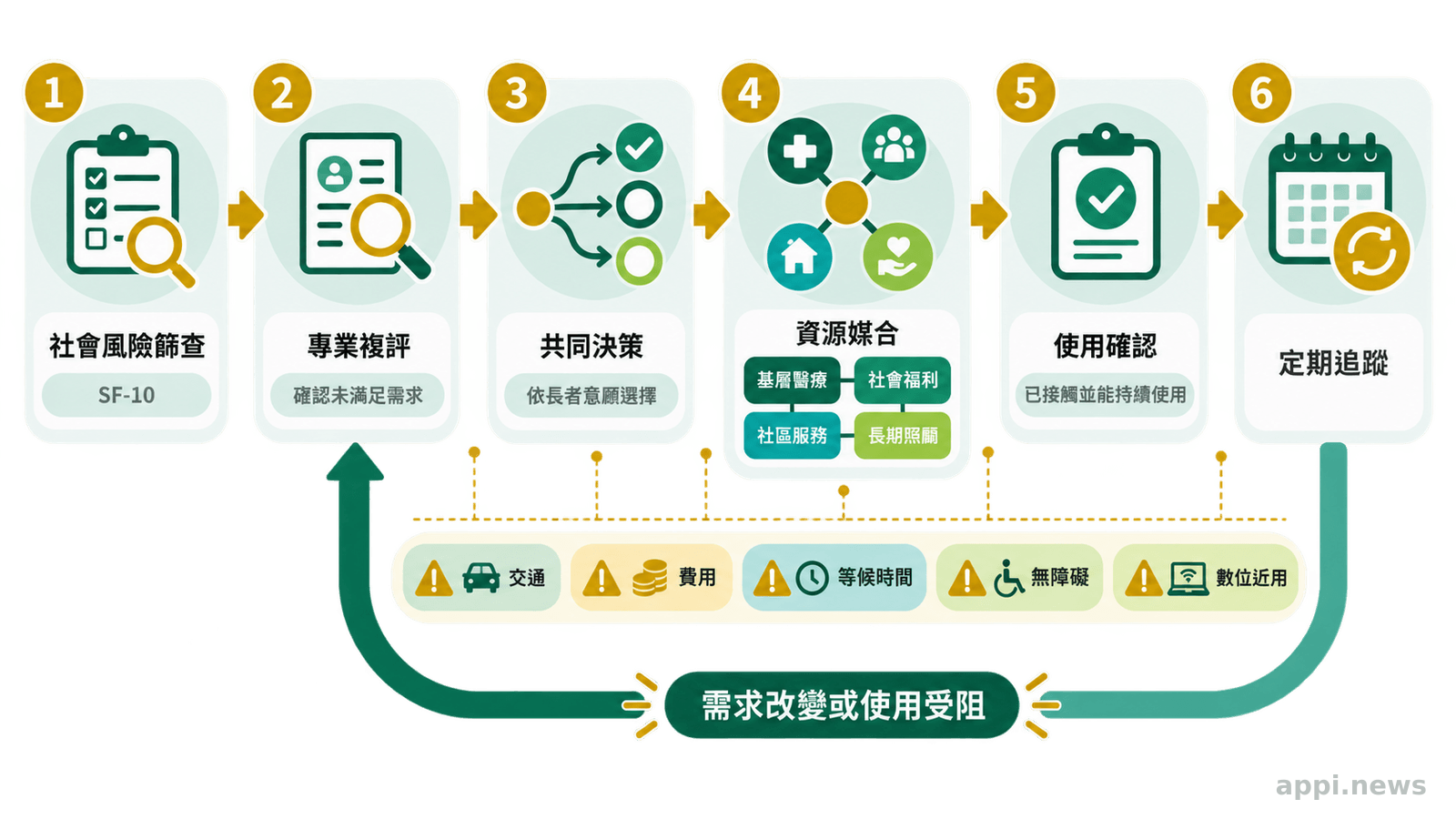
For SF-10, a practical handoff can be divided into five checkpoints. This sequence is an APPI News synthesis of the cited SF-10 and ICOPE material, not a validated SF-10 protocol or a universal timetable.
- Review the result: Record the domain that raised concern and the conclusions that the screen cannot support.
- Assess the need: Examine health, communication, transport, financial and relationship factors that may explain the reported difficulty.
- Agree on a goal: Record the older person’s priorities and consent before sharing information or arranging support.
- Confirm the handoff: Name the receiving local service and document whether it accepted the referral and made contact.
- Monitor access: Check whether cost, waiting time, language, disability access or transport prevented use, then reassess when circumstances change.
A sent referral shows that a request left one service; it does not show that another service accepted it or that support began. Without those later records, a program cannot distinguish screening reach from actual access.
Cross-cultural use and service capacity remain unresolved
The authors described SF-10 as culturally grounded for older Chinese adults in Hong Kong and explicitly called for cross-cultural validation. That evidence does not show that translated wording, response patterns or thresholds perform the same way in another population.
Programs also need consent and access controls because the domains concern relationships, resources and support networks. The accessible study abstract does not report whether digital, paper or interviewer-led administration changes participation, privacy or refusal rates.
Service capacity is a separate constraint. Screening can expose transport, financial or social-support needs, but the cited sources do not show that a suitable local service is available, affordable or able to accept each referral.
The evidence applies to older adults, not every population
The study enrolled adults aged 60 or older and provides no validation evidence for children or pregnant people. A child or pregnant person with a change in health or function needs clinician-led assessment rather than an older-adult social-frailty score.
Chronic illness, disability, sensory loss and regular medicines can affect social participation and the appropriate follow-up. An SF-10 result cannot determine the cause of those changes or serve as a basis for starting, stopping or changing medical treatment.
Initial validation supports a limited claim
SF-10 has initial psychometric evidence as a brief social-vulnerability screen for community-dwelling older adults in Hong Kong. The study does not establish a universal cutoff, predict outcomes over time or show that completing the screen reduces disability, hospital admission or mortality.
The next evidence gap is operational as well as statistical: independent studies need to test the scale in other populations, while services need to report whether flagged needs lead to accepted referrals and sustained support. Until then, the tool is an assessment entry point rather than proof of an effective care pathway.
Sources and further reading
- PolyU develops Hong Kong’s first screening tool to detect social frailty in seniors(The Hong Kong Polytechnic University)
- Development and validation of the co-designed social frailty 10-Item screening tool (SF-10)(Contemporary Nurse)
- Social frailty in older adults: a scoping review(European Journal of Ageing)
- Integrated care for older people (ICOPE): guidance for person-centred assessment and pathways in primary care, 2nd ed(World Health Organization)
- Social connection(World Health Organization)
- Cardiovascular diseases (CVDs)(World Health Organization)