The World Health Organization (WHO) published the second edition of its Integrated Care for Older People handbook on September 22, 2025, and placed basic assessment, in-depth assessment, a personalized care plan, and implementation and monitoring in one pathway. A completed screen is therefore the first recorded contact, not the end of care.
WHO's ready-phase pilot found that all four case-study sites screened older participants, while only the sites in Andorra, China and France proceeded to in-depth assessment. The site in India planned assessment but could not continue beyond screening because of the COVID-19 pandemic.
Routine screening is not an emergency route
WHO lists sudden one-sided weakness, new difficulty speaking or understanding speech, sudden vision trouble, loss of balance, a severe unexplained headache and unconsciousness among stroke warning signs that require immediate medical care. An older person with any of these sudden changes needs the local emergency route rather than waiting for a routine ICOPE appointment; emergency numbers and access systems differ by country.
That list is not exhaustive, and a routine function screen cannot triage every acute problem. The follow-up evidence below concerns non-emergency screening results.
ICOPE starts with capacity rather than a disease label
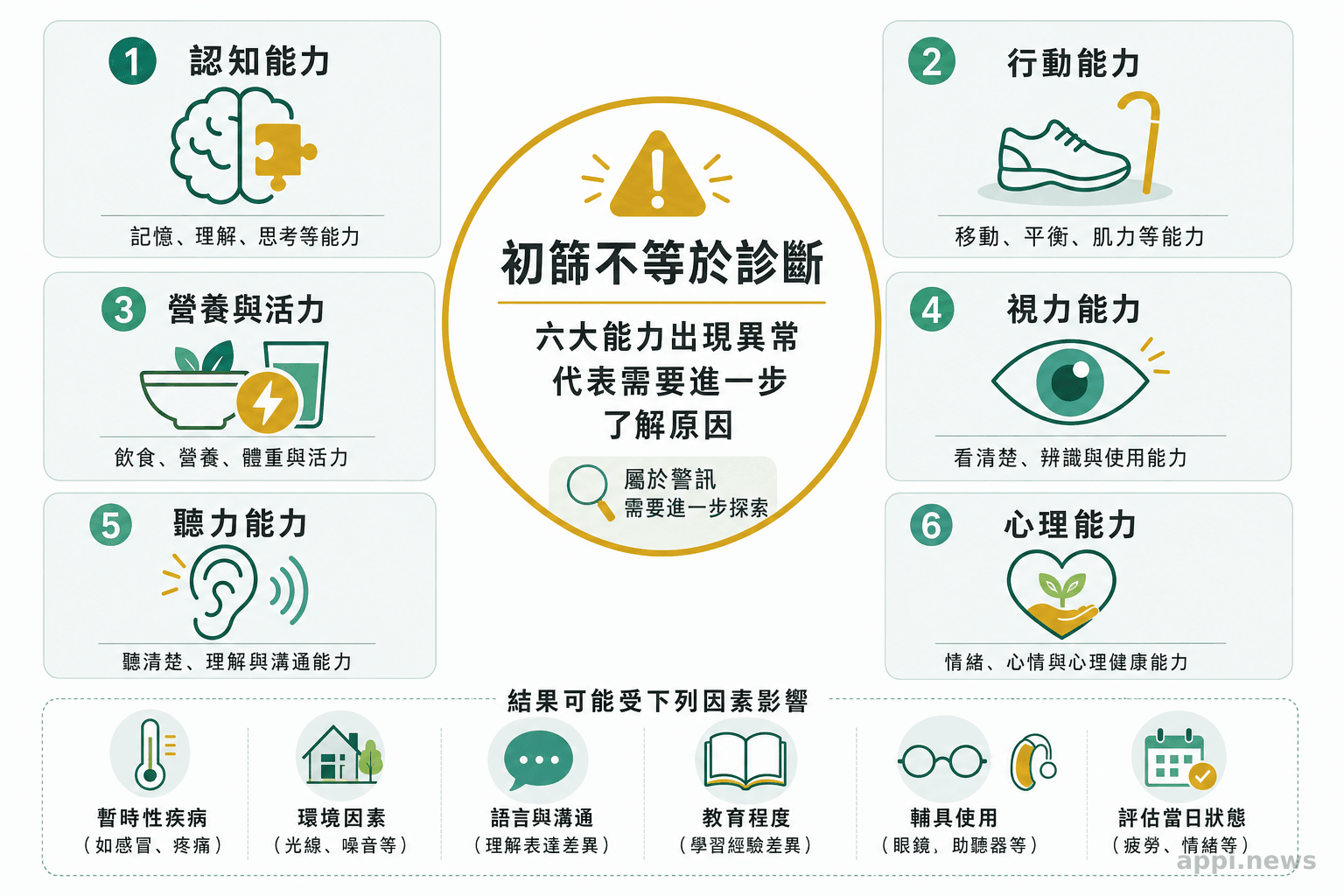
WHO's basic ICOPE assessment covers cognition, mobility, vitality, vision, hearing and psychological capacity, while validation findings vary by domain and by the local version of the tool. A flagged area directs attention to a possible change; it does not establish a diagnosis or identify the cause.
The 2025 handbook asks health and care workers to examine underlying conditions, the social and physical environment, support needs and the older person's priorities during the later stages. The resulting plan may involve health care, rehabilitation, sensory support, nutrition or social care, depending on the assessment and the services available locally.
Six handoffs make follow-up traceable
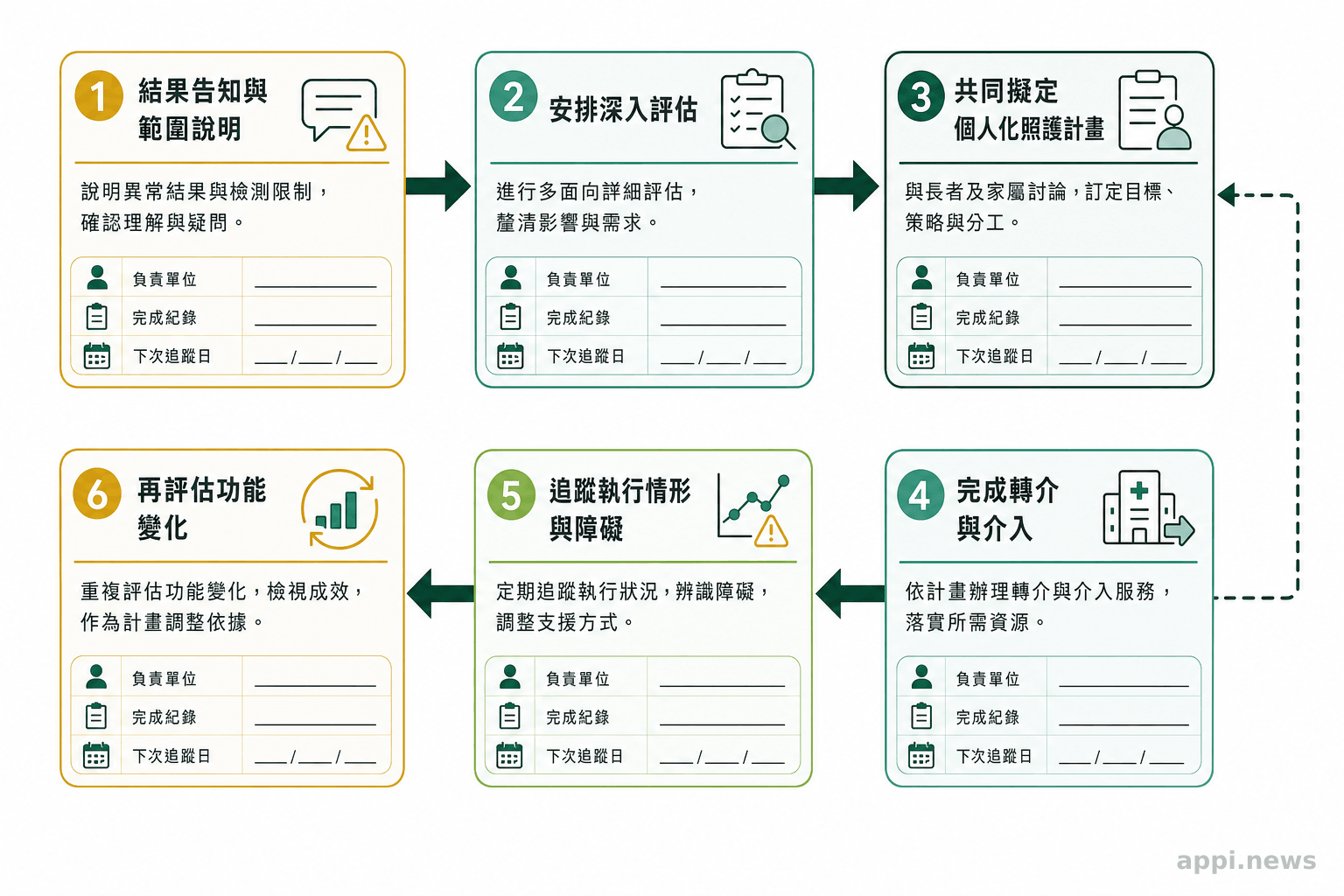
WHO organizes the pathway into four broad stages, but a service record needs finer checkpoints to show whether a person reached the next step. The following six-part sequence is an APPI News operational breakdown of the WHO pathway, not a universal timetable or a separate clinical protocol.
- Result recorded: The record identifies the area flagged, the tool and date, and the conclusions that the screen cannot support.
- Assessment arranged: It names the receiving service, the reason for assessment and the person or team responsible for the handoff.
- Care plan agreed: The plan brings together the older person's priorities, assessed needs, current conditions, regular medicines and available support.
- Referral accepted: The sending service confirms that the receiving service took the referral and records whether care or support began.
- Monitoring completed: The record captures contact attempts, progress and barriers such as waiting time, transport, cost, accessibility or language.
- Capacity reassessed: A later review records changes in function and priorities and whether the plan needs revision.
Each checkpoint needs an accountable service and a status that distinguishes pending, completed and unsuccessful handoffs. A referral form alone shows that a request was sent; it does not show that the next service received it or that the older person reached care.
Occitanie's records expose a measurement gap
The French pilot site in Occitanie screened 10,903 participants. Its database contained in-depth assessment results for 958 people, but primary care doctors were not required to enter those results.
WHO said the number of Occitanie participants who actually received a full assessment was unknown. The difference between the screening and database totals is therefore a documentation gap, not proof that every unrecorded assessment was missed.
The same report shows that local teams assigned later steps differently. A geriatrician led care planning for some participants in Andorra, integrated care managers provided follow-up in China, and primary care workers received responsibility for care plans and follow-up in France.
One accountable service must connect the pathway
The pilot teams intended to deliver every step directly but could not always do so. Some formed partnerships with providers outside the study so that referrals and later care could continue, while the China site trained integrated care managers to connect providers, services and systems.
No single job title can be assigned across countries with different primary care, social care and long-term care structures. The transferable requirement is narrower: the record should name the service responsible for the next contact, the expected destination and the route for information to return.
WHO's 2019 implementation framework uses a scorecard with 19 service- and system-level actions to assess whether community services can deliver integrated care. In the 2022 pilot report, the scorecard survey produced 259 valid responses from 35 nominated member states, and readiness varied widely by setting.
Program measures need to continue after the screening count
A program can separate its reporting into reach, process, access and outcomes. This structure is an editorial inference from the WHO pathway and pilot findings; WHO does not prescribe one global reporting dataset in the cited material.
- Reach: unique people screened, repeat screens and the share with at least one flagged area.
- Process: in-depth assessments recorded, care plans agreed, referrals accepted and services started.
- Access: waiting time, unsuccessful contacts and recorded barriers to reaching the next service.
- Outcomes: changes in the person's stated goals and assessed function at reassessment, with the follow-up period reported.
Those measures answer different questions. A high screening count shows reach, a referral completion rate shows whether a handoff occurred, and a later function measure describes change without proving that the program caused it.
WHO's pilot report said follow-up of about one year was too short to reach conclusions about ICOPE's effectiveness or its effect on health systems and care dependency. The four case studies examined implementation under different conditions and did not establish one outcome rate that can be applied internationally.
Local capacity changes roles and timing
The 2025 handbook calls for each care pathway to be adapted to the local context. Workforce, travel, language, accessibility, financing and the connection between health and social care can change who accepts a referral and how monitoring occurs.
The 2022 pilot described digital tools as possible support for screening and follow-up, but it also identified access, interoperability, data governance, cybersecurity and usability as issues requiring local work. A digital alert does not remove the need for an accountable person or service to respond.
WHO's pathway includes implementation and monitoring but does not set one reassessment interval for every country, service or flagged area. APPI News could not find current, comparable cross-country data showing how often a flagged ICOPE result leads to completed assessment, referral and reassessment at the time of writing.
The pathway is designed for older people
The cited ICOPE material addresses older people and does not establish a screening route for children or pregnant people. People in those groups with a new functional change should talk to a clinician rather than apply the ICOPE pathway to themselves.
Chronic illness, disability, recent medical care and regular medicines can also affect both a screening result and the appropriate referral. Grip and gait findings can flag possible decline but cannot identify its cause, and a medication history belongs beside the function assessment; a screening result alone is not a basis for changing treatment.
The available evidence supports a limited conclusion. Screening counts show how many people entered the pathway, while documented assessment, accepted referrals, monitoring and reassessment show whether the pathway continued.
Sources and further reading
- Integrated care for older people (ICOPE): guidance for person-centred assessment and pathways in primary care, 2nd ed(World Health Organization)
- Integrated care for older people (ICOPE) implementation pilot programme: findings from the ready phase(World Health Organization)
- Integrated care for older people (ICOPE) implementation framework: guidance for systems and services(World Health Organization)
- Cardiovascular diseases(World Health Organization)