DeepSeek V4.1 Flash was described as an interim test build in a September 8, 2026 report, while OpenAI's GPT-6 Astra had public model documentation. The two models therefore do not start from the same evidence base.
The practical comparison is broader than a token price. Teams need to test task success, tool recovery, latency, data controls, regional access and the cost of human review before moving a workflow.
What is actually public about the two models?
Yicai described DeepSeek V4.1 Flash as an interim model under limited testing, with a model name that included an expiry marker and account-level concurrency limits. Those details are media reporting, not a complete product specification.
In the official pages checked for this article, DeepSeek's model and pricing documentation did not list a formal V4.1 Flash entry on September 8, 2026. The DeepSeek change log can show later updates, but it cannot by itself prove a model's current availability, service-level terms or price.
OpenAI's GPT-6 Astra model page lists complex reasoning, coding, computer use, image input, tools and a context window of about 1.05 million tokens. It also lists an output limit of about 128,000 tokens. Documentation describes supported functions; it does not establish accuracy on a team's own data.
OpenAI's safety overview places Astra within the company's preparedness framework. That is a provider safety document, not a government approval or an independent security certification. A deployment still needs least-privilege access, logging, testing and a way to stop or roll back a failed workflow.
How should teams compare reasoning, coding and multimodal work?
Use the same task set, prompt version, output format and tool permissions for both models. Record first-pass success, final success after retries, latency, token use, review time and the reason for every failure.
The DeepSeek V4 model card reports about 285 billion total parameters, roughly 13 billion active per token and a one-million-token context. Those figures describe V4. They do not establish V4.1 Flash's architecture or performance.
For coding, a useful test is a real repository with a fixed issue list. Measure whether the patch passes tests, how much correction is needed and how often the model loses context after a tool error. For long documents, include extraction, citation and refusal cases instead of relying on a context-window number.
Media reporting is the only source in the supplied material for V4.1 Flash's native multimodal claim. GPT-6 Astra's public page lists text and image input, but not audio or video input. Image reading, table extraction and form understanding still need the same labeled test set.
What do the published prices show?
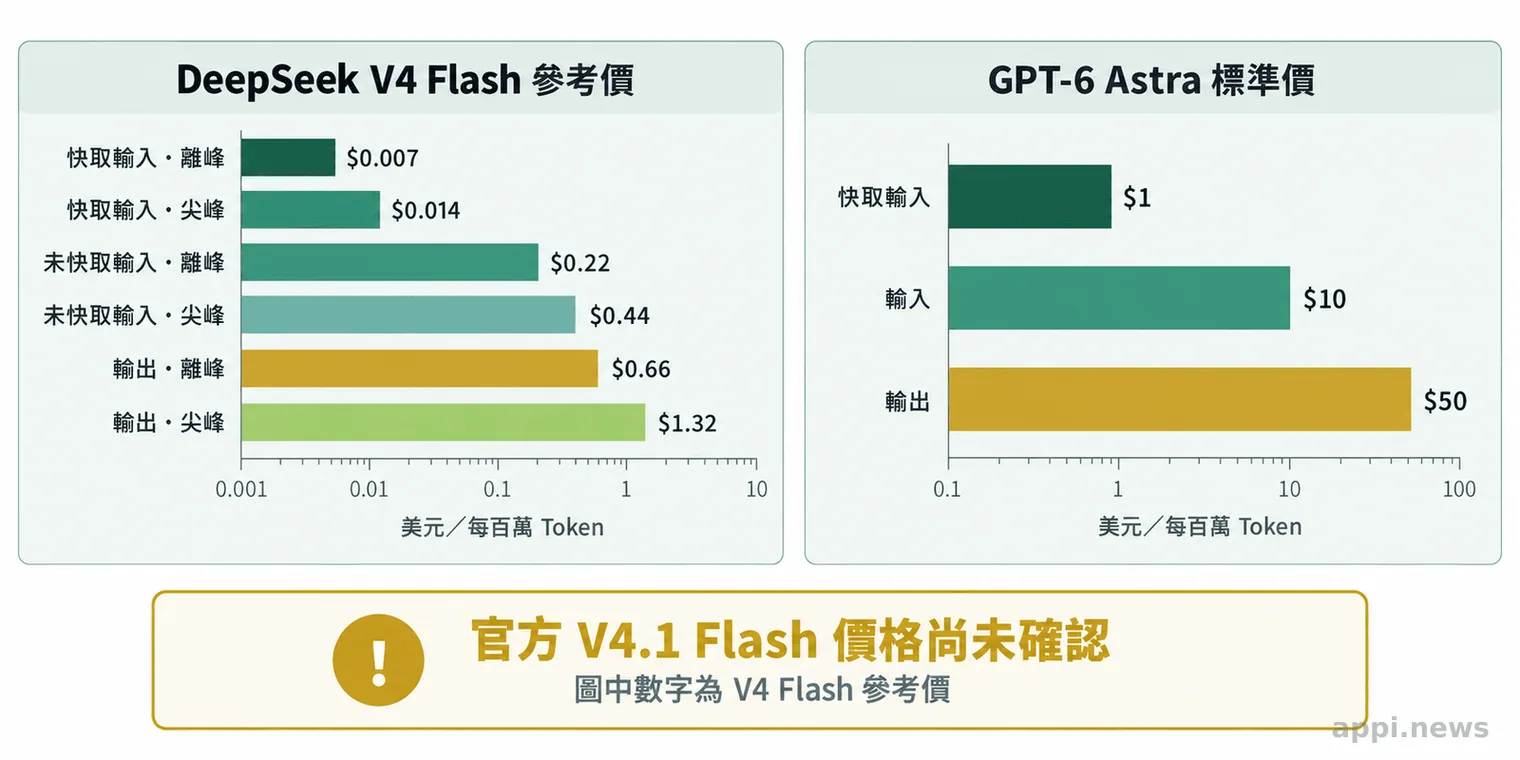
DeepSeek's pricing page lists V4 Flash prices in US dollars per million tokens: input prices vary by cache status and time period, with listed output prices below the corresponding GPT-6 Astra output rate. The page does not turn a reported V4.1 Flash test price into a formal V4.1 price.
The comparison should therefore use a cost sheet rather than a headline rate. Include input and output tokens, cache hits, retries, failed tool calls, queue time, review labor, monitoring, data processing and the cost of keeping a fallback model available.
What would local deployment require?
The V4 model card's open-source distribution description does not prove that V4.1 Flash has downloadable weights or the same license. Before planning self-hosting, confirm the exact model ID, weight release, license, quantization options, hardware memory, throughput limits and update process.
Self-hosting can keep some inputs inside an organization's network, but it moves capacity planning, patching, dependency review, incident response and log retention to the operator. A hosted API shifts some of that work to the provider while raising questions about processors, retention, transfer routes and account controls.
How this plays out outside Taiwan
The first check in any market is whether the provider actually supports access there. OpenAI's official API country list says access is supported only in listed countries and territories, and it can change. A team in the United States, Singapore, the United Kingdom or Australia should save the list checked on the procurement date, then confirm that the API account, billing profile and intended users match the provider's current terms. The same check is needed for DeepSeek: this article did not verify a public V4.1 Flash availability list, so a product page or reseller listing is not enough evidence.
For a United States deployment, the immediate question is not whether a model is popular in the US. It is what data the application sends, who can retrieve logs and whether the customer contract permits the proposed use. The procurement file should identify the provider entity, subprocessors, retention setting, deletion process and incident contact. If a team handles regulated records, it should ask its own counsel whether the service and contract meet the applicable sector rules; a model page cannot answer that question.
Singapore gives teams a concrete governance reference even when a model is hosted abroad. The Singapore Personal Data Protection Commission's Model AI Governance Framework calls for explainability, transparency, fairness, human involvement and clear organizational responsibility. Its implementation advice can be turned into a test record: name the owner, define when a human must approve an output, document the data source, log material changes and give affected users a way to raise a problem. That is useful for a low-risk V4.1 Flash proof of concept, but it does not make the model suitable for an automated decision.
In the United Kingdom, organizations processing personal data should read the Information Commissioner's Office guidance on AI and data protection. The ICO says its guidance explains how data-protection law applies to AI and recommends ways to assess risks to people's rights. A UK team comparing the models should record the lawful basis, purpose limitation, data minimization, accuracy controls, access rights and any impact assessment needed for the proposed processing. The ICO page also says the guidance is under review, so the procurement record should preserve the version and date used.
Australia has a similarly practical starting point. The Office of the Australian Information Commissioner's checklist covers privacy considerations for generative AI developers and systems subject to the Privacy Act. An Australian buyer can use it to ask where training or prompt data came from, whether personal information is being disclosed to a provider, how correction and deletion requests are handled, and what safeguards apply to outputs. Those questions matter whether the team buys a hosted GPT-6 Astra endpoint or tests an external DeepSeek endpoint.
Across these markets, availability is only the first gate. A workable comparison sheet should have one row for the provider's country list, one for contract and data terms, one for retention and deletion, one for human approval, and one for the fallback path. If any row is unknown, keep the test data non-sensitive and stop short of production. That produces a local decision without pretending that one country's rules or prices apply to every English-speaking reader.
Which workloads should be tested first?
Use V4.1 Flash only for a short, reversible proof of concept with de-identified inputs, retryable tasks and human review while its formal status remains unclear. Include GPT-6 Astra as a reference model for the same tasks rather than treating its documentation as proof of superior results.
For browser actions, code changes, external notices or scheduled operations, record completion and recovery after failure. Keep permissions narrow, validate structured outputs and retain a rollback version. For sensitive data, first document the fields leaving the system, retention period, log access, transfer route and deletion mechanism.
Bottom line: compare completed work, not token price
As of September 8, 2026, the evidence supports treating DeepSeek V4.1 Flash as a test signal rather than a stable production dependency. GPT-6 Astra has more public documentation, but its listed capabilities still need testing against the workflow that matters.
The useful unit is the cost of a correctly completed task. That includes tokens, retries, human review, data governance, monitoring and maintenance. A small test set of 30 to 50 de-identified tasks covering documents, tables, code, images and tools can expose those differences before a team commits to a model or deployment path.
Frequently asked questions
Is DeepSeek V4.1 Flash a formal release?
The supplied media report described it as an interim test build, and the official pages checked for this article did not provide a formal V4.1 Flash model entry on September 8, 2026. Recheck the current model ID, pricing page, terms and account billing before use.
Is V4.1 Flash definitely cheaper than GPT-6 Astra?
Published V4 Flash prices are lower than the listed GPT-6 Astra rates, but that does not establish V4.1 Flash pricing. Total cost also depends on retries, output length and review time.
Does an open model card mean easy local deployment?
No. The V4 model card does not establish V4.1 Flash weights, licensing or hardware needs. Confirm those items for the exact release.
What should a team do before testing?
Confirm the provider's country list and terms, classify the data, use de-identified inputs, define human approval and keep a fallback path. Stop at the test stage if those conditions are unclear.
Can one benchmark decide the model choice?
No. Add real tasks, failure recovery, latency, token use and human review to the benchmark result.
Sources and further reading
- OpenAI (2026). GPT-6 Astra Model. OpenAI API Documentation
- OpenAI (2026). Safety overview: GPT-6 Astra
- DeepSeek (2026). DeepSeek V4 Model Card
- DeepSeek (2026). Models and Pricing
- DeepSeek (2026). Change Log
- Yicai (2026). DeepSeek new model opens limited testing
- OpenAI. API supported countries and territories
- Singapore Personal Data Protection Commission. Singapore's approach to AI governance
- UK Information Commissioner's Office. About AI and data protection guidance
- Office of the Australian Information Commissioner. Privacy checklist for generative AI