
Codex Alimentarius guidance treats “natural” and absence claims as conditional marketing claims, not proof that a packaged food is safer or more nutritious. The ingredient list provides more specific evidence, but national rules determine how each claim and additive must be declared.
The wording on the front of a package still matters. It identifies the exact promise a manufacturer has chosen to make, such as “no added sugar,” “no preservatives” or “zero calories.” The next step is to test that narrow promise against the qualifier, ingredient list, nutrition panel and storage instructions instead of extending it into a broader health claim.
“Natural” follows national practice, not one global definition
The Codex Alimentarius Commission's guidance says food claims should not be false, misleading or deceptive and that the marketer should be able to justify them. Codex is the food-standard body established by the Food and Agriculture Organization of the United Nations and the World Health Organization (WHO). Its texts provide an international reference, while governments decide how to adopt and enforce them.
The same guidance places “natural,” “pure,” “fresh,” “home made” and organic-production terms under the practices of the country where the food is sold. “Natural” is therefore not a single international certification. A shopper needs the rule for the market of sale before assuming the term excludes a particular process or ingredient.
An absence claim is narrower than the package impression
Codex guidance allows a claim highlighting the absence or non-addition of a substance only under stated conditions. The substance should be one consumers would normally expect in that food, and the claim must not mislead. If another substance supplies an equivalent characteristic, the substitution should be disclosed with equal prominence.
That distinction matters for claims such as “no added sucrose” or “no preservatives.” The first does not, by itself, say that a product contains no other sugars. The second does not describe calories, sodium, allergens, processing, shelf life or the complete formulation.
“Zero” also needs its noun and its legal context. A zero claim may refer to sugar, calories, alcohol, trans fat or another component, and jurisdictions can set different definitions or thresholds. The front-panel word alone cannot establish what was measured or which rule applies.
The ingredient list answers a different set of questions
The Codex labeling standard says ingredients in most multi-ingredient packaged foods should appear in descending order of their weight when the food was manufactured. That order can show whether a highlighted ingredient is a major part of the formulation. It does not show which ingredient is more nutritious, and the order of ingredients present in similar amounts may reveal little about their exact proportions.
The standard also says additive functional classes, such as preservative, sweetener or emulsifier, should appear with the specific name or a recognized number as required by national legislation. This lets the label describe both what an additive does and which additive was used. Processing aids and additives carried over at levels too low to perform a technological function can qualify for exemptions, so an ingredient list is not always a record of every substance used anywhere in production.
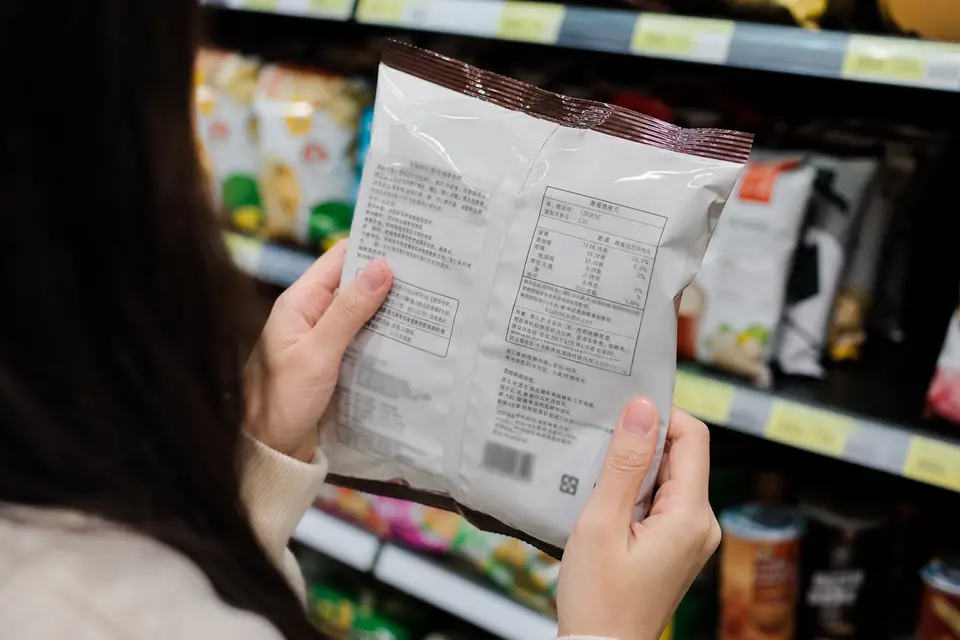
A practical reading starts with the claim's exact scope. Compare it with the product name and ingredient list, then check the nutrition panel, allergen declaration, date mark and storage directions. For supplements, confirm whether the product is regulated as a food, supplement or medicine in the market where it is sold, because the label category and permitted claims can differ by country.
Additive-free does not establish that a food is safer
WHO says the Joint FAO/WHO Expert Committee on Food Additives evaluates additives used in internationally traded food, while national authorities authorize specific uses and levels. The assessment applies to additives from natural sources and to synthetic additives. Safety depends on the substance, exposure, food category and permitted conditions of use rather than the origin implied by a marketing word.
WHO also says preservatives can slow decomposition caused by mold, air, bacteria or yeast and can help control contamination that causes foodborne illness. Removing a preservative does not automatically make a product unsafe, because manufacturers can use refrigeration, heat treatment, acidity, drying or packaging controls. It does mean that “preservative-free” alone cannot establish safety; the product's process, storage conditions and use-by instructions still matter.

A five-point check for front-of-pack claims
First, read the complete phrase rather than the largest word. Identify what “free,” “no added” or “zero” modifies and look for a qualifier in smaller type. Second, check whether another ingredient appears to serve the same sweetening, coloring, thickening or preserving function.
Third, use ingredient order to understand the broad composition without treating the order as a safety ranking. Fourth, read the nutrition, allergen, storage and date information that addresses issues the marketing claim does not cover. Fifth, check the regulator's definition in the country of sale when the claim affects a purchase decision, especially for imported foods and supplements.
Codex offers a common baseline, not a universal enforcement code. APPI News did not verify the legal definition of “natural,” “additive-free” or “zero” in every market at the time of writing. A compliant claim in one country may require different wording, evidence or thresholds in another.
Frequently asked questions
Does “natural” mean a food has been certified?
No universal Codex certification follows from that word alone. Codex guidance says use of “natural” should follow national practice in the country where the food is sold.
Does “no added sugar” mean sugar-free?
Not necessarily. It is an absence claim about what was added, while the food may contain sugars from ingredients or use a different sweetening substance. The exact definition and any threshold depend on the market's rules.
Are approved food additives automatically harmful?
No. WHO says international and national bodies assess additives and authorities authorize uses at specified levels for particular foods. A label should be assessed against those conditions, not by treating every additive as equally risky.
Is an ingredient list complete?
It is the main record of ingredients in a packaged food, but Codex provides exemptions for some processing aids and carried-over additives that no longer perform a technological function. National labeling rules can add or modify requirements.
Sources and further reading
- General Guidelines on Claims(Codex Alimentarius Commission)
- General Standard for the Labelling of Prepackaged Foods(Codex Alimentarius Commission)
- Food additives(World Health Organization)