
Taiwan Health Nexus began operations on January 9, 2026, with a plan to connect health information held by separate hospitals and other providers. Taiwan's Central News Agency reported that the company was launched to support health-data services, medical research and AI development while keeping the information in Taiwan. The project offers a commercial route to interoperability, but its consent and secondary-use controls are not yet publicly demonstrated.
The launch creates a possible route around years of fragmented records, but it does not settle who may authorize reuse, who supervises access or what happens when a participant withdraws. Those questions are central because Taiwan's highest court has already found gaps in the legal safeguards governing another large health database.

A company is trying a different route to connection
Taiwan Health Nexus is a private company promoted with support from public officials and backed by technology-sector investors. Its function needs explanation outside Taiwan: it aims to link health information held across hospitals, personal record services and other providers so approved users can conduct research or develop digital health tools.
The company is not the same body as Taiwan's National Health Insurance Administration, which runs the country's single-payer insurance scheme covering nearly the entire population. That distinction matters. Public insurance records are collected for administration and payment, while a commercial platform needs a separate, clearly stated basis for every source of data and every later use.
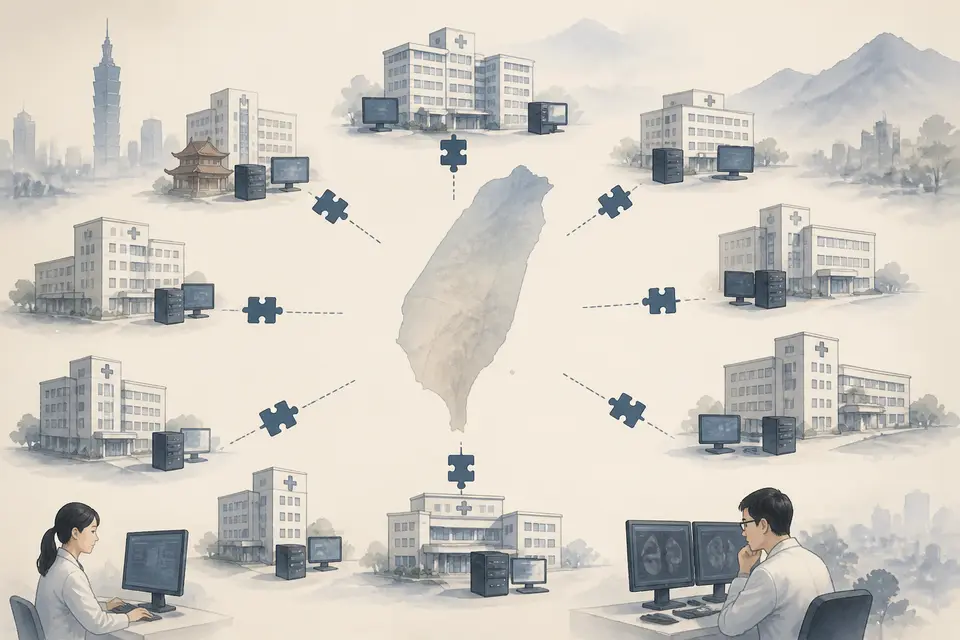
At the launch, company chair Pan-Chyr Yang described a model in which data would remain at hospitals. GeneOnline News reported that Yang also promised nonreversible identifiers and a dynamic-consent framework through which people could manage authorization. These are design claims, not published proof that the controls work in production.
Interoperability and permission are separate problems
A common data format can help two systems interpret the same clinical field, and distributed computation can reduce the need to copy complete records into one central store. Neither feature decides whether a proposed use is permitted. Governance still has to identify the controller, the legal basis, eligible users, allowed purposes, retention period and consequences of withdrawal.
The distinction also limits what can be inferred from the phrase "data never leaves the hospital." Model updates, query results and derived records can reveal information even when raw files remain in place. A defensible architecture therefore needs controls on outputs, attempts to reconnect records to individuals, access logs and enforcement against uses outside the agreed purpose.

International guidance treats those safeguards as part of the infrastructure, not an optional layer. The Organisation for Economic Co-operation and Development recommends national frameworks that make personal health data available for public-interest purposes while protecting privacy, security and public confidence. The World Health Organization says health-data governance should give people and communities control over, and benefits from, their data while creating accountability against misuse.
Taiwan's court has already defined the legal gap
Taiwan's National Health Insurance Research Database offers a direct domestic warning. The database grew from records submitted to the national insurer and has been made available to approved researchers for work beyond insurance administration.
Taiwan's Constitutional Court ruled in August 2022 that the framework lacked adequate independent supervision, explicit rules for storing and transferring the data, and a mechanism allowing people to opt out of secondary use. The court gave the authorities three years to amend or create legislation. The ruling did not prohibit research use of properly processed health data, but it made clear that de-identification alone did not fill the governance gaps.

That decision sets a practical test for the new platform. It should publish who provides independent oversight, how a person can refuse or later withdraw, which secondary uses require new authorization, and whether withdrawal stops future use only or also affects data and models already created.
Two international cases show different failure paths
England's care.data program was intended to extract information from general-practice records for uses beyond direct care. Officials delayed extraction in 2014 after objections from patients and doctors. NHS England's archived program page says care.data closed in 2016 and records its plan to tell 22 million households how information would be used and how people could object. The case shows that a public-interest objective and a national health service do not remove the need for clear communication and workable choices.
The 23andMe bankruptcy exposed a different risk: a company can change hands while retaining extraordinarily sensitive information. The US Federal Trade Commission told the bankruptcy trustee in March 2025 that any transfer should honor the genetic-testing company's privacy promises and customers' ability to delete their information. A later company filing with the US Securities and Exchange Commission records that a nonprofit research institute acquired substantially all 23andMe assets for US$305 million on July 14, 2025.

Neither example predicts that Taiwan Health Nexus will fail. Together, they show why promises made at launch must survive public resistance, ownership changes, insolvency and new commercial uses. Contracts and governance rules need to address each event before data begin moving through the system.
Capital can fund integration but cannot establish trust
The platform's investor group may fund engineering, contracting and long implementation cycles that smaller projects struggle to sustain. It may also create a commercial reason for hospitals and technology companies to participate. Those advantages address capacity and incentives, not legitimacy.
APPI News could not independently reconcile the source article's financial comparison. Registered capital, planned investment and a startup fundraising round measure different stages, so placing them in one ranking would give a false sense of precision.

The more useful evidence will be operational: signed participation agreements, a public list of permitted purposes, independent audit results, breach and insolvency provisions, decision records for new uses, and withdrawal statistics. Until those records are available, the platform has a plausible structure and stated safeguards, but not a publicly demonstrated trust model.
Frequently asked questions
Does keeping records at hospitals eliminate privacy risk?
No. It can reduce centralized copying, but queries, derived outputs, identifiers and model updates still require access controls, disclosure-risk testing and enforceable limits on reuse.
Why is Taiwan's 2022 Constitutional Court ruling relevant?
The ruling concerned the secondary use of data from Taiwan's national health insurance system, not this company. It nevertheless identified safeguards that any large Taiwanese health-data project must address: independent supervision, explicit processing rules and an opt-out mechanism.
What would show that dynamic consent is working?
Useful evidence would include the choices shown to participants, records of authorization changes, the effect of withdrawal on prior outputs and an independent audit confirming that system behavior matches the published policy.
Sources and further reading
- Taiwan Health Nexus launches to develop health data services(Central News Agency)
- Taiwan Health Nexus launches with plans to connect hospital data(GeneOnline News)
- Summary of TCC Judgment 111-Hsien-Pan-13 (2022)(Constitutional Court R.O.C. (Taiwan))
- NHS England sets out the next steps of public awareness about care.data(NHS England)
- Federal Trade Commission letter on the 23andMe bankruptcy(US Federal Trade Commission)
- 23andMe quarterly report for the period ended June 30, 2025(US Securities and Exchange Commission)
- Health data governance(OECD)
- Health data as a global public good: a call for health data governance(World Health Organization)