
Taiwan Health Data Platform Co. unveiled TwHealth Nexus on January 9, 2026, as a proposed link between health records held by hospitals, screening providers and long-term care services. Launch reporting put the company's initial target at five million users and described plans to connect records across institutions for research and artificial intelligence applications.
Those plans are distinct from My Health Bank, the personal record service operated by Taiwan's National Health Insurance Administration, which runs the country's single-payer health insurance program. My Health Bank gives an individual access to selected records and lets that person send them to an app. TwHealth Nexus proposes an additional role for health data: linking information held by care organizations and supporting secondary uses beyond an individual's own record management.

Two systems serve different purposes
My Health Bank addresses patient access and authorized sharing. Taiwan's National Health Insurance Administration says its software development kit lets users select records covering medical visits, medications and examination results for a defined period and authorize transfer to a trusted third-party app. The individual initiates the transfer and chooses the period and receiving app.
TwHealth Nexus has a broader stated scope. Launch materials said its architecture would use a globally unique identifier to connect information across hospitals and systems while keeping source data at the hospital. They also described a personalized record service and de-identified secondary use by hospitals, researchers and life-sciences companies.
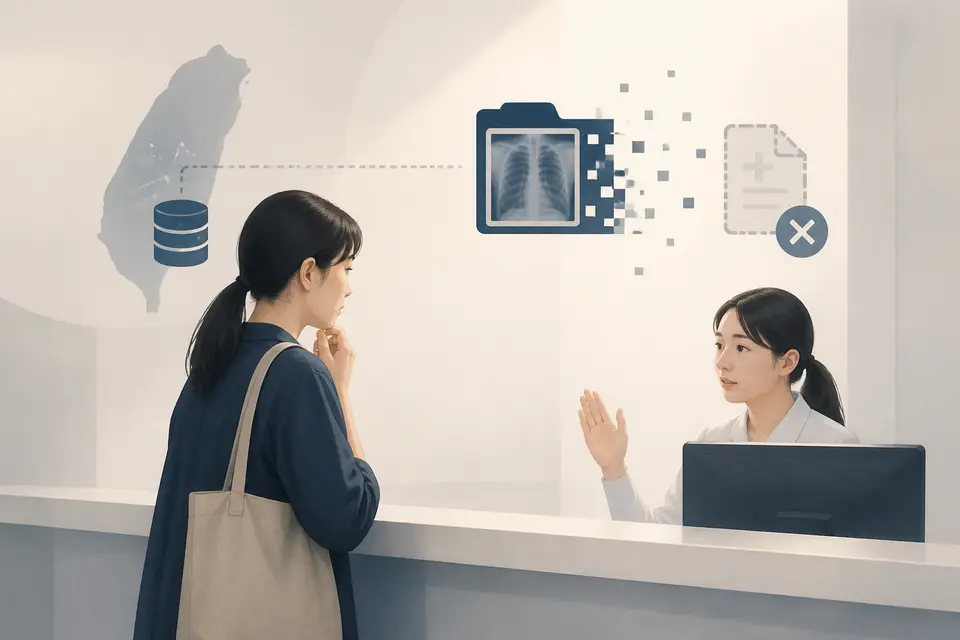
The distinction is not merely technical. A person using My Health Bank is requesting and sharing a copy of selected information for personal use. A person whose records support a linked dataset or an AI model is also a data subject in a system that may benefit researchers, hospitals and commercial partners. The second role requires rules for purposes, users, access conditions and later reuse.
Data staying in a hospital does not settle governance
A distributed architecture can reduce the need to move raw records into a central repository. It does not answer who may run a query, which outputs may leave an institution, how activity is logged or whether data approved for one purpose can later support another. De-identification also reduces some privacy risks without making a dataset immune to linkage or re-identification.

The OECD's health data governance framework calls for public participation, clear information about data processing, mechanisms to provide or withdraw consent where consent is the legal basis, and safeguards for privacy and data security. It also recognizes that some health-data processing may rely on another legal basis. In those cases, people should receive an explanation of the basis and ways to express preferences or object where the rules allow it.
That framework makes withdrawal only one part of the design. A platform also needs a published decision process for secondary-use requests, limits on onward sharing, controls for authorized users and records showing who accessed what. An assertion that data remain at the hospital cannot substitute for those controls.

More local data may help, but representation still matters
TwHealth Nexus has presented a model based on Asian real-world data as one of its goals. Locally collected records can help developers examine performance in populations that were poorly represented in an imported training set. They do not automatically produce an accurate or equitable model.
A 2025 World Health Organization report says health AI depends on large, high-quality datasets and that governance should ensure training data are ethically sourced, representative and free from bias. A five-million-user target measures scale, not representativeness. Enrollment methods, missing records, differences among participating hospitals and the exclusion of people who use less care can all shape the resulting dataset.

The unresolved questions are operational
Reporting from the platform's launch said it planned to use dynamic consent and allow people to manage their data. APPI News could not find detailed public rules explaining how withdrawal would affect data already incorporated into a dataset, a completed analysis or a trained model. It also could not verify a published independent oversight structure, a public access register or binding limits on downstream reuse.
These gaps do not show that the controls are absent. They mean the available material does not yet let an outside reader test how the promises would work in practice. Publication of the participation terms, data-use review process, audit arrangements and withdrawal consequences would turn broad commitments into verifiable rules.

Frequently asked questions
Is TwHealth Nexus the same as My Health Bank?
No. My Health Bank is Taiwan's patient-facing service for viewing selected health insurance records and authorizing their transfer to third-party apps. TwHealth Nexus proposes cross-organization linkage and secondary use for research and AI in addition to personal record services.
Does the platform mean a patient will not need a repeated test after a referral?
The launch material described cross-hospital integration, but APPI News found no published outcome data showing that participating clinicians routinely accept records from another institution without repeating a test. Clinical decisions also depend on whether the available record is complete, current and suitable for the decision at hand.
Does keeping data at the hospital remove privacy risk?
No. It can limit movement of raw records, but access permissions, query outputs, linkage, audit logs and secondary-use rules still determine exposure. De-identification is one safeguard within that larger system.
What would make the platform's consent model verifiable?
Public terms would need to identify the data involved, permitted users and purposes, the process for approving secondary uses, how withdrawal operates and what happens to prior outputs or trained models. Independent oversight and accessible audit information would make compliance easier to assess.
Sources and further reading
- Taiwan Health Data Platform unveiled with plans for data and AI services(Healthcare+)
- My Health Bank SDK Awarded for Smart Innovation(Taiwan National Health Insurance Administration)
- Taiwan health data platform launches with an AI sovereignty goal(GeneOnline News)
- Health Data Governance for the Digital Age(OECD)
- Health data governance in the age of artificial intelligence(World Health Organization Regional Office for Europe)