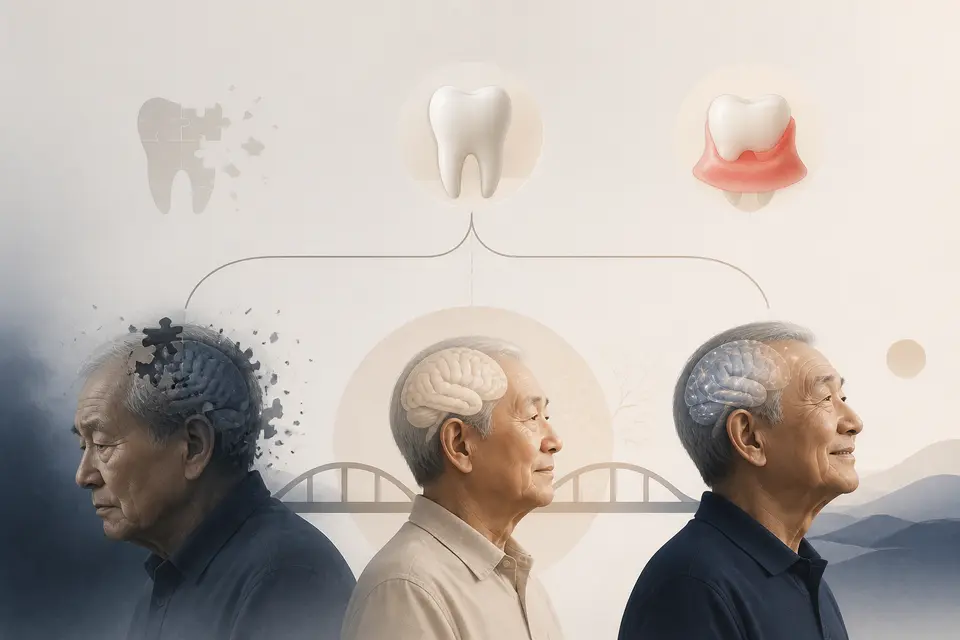
Meta-analyses of cohort studies have linked tooth loss with a higher rate of dementia, though the size of the association varies across studies. Denture users did not have a clear increase in one subgroup analysis, but those data do not show that replacing teeth prevents cognitive decline.
The distinction matters because tooth loss and dementia share several influences, including age, education and general health. Observational research can adjust for some of them, but it cannot reproduce the balance of a randomized trial or establish which condition caused the other.
The association appears across reviews, at different strengths
A 2018 meta-analysis of eight cohort studies, with 14,362 participants and 2,072 dementia cases, associated tooth loss with a 34 percent higher rate of dementia. Its dose-response model also found that the measured rate rose as the number of missing teeth increased.
The estimate was not uniform. The authors reported differences by study design, geographic area, education adjustment and denture status. They also said the review included only eight eligible studies and combined different measures of relative risk.
A 2023 meta-analysis of 18 cohort studies, covering 356,297 participants with an average follow-up of 8.6 years, estimated a 15 percent higher dementia risk among people with tooth loss. The pooled result varied by location, sex, denture use, number of teeth, the way dental status was assessed and length of follow-up.
Dental warning signs need prompt assessment
Heavy bleeding from the mouth that will not stop, a serious injury to the face or jaw, or severe swelling of the mouth, lips, throat or neck that affects breathing requires emergency medical care. The United Kingdom's National Health Service also advises urgent dental assessment for persistent or severe mouth pain, an enlarging swelling or lump, and a broken or loose denture, filling, crown or bridge.
Local emergency numbers and referral routes differ by country. Older adults with chronic conditions, those taking medicines and people who need help with daily care may require a treatment plan coordinated with their clinician or caregiver.
The denture result is not proof of prevention
In the 2018 review, four-study subgroup analyses produced different results for people with and without dentures. The pooled relative risk was 0.98 for denture users and 1.53 for people with tooth loss who did not use dentures. The confidence interval for denture users crossed 1.0, meaning the analysis did not identify a clear increase or decrease for that group.
That comparison does not show that dentures changed anyone's dementia risk. People who obtain and use dentures may differ from nonusers in income, access to dental care, nutrition, independence or overall health. Those differences can remain even after statistical adjustment.
Replacing teeth can still be considered for established dental reasons, including chewing and oral function. The type of restoration, its likely benefit and the ability to maintain it require an individual dental examination; access, cost and insurance coverage vary by country.
Tooth loss has direct effects apart from dementia
The World Health Organization estimates that 23 percent of people aged 60 or older have lost all their teeth worldwide. WHO describes complete tooth loss as the usual endpoint of a long history of oral disease, mainly advanced tooth decay and severe gum disease, while trauma and other causes also contribute.
The direct consequences do not depend on whether a dementia link is causal. WHO says tooth loss can be functionally limiting, socially damaging and psychologically traumatic. It also reports that oral health services are unevenly distributed and that out-of-pocket costs can block access to care.
Oral frailty broadens the assessment
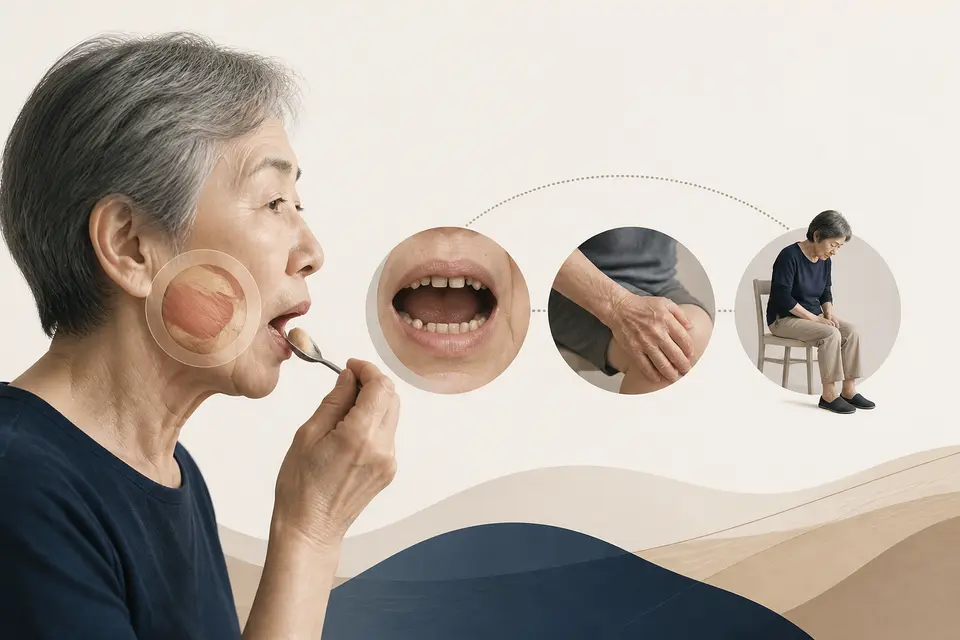
Tooth count is only one part of oral function. A 2024 consensus statement from the Japan Geriatrics Society, Japanese Society of Gerodontology and Japanese Association on Sarcopenia and Frailty places oral frailty between a healthy mouth and overt decline in oral function, and proposes a five-item assessment.
The statement describes links with reduced dietary variety, social isolation, physical frailty, disability and mortality. It introduced a five-item screening tool for use in Japan, but screening identifies people who may need assessment; it does not diagnose the cause of chewing or swallowing difficulty.
A change in the ability to chew, swallow or speak warrants a dental or clinical assessment because causes and treatment options differ. The Japanese criteria may also not match tools or care pathways used in other countries.

What the evidence can support
Tooth loss is a marker of oral disease and reduced function that deserves attention on its own. The dementia literature adds an association, not a promise that dental treatment will prevent cognitive decline.
For researchers, the unresolved question is whether replacing teeth changes cognitive outcomes after differences in health, education and access to care are addressed. For patients and families, treatment decisions can rest on present dental needs such as comfort, chewing function and maintainability rather than an unproven dementia-prevention claim.
Frequently asked questions
Does tooth loss cause dementia?
No causal link has been established. Cohort meta-analyses report an association, but residual confounding and differences among study populations prevent them from showing that tooth loss itself causes dementia.
Do dentures prevent dementia?
The evidence does not establish that. A 2018 subgroup analysis found no clear increase in dementia among denture users, but it compared groups in observational studies rather than assigning treatment in a randomized trial.
Why replace missing teeth if dementia prevention is unproven?
Missing teeth can affect chewing and other oral functions. A dentist can assess the cause of tooth loss, the condition of the remaining teeth and gums, and whether a removable or fixed replacement is suitable.
Is tooth loss a normal part of aging?
Age is associated with accumulated exposure to oral disease, but WHO describes complete tooth loss mainly as the endpoint of advanced tooth decay and severe gum disease. It should not be treated as an inevitable or harmless consequence of getting older.
Sources and further reading
- Tooth Loss Is Associated With Increased Risk of Dementia and With a Dose-Response Relationship(Frontiers in Aging Neuroscience via PubMed Central)
- Tooth loss and the risk of cognitive decline and dementia: A meta-analysis of cohort studies(Journal of the American Medical Directors Association via PubMed)
- Consensus statement on oral frailty(Geriatrics & Gerontology International via PubMed Central)
- Oral health(World Health Organization)
- How to find an emergency or urgent NHS dentist appointment(United Kingdom National Health Service)