
In a randomized trial published March 12, 2026, 97 inactive adults aged 65 or older in the United States with walking difficulty were assigned to a four-minute daily home strength program or a delayed-treatment control group. After 12 weeks, the intervention group improved more than the control group on five-times sit-to-stand, one-legged stance and 30-second chair-stand tests.
The trial measured functional performance, adherence and adverse events; it did not report the number of falls or fractures. The 2022 World Falls Guidelines treat exercise as one part of fall prevention alongside assessment of medical, functional, medication and environmental risks.
Sudden gait changes and serious falls need urgent assessment
The World Health Organization lists sudden dizziness or loss of balance or coordination, sudden vision loss, facial droop, arm weakness and slurred or unusual speech as possible stroke signs. Any of these signs warrants immediate contact with the local emergency medical service; emergency numbers and response systems vary by country.
England's National Health Service advises emergency help after a fall when a person cannot get up or may have injured the head, back, neck or hip. A strength routine should not delay assessment, and head injuries in older adults require immediate checks followed by continued observation.
A changing gait is a signal, not a diagnosis
A new shuffle, repeated trips, unstable turns or increasing reliance on furniture describes a change in mobility, but it does not identify the cause. Strength, balance, joints, sensation, vision, cardiovascular function, medicines and neurological control can each affect walking.
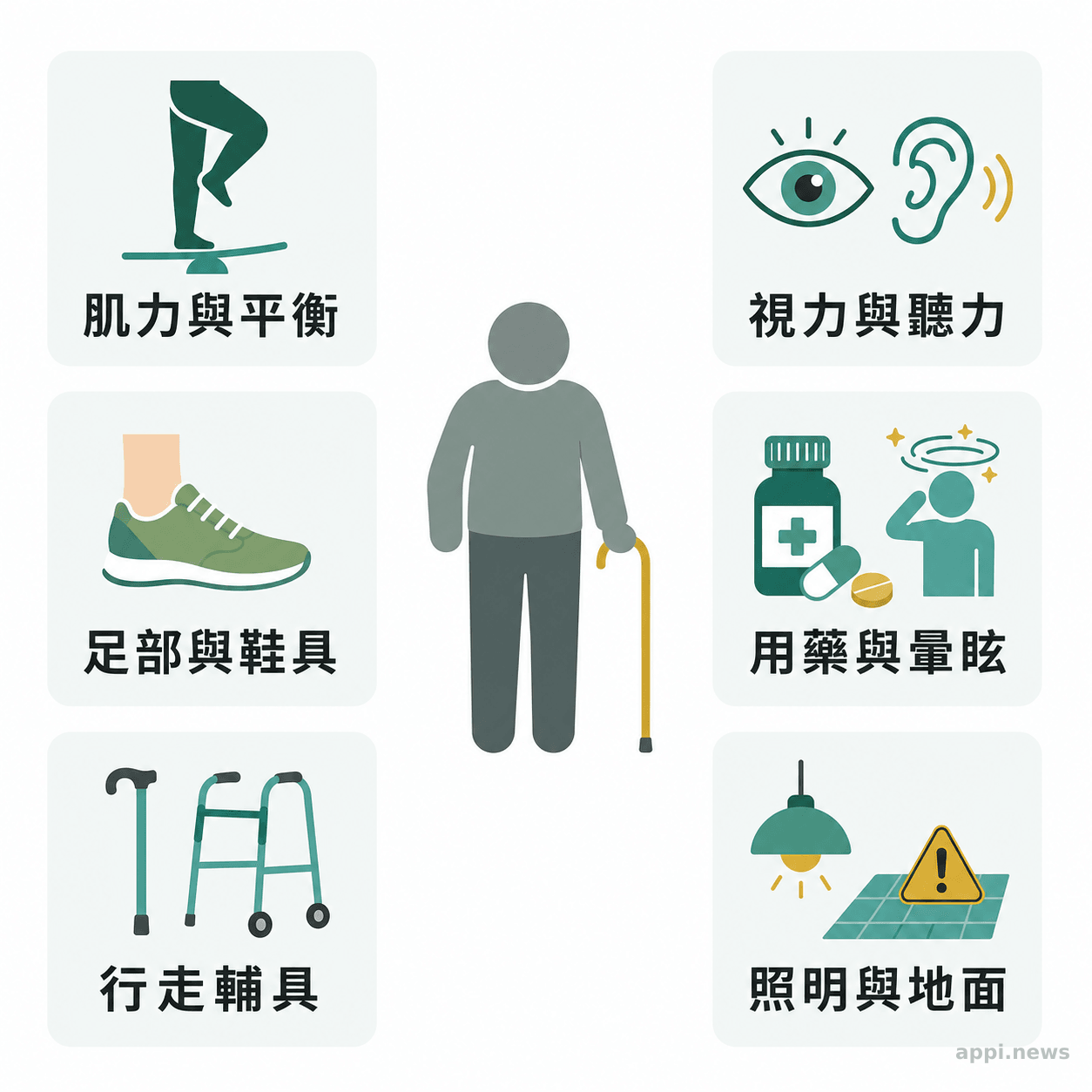
The World Falls Guidelines recommend a multiprofessional, multifactorial assessment for community-dwelling older adults at high risk of falling. The assessment covers gait and balance, muscle strength, medicines, cardiovascular disorders, dizziness, daily function, walking aids, vision and hearing, feet and footwear, cognition, neurological and other diseases, nutrition, pain and the home environment.
The guideline includes gait speed in fall-risk stratification and permits the Timed Up and Go test as an alternative, although its evidence for predicting falls is less consistent. Grip and gait checks can flag decline but cannot explain its cause, and one result cannot establish a diagnosis.
The World Health Organization's 2025 Integrated Care for Older People handbook places a basic capacity screen at the start of a pathway that continues through fuller assessment, a personalized care plan and monitoring. Its six-area screen can flag a need for follow-up but does not diagnose a condition, and local services must adapt the referral path.
FAST-2 added coaching to four minutes of movement
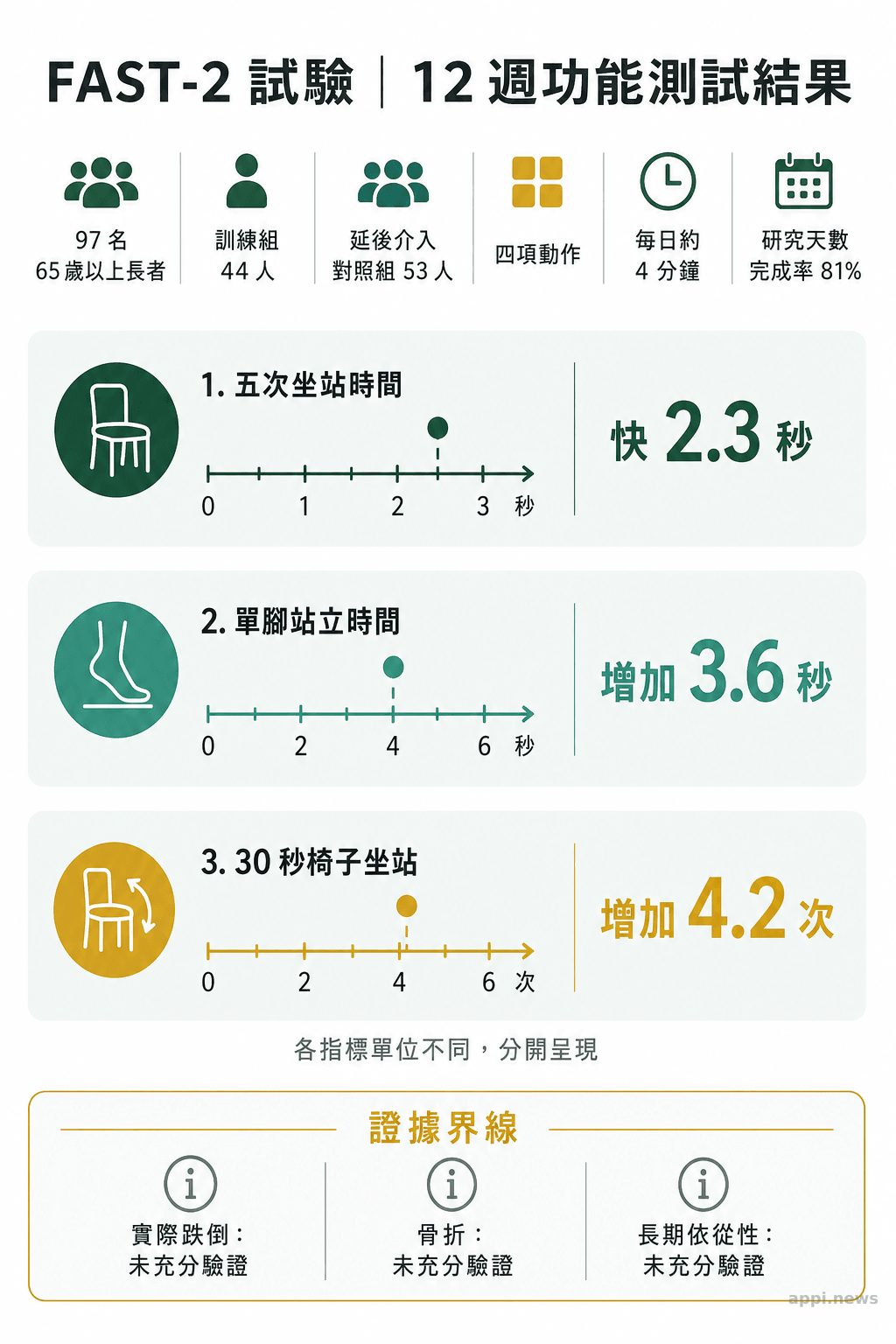
The trial recruited Penn State Health patients living within about 48 kilometers of a medical center in the US state of Pennsylvania. Their average age was 74, 68 percent were women and all reported difficulty walking about 400 meters without special equipment.
Eligibility required less than 60 minutes of self-reported physical activity a week, no resistance training, internet access, no chest pain on a pre-exercise risk screen and correct answers on a brief dementia screen. Inability to walk without equipment was the most common reason for exclusion.
The researchers provided resistance bands and an adjustable step. Each daily session used push-ups, chair stands, seated two-arm rows and step-ups for 30 seconds each, with 30 seconds of rest between movements.
The program included individual video coaching at baseline and at weeks two, four and eight, when staff checked form and adjusted movements and progression. Participants received daily email reminders, reported performance and exertion, and received feedback every two weeks. The intervention therefore tested a supported program rather than an unsupervised list of four exercises.
The functional gains were measurable and narrow
Relative to the control group, the intervention group completed five chair rises 2.3 seconds faster after 12 weeks. One-legged stance increased by 3.6 seconds and the number of chair stands completed in 30 seconds increased by 4.2 repetitions. Participants reported completing the workout on 81 percent of study days.
The full report recorded seven events in six participants that the researchers judged definitely, probably or possibly related to the intervention across 2,994 completed sessions. All were orthopedic in nature; three participants saw a health professional, and one stayed overnight for observation after shoulder pain while clinicians ruled out a heart attack.
Participants and the staff conducting assessments knew the group assignments, although secondary video coders were blinded. Pandemic restrictions moved the three outcome tests to video and prevented broader in-person measures, while the 12-week design could not establish whether gains lasted. The paper also disclosed that one author was part-owner of two companies formed to test business models for disseminating exercise-study findings.
The trial did not measure falls, fractures, body composition or cardiovascular health. Its three test results cannot establish that four minutes of daily exercise prevents a fall or replaces a full physical-activity program.
Falls evidence comes from longer, broader programs
A 2020 systematic review conducted for the World Health Organization's physical-activity guideline included 116 randomized studies with 25,160 community-dwelling participants. Sixty-four studies with 14,306 participants contributed to the pooled fall-rate estimate, which was 23 percent lower with exercise than with control conditions.
Balance and functional programs were associated with a 24 percent lower fall rate, while programs combining several exercise types were associated with a 28 percent reduction. The reviewers judged the effect of resistance-only programs uncertain, so the pooled estimate cannot be transferred to FAST-2.
The World Falls Guidelines recommend balance-challenging and functional exercises at least three times weekly, individualized and progressed in intensity for at least 12 weeks. They also recommend trained providers who can adapt exercise to functional ability and other medical conditions. The guidance does not set one universal session length or identify four minutes as a proven fall-prevention dose.
Fall prevention needs a multidomain plan
For older adults at high risk, the World Falls Guidelines recommend tailored interventions based on the risks found in a multifactorial assessment. A generic exercise routine does not address dizziness, postural blood-pressure changes, impaired vision, unsuitable footwear, walking-aid problems, pain or cognitive change.
Home modifications should match the person's abilities and behavior in that environment, preferably after assessment by a trained clinician. The guidelines also recommend a structured review of medicines that can raise fall risk and shared decisions about appropriate deprescribing. A fall or new dizziness can prompt review, but medication changes require a plan with the prescribing clinician or pharmacist.
The trial's population limits who its results cover
FAST-2 did not enroll people who needed equipment to walk, lacked internet access, reported chest pain on its risk screen or failed its brief dementia screen. Its results do not establish the program's safety or effect for those groups, for long-term care residents or for people recovering from stroke or hip fracture.
The World Falls Guidelines call for individualized supervised exercise in long-term care and separate, condition-specific approaches for Parkinson's disease, stroke and hip fracture. Chronic illness, regular medicines, recent injury or a need for walking assistance changes the assessment and the safe starting point.
APPI News could not find published results from an independent replication of FAST-2 or a study reporting fall or fracture outcomes for the protocol at the time of writing. The available result remains a small, 12-week US trial of functional performance.
Sources and further reading
- Brief daily functional strength training to improve functional performance in older adults with mobility disability: A randomized trial(PLOS ONE)
- Evidence on physical activity and falls prevention for people aged 65+ years: systematic review to inform the WHO guidelines on physical activity and sedentary behaviour(International Journal of Behavioral Nutrition and Physical Activity)
- World guidelines for falls prevention and management for older adults: a global initiative(Age and Ageing)
- Stroke(World Health Organization)
- Integrated care for older people (ICOPE): guidance for person-centred assessment and pathways in primary care, 2nd ed(World Health Organization)
- Falls(National Health Service in England)
- Falls(World Health Organization)
- The clinician's guide to prevention and treatment of osteoporosis(Osteoporosis International)
- Environmental interventions for preventing falls in older people living in the community(Cochrane Database of Systematic Reviews)
- Calcium Recommendations(International Osteoporosis Foundation)