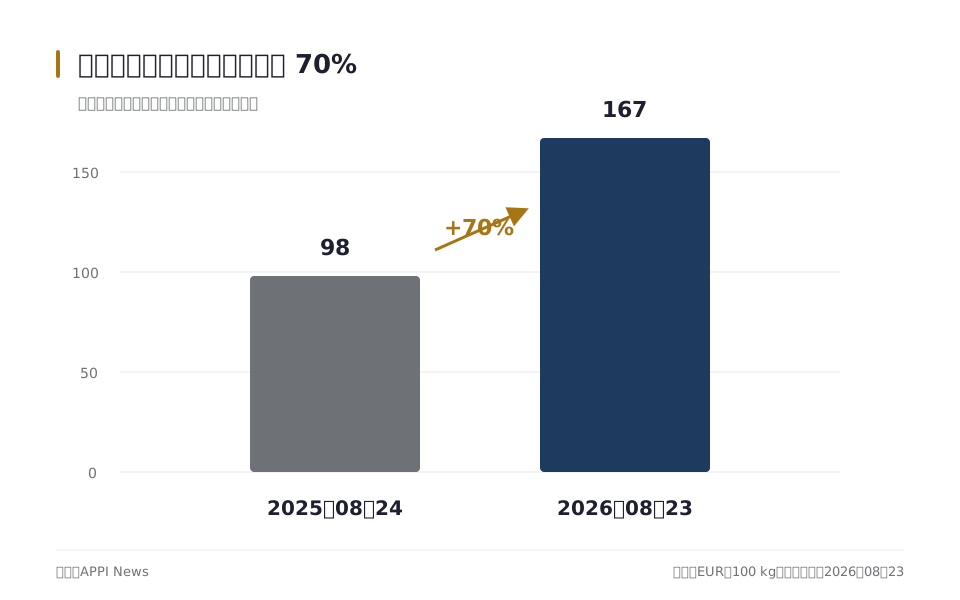
The European Commission's August 2026 dairy report put the EU whey powder quote at €167 per 100 kilograms for the week ending August 23, up 70 percent from a year earlier. At the European Central Bank's August 28, 2026 reference rate, that was about US$194 per 100 kilograms; neither figure predicts a retail supplement price.
Package labels provide a separate way to compare products without assuming that a wholesale quote has reached every store. Dividing the delivered price by the total labeled protein in the package gives a common cost per gram across sizes and concentrations.
Urgent allergic reactions need immediate care
Whey comes from milk, so price is not the only label check. The United Kingdom's National Health Service lists cow's milk among foods that can trigger anaphylaxis and identifies sudden swelling of the lips, mouth, throat or tongue, breathing or swallowing difficulty, confusion and fainting as signs that require emergency help. Anyone developing those signs after a food or supplement needs the local emergency service immediately.
The US National Center for Complementary and Integrative Health says dietary supplements can interact with medicines or pose risks with some medical conditions, and many have not been tested in pregnant or breastfeeding people or children. People in those groups, those with a chronic condition and those taking regular medicines should have a clinician or pharmacist assess the exact product rather than relying on a cost calculation.

How this plays out outside Taiwan
The same tub can be described and regulated differently depending on where it is sold. A useful comparison therefore starts with the label that the buyer can actually read in that market, not with a product page copied from another country. The European Union commodity quote remains a signal about an ingredient market. It is not a universal retail benchmark, and it does not tell a buyer whether a product imported into the United States, United Kingdom, Australia or Singapore is legally marketed as a food, a dietary supplement or another category.
In the United States, the US Food and Drug Administration says dietary supplements are not approved by the agency for safety and effectiveness before sale, while their labels must carry a Supplement Facts panel with serving size, servings per container, dietary ingredients and amounts per serving. That distinction matters when comparing an online US listing with a conventional food sold elsewhere. A buyer should record the net quantity, serving size and protein amount from the physical label or a clear label image, then include delivery charges and any taxes in the same way for each product.
In the United Kingdom, the Department of Health and Social Care says food supplements are regulated as food and products placed on the Great Britain market must be labeled “food supplement,” with ingredients, emphasized allergens, conditions of use, storage information and a date mark. The page also directs businesses to general food-labelling rules and the separate rules for England, Scotland, Wales and Northern Ireland. For a shopper, the practical check is not whether a seller uses the word “supplement” in an advertisement. It is whether the package identifies the product, lists milk as an allergen when applicable, shows the net amount and provides a usable nutrition declaration. UK prices should be compared in pounds on the same delivered basis; a converted euro or dollar price can hide shipping, VAT and retailer charges.
Australia and New Zealand use the Food Standards Code, and Food Standards Australia New Zealand says a nutrition information panel normally presents protein and other nutrients per serving and per 100 grams, or per 100 milliliters for liquid foods. That gives a direct route to a cross-brand calculation: use the per-100-gram protein figure when serving sizes differ, multiply it by the package weight, and divide the delivered price by the resulting protein total. The serving column is still useful for checking what a brand calls one portion, but it should not be the only basis for comparing a 25-gram scoop with a 40-gram scoop. FSANZ's consumer guidance describes average quantities, so the calculation remains a label-based estimate rather than a laboratory measurement of every scoop.
Singapore adds a classification point that can be missed by importing US terminology. Singapore's Health Sciences Authority says products containing proteins intended to supplement protein or provide energy are not health supplements when they are presented as food, and that the Singapore Food Agency regulates those food products. The Singapore Food Agency says prepacked food labels must state the product name, ingredients and net quantity, while a nutrition information panel provides protein and other nutrient amounts when the applicable rules require one. It also notes that food labels must be in English. A Singapore comparison should therefore check the English package, the net weight in grams or kilograms, the protein declaration and the importer or seller information. A US-style claim or serving format should not be assumed to carry the same regulatory meaning.
These market checks change how the formula is used, not the formula itself. For each product, save the country of sale, currency, date, package weight, serving weight, protein per serving or per 100 grams, shipping, taxes, duties and discounts. If a listing omits a required field or shows only a promotional serving count, ask the seller for the current label before comparing it. If the product is imported, check the destination market's food-labeling authority rather than treating the exporting country's label as proof of local compliance. This approach can identify a lower cost per gram without turning a commodity statistic into a retail forecast or treating different legal categories as interchangeable.
The EU quote is an input signal, not a retail price
The United States International Trade Commission (USITC) describes fluid whey as a coproduct of cheese production that can be processed into dry whey, whey protein concentrate (WPC) and whey protein isolate (WPI). Its 2026 report defines WPC as containing 25 to 89 percent protein and WPI as containing at least 90 percent. The product names and protein concentrations therefore cannot be treated as interchangeable.
The European Commission table labels the series “whey powder” and reports an EU average. The USITC classification separates dry whey from WPC and WPI, so the Commission quote should not be assigned to a concentrate, isolate or finished retail product.

The same USITC report estimates that raw milk accounts for roughly 80 to 90 percent of nonfat milk solids processing costs. The finding explains why milk supply and milk-pricing systems matter to processors, but it does not assign 80 to 90 percent of a retail tub's price to milk.
A finished product also carries filtration, drying, flavoring, packaging, testing, transport, inventory, duties, taxes and retail costs. Those components differ by product and market, so a 70 percent rise in the EU commodity series cannot be converted into a 70 percent retail increase elsewhere.

Calculate the package's total labeled protein first
Codex Alimentarius guidelines express protein in grams per 100 grams, per 100 milliliters or per single-serving package, and allow a per-serving declaration when the serving is quantified. Codex also treats declared values as representative averages and leaves tolerances and implementation to national or regional authorities, so the package sold in the relevant market remains the working source.
Cost per gram of protein = final delivered price ÷ total grams of protein in the package. The same currency and the same treatment of shipping, tax, duties, coupons and subscription discounts must be used for every product in a comparison.
When a label gives protein per 100 grams, total protein equals package weight multiplied by the protein figure and divided by 100. A 1,000-gram package labeled with 80 grams of protein per 100 grams therefore contains an estimated 800 grams of protein.
When a label gives protein per serving, total protein equals package weight divided by serving weight, then multiplied by protein per serving. If the label states an unrounded number of servings, multiplying that number by protein per serving is another route, but rounded serving counts can produce a small difference.

The following example uses two hypothetical products and US-dollar prices; it does not describe any brand or market. Both prices are assumed to include delivery, which keeps the comparison basis consistent.
| Input | Product A | Product B |
|---|---|---|
| Delivered price | US$32 | US$50 |
| Package weight | 1,000 grams | 2,000 grams |
| Serving weight / protein | 30 / 24 grams | 30 / 21 grams |
| Estimated total protein | 800 grams | 1,400 grams |
| Cost per gram of protein | US$0.040 | US$0.036 |
Product B has the higher checkout price and lower protein concentration, yet its larger package produces the lower estimated cost per gram. A different shipping charge, coupon or formulation would change the result, so saved calculations should include the date and label version.
Keep price, concentration and suitability in separate columns
A reproducible comparison records the delivered price, net package weight, label basis and protein amount on the same row. It also records the flavor or formulation because protein content can differ within one product line. The cost result should be rounded only after total protein has been calculated.
The metric does not assess ingredient identity, allergens, sweetness, taste, storage life or whether a powder fits an individual's diet. APPI News' guide to daily protein reference values explains why age, exercise and health conditions require separate evidence; the purchasing formula here does not set an intake target.
Large packages can also create waste if they cannot be stored as directed or used before the labeled date. A lower theoretical cost per gram is not a saving when part of the package is discarded.
Frequently asked questions
Does the EU quote show that every whey product rose 70 percent?
No. It is an EU average for whey powder in one reporting week, not a global index for WPC, WPI or finished retail products. APPI News did not verify retail changes in every market.
Is a larger package always cheaper?
No. The delivered price must be divided by the package's total labeled protein. Lower concentration, a smaller discount or higher delivery costs can erase a size advantage.
Can WPC and WPI be compared with the same formula?
The formula can compare their labeled protein cost, but it does not make the formulations equivalent. Their specifications and ingredient lists may reveal other differences relevant to the purchase.
Does the lowest cost per gram identify the best product?
No. It measures only the price paid for declared protein. It does not verify label accuracy, product quality, allergy safety or suitability for an individual.
Which price belongs in the numerator?
The final payable amount on a consistent basis gives the cleanest comparison. Shipping, tax, duties and discounts should either be included for every product or excluded for every product.
Sources and further reading
- Prices of EU Dairy Commodities, last update August 26, 2026(European Commission Milk Market Observatory)
- Euro foreign exchange reference rates(European Central Bank)
- Nonfat Milk Solids: Competitive Conditions for the United States and Major Foreign Suppliers(United States International Trade Commission)
- Guidelines on Nutrition Labelling (CXG 2-1985)(Codex Alimentarius Commission)
- Anaphylaxis(United Kingdom National Health Service)
- Using Dietary Supplements Wisely(US National Center for Complementary and Integrative Health)
- FDA 101: Dietary Supplements(US Food and Drug Administration)
- Food supplements(UK Department of Health and Social Care)
- Nutrition information panels(Food Standards Australia New Zealand)
- Understanding Food & Nutrition Labels Before Purchase(Singapore Food Agency)
- Q&A on classification of complementary health products(Singapore Health Sciences Authority)