Researchers at the Chinese University of Hong Kong reported in March 2026 that an electroencephalography model could forecast later language delay from neural responses recorded during infancy. The prospective cohort included 423 Chinese-learning children, making it substantially larger than the team's initial 118-infant study published in 2021.
The 2026 study found that an EEG-only model retained sensitivity above 80 percent and an area under the receiver-operating characteristic curve above 0.90 when tested on an independent group of 82 children. Those measures describe performance within the study; they do not mean that the test gives every child a diagnosis with more than 90 percent accuracy.
The test records how the nervous system follows speech
The procedure uses scalp electrodes to record electrical responses while an infant hears speech sounds through earphones. Researchers extract features from early and later neural responses, then use a machine-learning model to compare those signals with language outcomes measured months later.
In the 2026 study, EEG recordings were collected when the children were between one and 24 months old. Their language outcomes were measured between seven and 32 months with the language scale of the Bayley Scales of Infant and Toddler Development, Third Edition. The model separated children whose scores were at or below the 16th percentile from those who scored above it.

The larger study adds an independent test set
The researchers trained and internally validated models using data from 341 children born in hospitals operated by Hong Kong's Hospital Authority, which manages the territory's public hospitals. They then tested the selected model on 82 children born outside that hospital system. The paper also reported nested five-fold cross-validation across all 423 participants.
The EEG-only model outperformed models based on non-neural factors such as gestational age and birth weight. Adding pediatric and socioeconomic variables did not improve the EEG model's performance. The authors said recordings obtained within weeks of birth could forecast language outcomes measured as late as 32 months.
The independent sample strengthens the evidence that the model did more than fit its training data. It remains a local validation, however: every participant was a Chinese-language learner in Hong Kong, and both the training and test groups came from the same territory.
The earlier 0.92 result was an AUC, not an accuracy rate
The team's 2021 paper followed 118 Cantonese-learning infants tested before 12 months of age and compared their EEG features with four parent-reported language and communication measures collected three to 16 months later. For a two-group classification, the reported areas under the receiver-operating characteristic curve ranged from 0.89 to 0.92.
An area under the curve, or AUC, measures how well a model ranks cases across possible decision thresholds. It is not the percentage of children classified correctly at one chosen threshold. The 2021 authors also stated that their model predicted language ability on a continuum and did not assign a categorical clinical diagnosis.
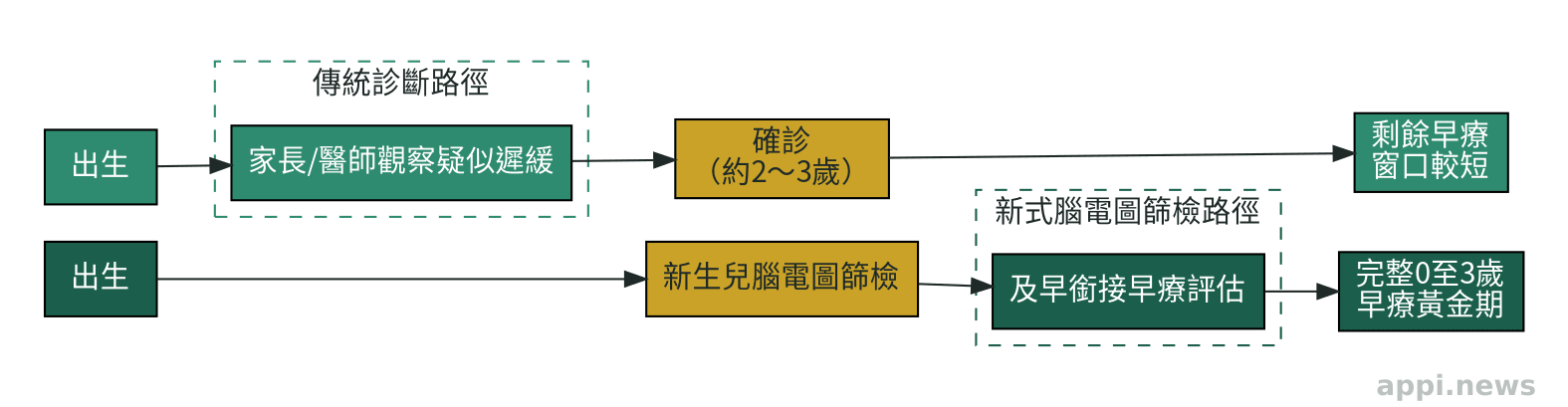
Screening and diagnosis answer different questions
The 2026 study used a standardized score cutoff to identify children with lower measured language performance. That can support screening research, but it does not determine why a child scored below the cutoff. Hearing, broader development, health, home language and the assessment itself can all affect how a result is interpreted in clinical practice.
All children included in the analysis had passed newborn hearing screening and had no reported major medical conditions. The findings therefore do not establish performance in children who already have hearing loss, genetic syndromes or severe fetal growth restriction. The authors said those children warrant closer developmental monitoring regardless of the EEG result.
Cross-language evidence remains missing
The Chinese University of Hong Kong said in 2021 that the test had been developed for Cantonese and Mandarin communities and that researchers were working with overseas universities to examine English-language performance. The 2026 paper still reported a Hong Kong cohort of Chinese-language learners rather than a multilingual or multinational validation.
The speech stimuli included two native sounds and one non-native sound. Models built separately for each stimulus produced AUC values above 0.85 in nested validation, but that result does not show that a model trained in one language will preserve its performance in another.
Commercial interests and deployment are unresolved
The 2026 paper disclosed that several authors hold patents associated with the research. Lead author Patrick Wong also founded Foresight Language and Learning Solutions Limited, a company developing the technology with support from a Hong Kong government university startup program. These disclosures do not invalidate the results, but independent replication would provide a stronger test of the model.
The published studies establish research performance, not routine availability. APPI News could not verify a clinical deployment program or regulatory status for the test in any country at the time of writing. Health systems would also need to determine who should be screened, how results should be communicated and whether earlier identification leads to better outcomes.
What the evidence supports
The newer study shows that speech-response EEG contains information associated with later language scores and that a model retained strong discrimination in a held-out Hong Kong sample. It does not show that the test can diagnose language disorder at birth, work equally well across languages or replace developmental assessment.
The distinction matters because a promising screening result and a clinical diagnosis serve different purposes. Further validation across languages, healthcare settings and children with a wider range of medical backgrounds is needed before the reported performance can be generalized.
Sources and further reading
- Speech Auditory Brainstem Response to Predict Language Delay(Pediatrics via PubMed)
- Neural Speech Encoding in Infancy Predicts Future Language and Communication Difficulties(American Journal of Speech-Language Pathology via PubMed)
- A 30-minute EEG Test Forecasts Children’s Language Development(The Chinese University of Hong Kong)