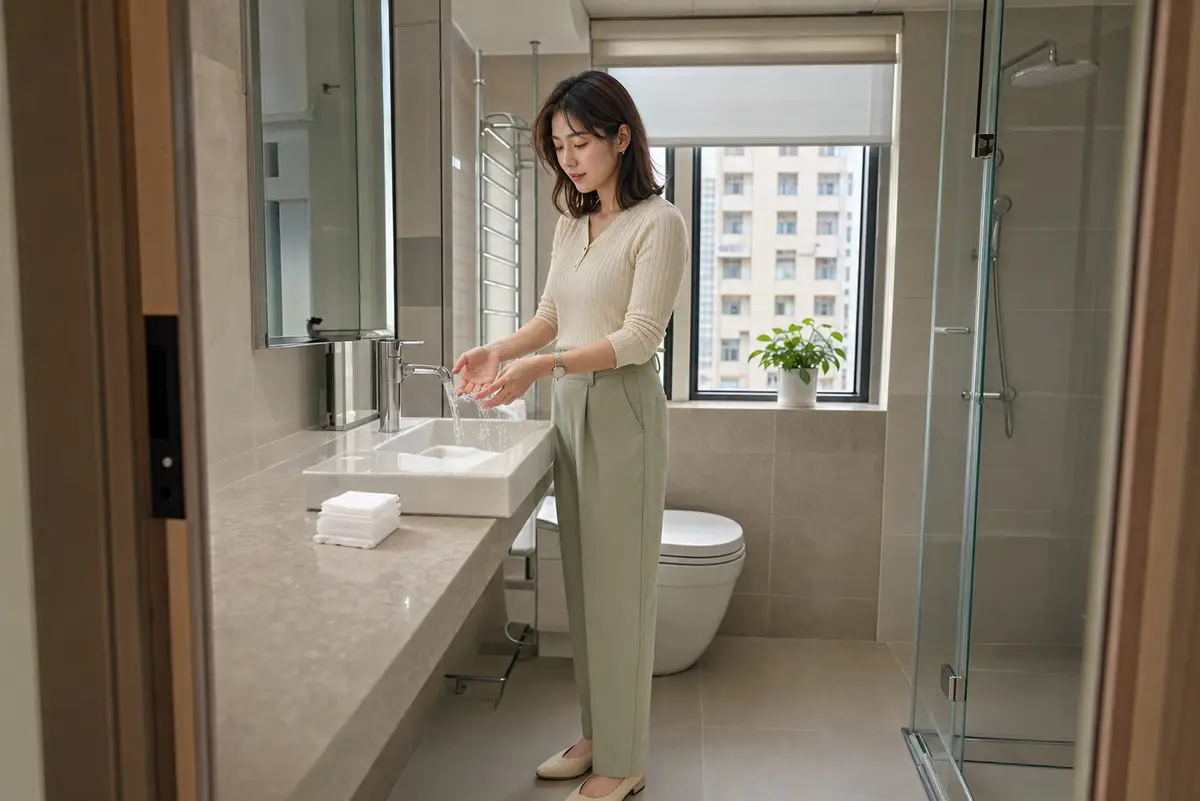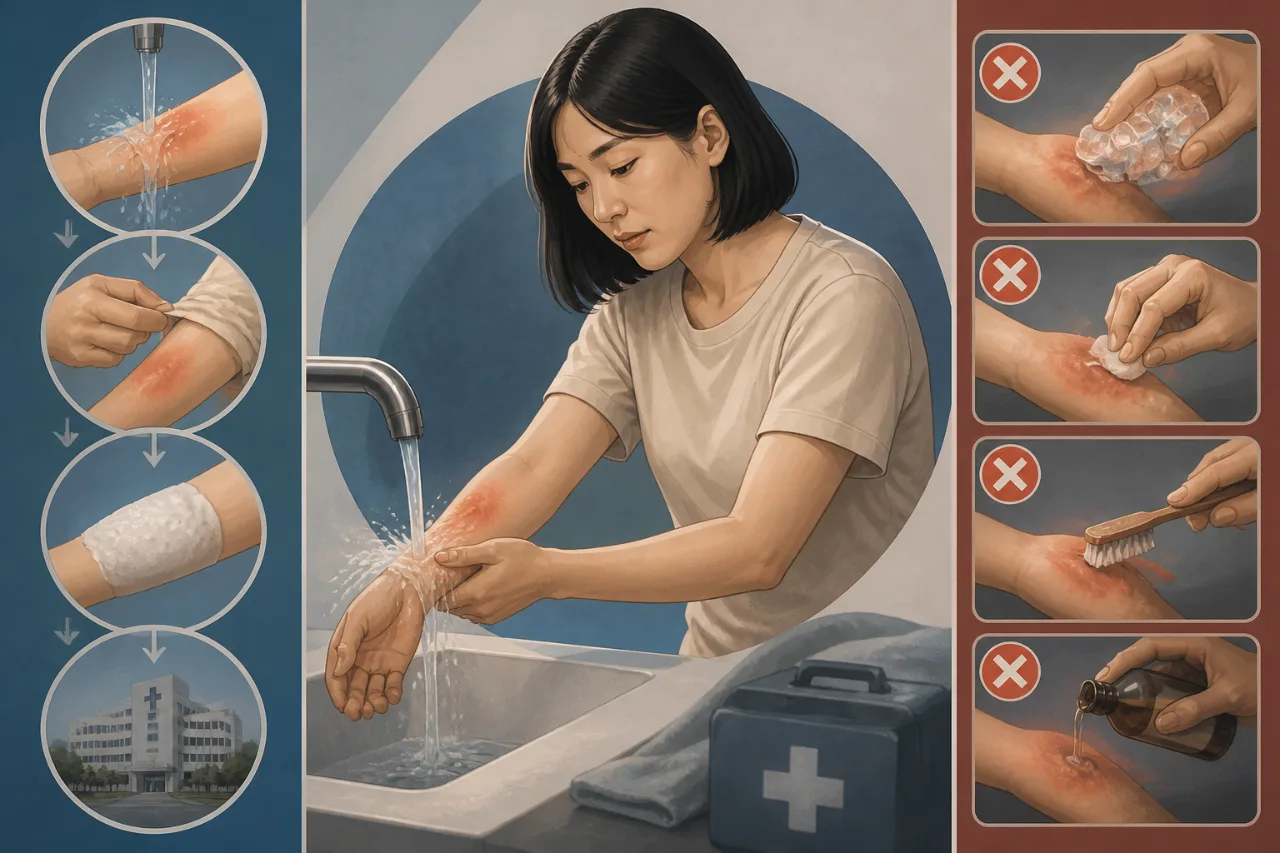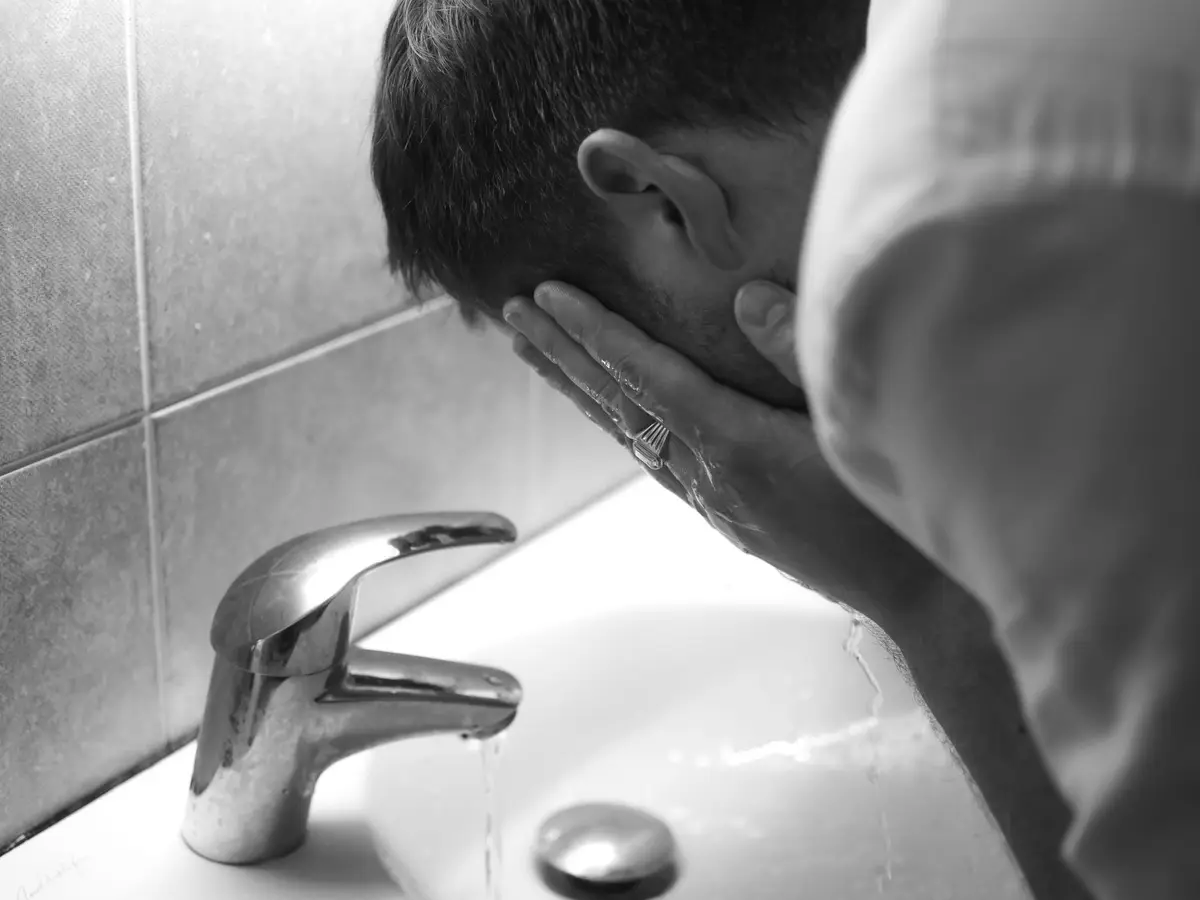
The 2024 US first-aid guidelines from the American Heart Association (AHA) and American Red Cross call for immediate irrigation after chemical exposure to an eye and advise copious tap water for 15 minutes unless local guidance says otherwise. The guidelines also say contaminated water must be kept away from the other eye, nearby skin and other people.
England's National Health Service (NHS) and Healthdirect Australia both use a 20-minute target. Start the water before looking up ingredients, and continue rinsing while urgent help is arranged for a strong or unidentified product or when warning signs appear. The duration is a practical target, not a universal safe stopping point.
Strong chemicals and sight changes need emergency care
Call the local emergency medical service while rinsing after exposure to a strong chemical such as oven cleaner or bleach. England's NHS also lists any sight change, severe eye pain, headache or light sensitivity, nausea or vomiting, inability to move or keep the eye open, and blood or pus from the eye as reasons for immediate emergency care.
Healthdirect Australia takes a broader position, directing anyone with a chemical in the eye to an emergency department or ambulance and identifying worsening pain, blurred or lost vision, black spots, blood and colored discharge as urgent warning signs. That route applies in Australia; readers elsewhere should use the emergency service where they are located.
Do not drive when pain or impaired sight could make travel unsafe. Have another person retrieve the product container, label or workplace Safety Data Sheet (SDS) while rinsing continues, because identifying the substance must not delay irrigation.

Use gentle running water and protect the unaffected eye
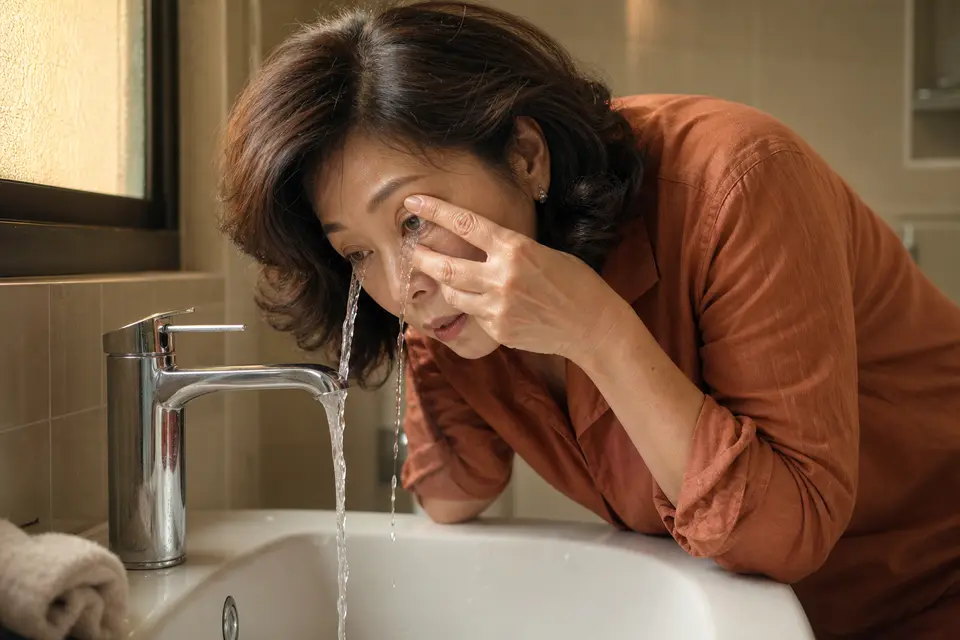
The NHS says to use clean water that is not hot, hold the eye open, run plenty of water over it for at least 20 minutes and keep the flow from becoming too strong. A tap, shower or clean bottled water can provide the flow when no eyewash station is available.
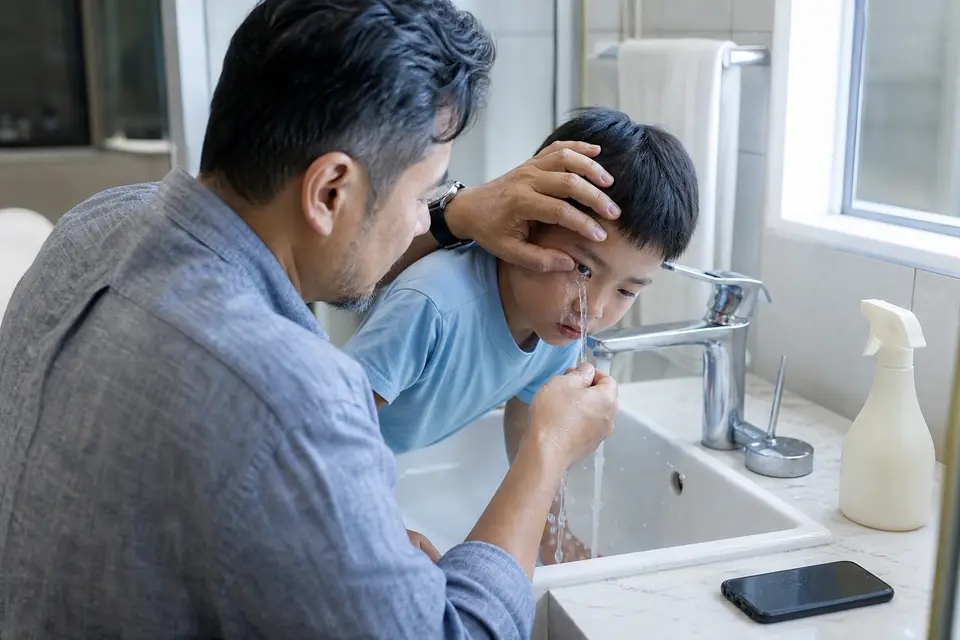
Healthdirect advises tilting the head back and toward the injured side, holding the eyelids open and flushing with cool water for 20 minutes without letting runoff enter the unaffected eye. Keep the stream gentle and directed across the eye rather than using a high-pressure jet against the eyeball.
Canada's national occupational health and safety center, the Canadian Centre for Occupational Health and Safety (CCOHS), says water flushing must begin immediately and that Section 4 of a hazardous product's SDS should contain product-specific first-aid instructions. Another person can locate those instructions after irrigation has started.
Contact-lens removal comes after the water starts
CCOHS says to start flushing immediately, remove contact lenses as soon as possible and never delay irrigation while trying to take them out. A lens that releases easily can come out during rinsing, followed by continued water flow.
Healthdirect advises trying to remove contact lenses after chemical exposure. If a lens does not release without force, continue irrigating and tell the responding clinician rather than repeatedly pinching or pulling at the eye.
Rubbing and household neutralizers can add injury
The NHS says not to touch or rub an injured eye, and Healthdirect says not to put unprescribed drops, ointments or medicines into it. Rubbing, wiping with a towel or probing under the eyelids does not replace continuous irrigation.
CCOHS warns that trying to neutralize an acid with a base, or a base with an acid, can delay irrigation, generate heat during the reaction and expose the eye to another damaging substance. Do not add vinegar, baking soda or another household chemical; begin with water and follow verified product instructions or clinical direction.
First aid for skin burns follows a different sequence and should not be used as a substitute for open-eye irrigation. A chemical eye splash follows the eye-specific steps in this guide.

Children and other higher-risk groups need separate judgment
Children
Australia's Royal Children's Hospital Melbourne says strong acid or alkali eye exposures in children require immediate copious irrigation and that every chemical burn should be discussed with an ophthalmologist. A child may need adult help to keep the eyelids open and maintain a gentle stream. If irrigation cannot continue safely, obtain emergency help; England's NHS also sets a lower threshold for urgent advice when a child has an eye injury.
Pregnancy
APPI News could not find a separate initial irrigation method for pregnancy in the cited guidance at the time of writing. Begin water irrigation immediately, then tell the treating clinician about the pregnancy so any further examination or medicine decision can be individualized.
Chronic illness and regular medicines
The cited guidance does not publish a different initial home-rinsing sequence for chronic illness or regular medicine use. Take a current medicine list or the medicine containers to clinical assessment, and leave decisions about eye drops or other treatment to the clinician.
How this plays out outside Taiwan
The first minutes are similar across countries, but the route to expert help depends on the health system where the exposure happens. The product label and the local poison service are more useful than a generic internet search because cleaning products differ by formulation, concentration and intended use. Keep rinsing while another person identifies the container, unless a local emergency dispatcher gives a different instruction.
In the United States, Poison Control says to irrigate an exposed eye immediately with room-temperature water for at least 15 to 20 minutes, then use webPOISONCONTROL or call 1-800-222-1222 for case-specific guidance. The service says its expert help is free, confidential and available around the clock. That number is for poison advice in the United States, not a universal international line. If the person collapses, has a seizure, has trouble breathing or cannot be awakened, Poison Control directs callers to 911 instead. Severe pain or visual problems after rinsing also call for urgent eye assessment, even when a poison specialist is available by phone.
In England, the National Health Service directs people with a strong chemical such as bleach or oven cleaner in the eye to an accident and emergency department or 999, while rinsing continues. Its public guidance also lists changes in sight, severe pain, headache or light sensitivity, nausea or vomiting, inability to move or open the eye, and blood or pus as reasons for emergency care. For a less urgent concern after an eye injury, the NHS route is 111 or an optometrist. Those numbers belong to England's system; readers in Scotland, Wales or Northern Ireland should use the emergency and urgent-care routes published by their own national health service. A traveler should not assume that a US poison-center number or NHS 111 will work abroad.
Australia separates emergency transport from poison advice. Healthdirect Australia says to call triple zero (000) for a harmful-substance exposure when someone stops breathing, collapses, has a seizure or has a severe allergic reaction, and to call the Poisons Information Centre on 13 11 26 for exposure advice when it is not an immediate medical emergency. The line is available Australia-wide, including for eye exposure, and the service recommends taking the product container or a clear photograph when seeking care. A person with blurred vision or severe pain should not drive to an emergency department. Ask another adult to call, bring the label and keep the affected eye away from the unaffected eye as rinsing continues.
Canada's workplace guidance is especially relevant when the splash occurs at a job site. The Canadian Centre for Occupational Health and Safety says an emergency eyewash must be reached immediately, flushing must start at once, and Section 4 of the product's Safety Data Sheet should contain first-aid information. A workplace eyewash station is useful only if it can deliver a gentle, continuous flow without making the worker search for paperwork first. Employers should make the station accessible and train workers to report the incident; the exposed person should not delay the rinse to complete an incident form. If the product is unidentified, bring the label or Safety Data Sheet to the clinician rather than trying to infer whether it was acidic or alkaline.
Rules about transport, poison-center calls and specialist eye care are local, but they do not change the first priority: water should reach the eye promptly. A local emergency operator can tell a caller whether an ambulance is appropriate, and a poison service can interpret the exact product after irrigation has begun. If the country has no public poison line, use the emergency number or the product manufacturer's published emergency contact. Do not use a number copied from a different country, and do not assume that a household cleaner sold under the same brand has the same ingredients everywhere. The label, Safety Data Sheet and local emergency service are the documents to check.
Twenty minutes is a target, not a universal stopping rule
The 2024 US AHA and American Red Cross guideline uses 15 minutes unless local guidance says otherwise, while the NHS and Healthdirect use 20 minutes. The US guideline says studies comparing different irrigation durations are not available and bases its 15-minute recommendation on an observational study and an animal experiment.
The 20-minute figure is therefore a practical minimum from the cited English and Australian public guidance, not proof that every chemical has been cleared at that point. Continue rinsing when an emergency dispatcher, poison specialist, product label or SDS calls for longer, and do not cancel medical assessment because pain briefly eases.
Frequently asked questions
What should happen first after a cleaning product reaches an eye?
Begin a gentle flow of clean, cool or lukewarm water immediately and hold the eyelids open. Product identification, contact-lens removal and calls for help can proceed without stopping the rinse.
Can vinegar or baking soda neutralize the product?
No household acid or base should be added to the eye. CCOHS warns that neutralization can delay water, release heat and cause injury from the second substance.
What if a contact lens will not come out?
Keep rinsing and stop repeated forceful attempts to remove it. Tell emergency or eye-care clinicians that the lens remains in place so they can assess the surface and remove it safely.
Does feeling better after 20 minutes rule out an injury?
No. Product strength, concentration and contact time vary, and symptom relief cannot establish that the eye surface is unharmed or that irrigation is complete.
Sources and further reading
- 2024 American Heart Association and American Red Cross Guidelines for First Aid(American Heart Association and American Red Cross (United States))
- Eye injuries(National Health Service in England)
- Objects or chemicals in the eye(Healthdirect Australia)
- Emergency showers and eyewash stations(Canadian Centre for Occupational Health and Safety)
- Clinical Practice Guidelines: Acute eye injury(Royal Children's Hospital Melbourne (Australia))
- Get help for a poisoning(Poison Control (United States))
- Poisoning(Healthdirect Australia)