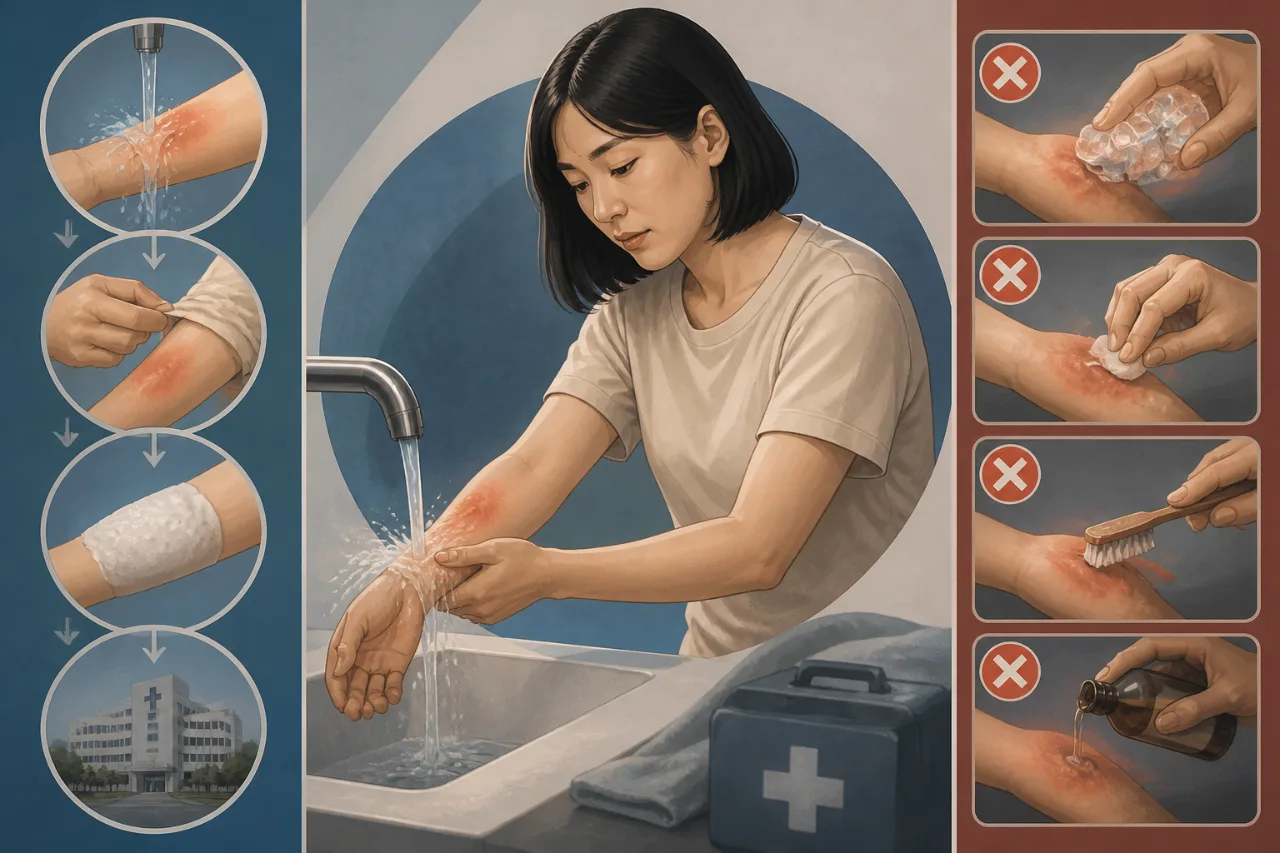
The International Federation of Red Cross and Red Crescent Societies (IFRC) advises cooling a thermal burn under clean running water for at least 10 minutes and ideally 20 in its 2025 guidelines. Australia's New South Wales Agency for Clinical Innovation uses a 20-minute target, giving bystanders a clear first step after a burn from hot liquid, steam, flame or a hot surface.
Cooling should begin as soon as the scene is safe, before creams or household remedies are considered. Loose clothing and jewelry near the injury should come off before swelling develops, but material stuck to the skin should remain in place and the rest of the body should be kept warm.
Breathing problems, deep burns and high-risk locations need urgent help
Call the local emergency medical service immediately if the person becomes unresponsive, is not breathing normally or has trouble breathing. Burns involving the face, mouth or throat also need emergency assessment because the airway may be affected. Follow the dispatcher's instructions while monitoring responsiveness and breathing.
Australia's government-funded Healthdirect service lists a burn larger than the injured person's hand, brown, black, white or leathery skin, and burns of the face, hands, feet or genitals among reasons to call an ambulance. A serious fall, crash or other injury at the same time raises the urgency.
The IFRC also directs people to emergency medical care for large or deep burns and burns caused by chemicals, electricity or flames. Blistered burns should be left intact and assessed by a clinician, while a burn in a baby or another vulnerable person warrants prompt medical advice even if it appears small.
Cool a thermal burn with running water before covering it
Move the person away from the heat source without putting the rescuer in danger. Extinguish burning clothing with water or by having the person stop, drop, cover the face and roll. Do not delay cooling a thermal burn while trying to name its depth.
The New South Wales Agency for Clinical Innovation's February 2026 guide calls for cool running tap water for 20 minutes and says cooling can still help within three hours of the injury. Let the water flow over the injured area, and do not use ice or ice water. Keep uninjured skin dry and warm to limit heat loss.
Remove rings, watches, belts, diapers and loose clothing near the burn, but do not pull away fabric or another material that has adhered to the skin. England's National Health Service (NHS) advises 15 to 30 minutes of cool running water, followed by plastic wrap laid over the cooled burn rather than wound around it. A clean, dry, non-fluffy, non-stick covering is an alternative, and any covering should remain loose as swelling develops.
The timing should not be treated as a sharp cutoff. The IFRC evidence review rated the cooling evidence as low or very low certainty and concluded that comparative studies do not establish one optimal duration. The 20-minute figure is a practical target within the cited public guidance, not a precisely proven universal threshold.
Ice, creams and broken blisters can interfere with care
The World Health Organization (WHO) advises against ice, paste, oil, raw cotton and topical medication before appropriate medical care. Ice can deepen tissue injury, while prolonged whole-body cooling can cause hypothermia.
Do not apply toothpaste, soy sauce, butter, lotion or another kitchen or bathroom product to a fresh burn. These products do not replace running-water cooling and can contaminate the wound.
Do not deliberately burst a blister or peel away loose skin. WHO and the IFRC advise leaving blisters intact, and the IFRC recommends medical advice when blisters develop. A clinician can decide whether a blister needs a procedure or a specific dressing.

Chemical and electrical burns require a separate safety check
Contact the local emergency service immediately for a suspected chemical burn and protect the rescuer from contact. England's NHS advises wearing gloves, removing contaminated clothing when possible, brushing dry chemicals off the skin and rinsing with large amounts of cool or lukewarm running water for about one hour. Follow the product's safety information and instructions from emergency or poison specialists, and do not try to neutralize one chemical with another.
Do not touch a person who may still be connected to an electrical source, and do not bring water near live electricity. Switch off the supply if this can be done safely and call the local emergency service. Healthdirect Australia says an electric shock can cause hidden internal injury and recommends medical assessment even when the shock appears mild.
Children, pregnancy and chronic illness change the care threshold
Babies and children
Cool only the injured area and keep the rest of the child covered, because young children lose body heat quickly. England's NHS child guidance calls for 20 to 30 minutes of cool running water, warns against ice or very cold water and says to keep the child warm. Obtain prompt pediatric advice for a baby, a young child, a large burn, blistering or any uncertainty about severity.
Pregnancy
APPI News could not find a separate thermal-burn cooling sequence for pregnancy in the cited sources at the time of writing. A pregnant person should contact a maternity or medical clinician promptly and follow instructions from the local emergency dispatcher when urgent help is needed. Decisions about pain relief or other medicines should be made with that clinician rather than inferred from general adult guidance.
Chronic illness and regular medicines
The IFRC identifies a person with diabetes as vulnerable and advises medical review rather than relying only on home assessment. APPI News could not verify separate cooling steps for other chronic illnesses or regular medicine use in the cited sources. People in these groups should contact a clinician promptly, take a current medicine list to medical care and not start, stop or change a medicine as part of first aid.
Reassess the burn after cooling
Size, depth, location, cause and the injured person's age all affect severity, and a blister alone does not establish the full depth of a burn. Do not rely on a photograph or one visible feature to rule out a deeper injury. If the burn is not clearly small and superficial, arrange clinical assessment.
Seek prompt medical advice if warmth or pain around the burn increases or fever develops. These changes require assessment rather than another household treatment.
Frequently asked questions
Should a thermal burn be cooled with water or ice?
Use cool running water and aim for 20 minutes. Do not place ice or ice water on the injury, and keep uninjured parts of the body warm.
Should clothing come off before cooling starts?
Start cooling promptly and remove loose clothing, diapers and jewelry near the burn. Leave anything stuck to the skin in place so removal does not cause more damage.
Can a burn blister be opened at home?
No. Leave the blister intact and seek medical advice, because a clinician should decide whether it needs drainage, removal or a particular dressing.
Can toothpaste, soy sauce or butter be put on a burn?
No. Cool running water comes first, and WHO advises against paste, oil and topical medication before appropriate medical care.
Do chemical and electrical burns follow the same sequence?
No. Both require scene safety and urgent professional advice; chemical exposure needs prolonged irrigation, while live electricity must be disconnected before anyone approaches or uses water.
Sources and further reading
- International first aid, resuscitation and education guidelines 2025(International Federation of Red Cross and Red Crescent Societies)
- Burns(World Health Organization)
- Burn first aid(New South Wales Agency for Clinical Innovation)
- Burns and scalds(National Health Service in England)
- What to do if your child has an accident(National Health Service in England)
- Acid and chemical burns(National Health Service in England)
- Fire safety in your home(Healthdirect Australia)
- Electric shocks and burns(Healthdirect Australia)