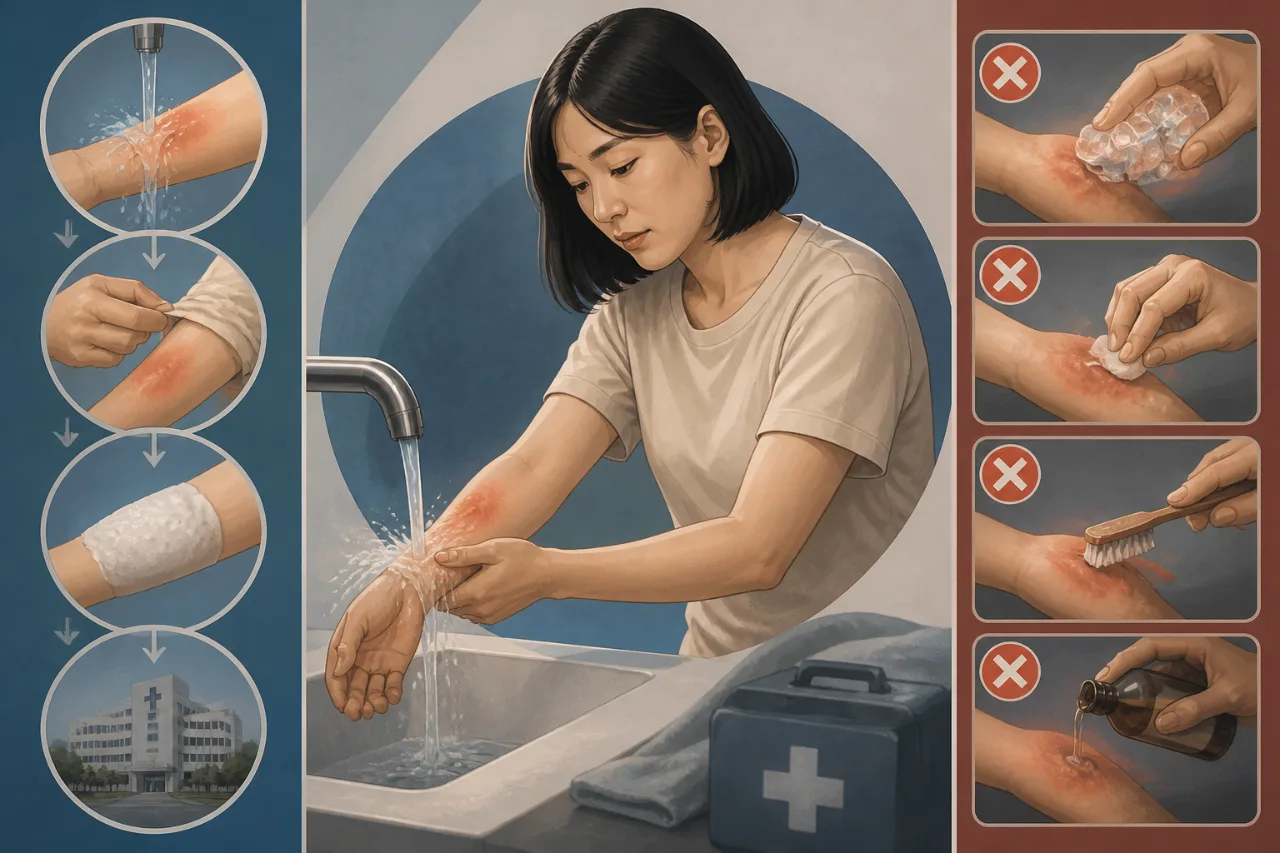
England's National Health Service (NHS) last reviewed its cuts-and-grazes guidance on April 2, 2026, and lists three core steps for a small wound: control bleeding, rinse with water and apply a clean dressing. That sequence is meant for a superficial injury with no embedded object and bleeding that can be controlled.
Healthdirect Australia likewise advises firm pressure, clean water or saline and a non-stick dressing for a minor wound. Deep, gaping, contaminated or bite wounds need medical assessment, while severe or spurting bleeding calls for the local emergency service.

Severe bleeding and hidden damage need urgent care
Healthdirect Australia tells people to call an ambulance for severe or spurting bleeding, faintness, confusion, shortness of breath or loss of consciousness. Keep firm pressure on the wound while help is arranged, unless an embedded object makes direct pressure unsafe.
MedlinePlus, a service of the US National Library of Medicine, says severe bleeding that has not stopped after 10 minutes of direct pressure requires the local emergency number. Do not use that timing to delay help when bleeding is already heavy, spurting or accompanied by reduced consciousness.
England's NHS directs people to emergency care for very large or deep wounds, serious cuts on the face or palm, loss of feeling, impaired movement or an embedded object such as glass. Do not pull out an embedded object; press on either side of it without pressing directly on the object.
Seek prompt medical assessment for a human or animal bite, a deep puncture, a gaping wound, a wound that remains dirty after rinsing or an uncertain tetanus vaccination history. Healthdirect also lists increasing pain, redness, swelling, warmth, pus, fever or failure to improve after about five days as warning signs that need clinical review.

Clean a minor wound in three stages
1. Wash hands and control bleeding
The US-based American Academy of Dermatology (AAD) advises washing the hands with soap and water before treating a minor cut. Place clean gauze or a folded clean cloth over the wound and hold firm pressure until the bleeding stops.
Keep the first pad in place while holding pressure. If blood comes through, England's NHS advises placing another bandage or cloth on top and continuing pressure.
2. Rinse, then remove only loose debris
After bleeding has stopped, England's NHS advises rinsing a small wound with bottled or tap water and cleaning the surrounding skin with soap and water. Pat the area rather than scrubbing the open surface.
Healthdirect Australia includes clean water or saline and allows clean tweezers or a clean cloth for loose dirt or debris. MedlinePlus says not to push or pick at debris and not to remove a deeply stuck object.
3. Cover and monitor the wound
England's NHS advises patting the area dry, applying a sterile dressing or plaster and keeping the covering clean and dry. Replace it whenever it becomes wet, dirty or loose.
Look for increasing redness, swelling, warmth or pain, pus, fever or a red streak extending from the wound whenever the dressing is changed. MedlinePlus lists those changes as signs that require prompt medical contact.

Hydrogen peroxide and antiseptic creams are not routine steps
England's NHS home-care sequence uses water, drying and a clean dressing, while Healthdirect Australia says antiseptic creams are not needed for routine minor-wound care. Neither sequence makes alcohol, iodine or hydrogen peroxide a standard step.
The AAD advises cleaning with soap and water and warns that hydrogen peroxide can further damage skin. This does not set the treatment for bites, punctures, surgical wounds, chronic wounds or wounds already under clinical care; a clinician may choose a different cleaning method, closure or medicine for those injuries.
Official consumer guidance is not uniform on topical antibiotic ointment. MedlinePlus includes antibacterial ointment in its minor-cut steps, while the AAD tells readers not to apply topical antibiotics; this guide therefore makes no topical product recommendation.

Bites, punctures and contaminated wounds need a tetanus check
The US Centers for Disease Control and Prevention's June 2025 guidance classifies penetrating or puncture wounds and wounds containing dirt, soil, feces or saliva, including animal and human bites, as dirty or major wounds. It tells clinicians to assess the wound and vaccination history before deciding whether tetanus vaccination or tetanus immune globulin is indicated.
The CDC document is US clinical guidance, not a universal vaccination timetable. A clinician should apply the tetanus schedule and care pathway used in the country where treatment is provided, especially when the vaccination history is unknown or incomplete.
Healthdirect Australia advises medical review for any human or animal bite and for a wound that is dirty, deep or difficult to clean. Washing remains a first-aid step, but it cannot settle the need for vaccination, wound closure or other clinical treatment.
The World Health Organization calls for early medical management after an animal bite and advises washing a dog-bite wound with soap and running water for 15 minutes. That 15-minute instruction is specific to dog bites and should not be treated as a universal rinsing time for ordinary cuts.
Children, pregnancy, diabetes and regular medicines change the threshold
Children
Healthdirect applies its minor-wound sequence to adults and children and uses the same referral signs for a child whose wound will not stop bleeding, is dirty, is deep or follows a bite. Those injuries need clinical assessment rather than an extended attempt at home cleaning.
Pregnancy
APPI News could not find a separate pregnancy-specific minor-wound cleaning sequence in the cited national guidance at the time of writing. A pregnant person considering a pain medicine, ointment or antiseptic should ask a clinician or pharmacist, while severe bleeding and the other urgent signs above still require immediate help.
Diabetes or severe immunodeficiency
Healthdirect advises people with diabetes to discuss wound care with a health professional because foot wounds can go unnoticed and may heal more slowly. The US CDC also makes severe immunodeficiency part of a clinician's tetanus immune globulin assessment for dirty or major wounds.
Blood-thinning medicines and other regular medicines
Healthdirect advises ambulance care when a deep wound continues to bleed under pressure in a person taking blood-thinning medicine. Take a current medicine list to urgent care, and do not stop or change a regular medicine as part of first aid unless a treating clinician directs it.

Common errors can make assessment harder
MedlinePlus warns against assuming that a wound is clean because no debris is visible, breathing on an open wound, probing for debris or removing a deeply embedded object. Rinse a minor wound, but leave deep material in place for medical assessment.

Frequently asked questions
What comes first, stopping the bleeding or rinsing?
Control active bleeding with firm pressure before rinsing a minor wound. Call the local emergency service if the bleeding is severe, spurting or will not stop.
Does every small cut need a disinfectant?
No routine antiseptic appears in the cited NHS or Healthdirect sequence for a small, clean wound. Water, gentle drying and a clean dressing are the basic steps, and the AAD warns against hydrogen peroxide.
Which wounds need a tetanus assessment?
Punctures, bites and wounds contaminated with soil, feces or saliva need clinical review, particularly when the vaccination history is unknown or incomplete. The clinician should use the schedule in the country where care is given.
When should a dressing be changed?
Replace it whenever it becomes wet, dirty or loose, and keep the wound covered while it remains open. Increasing pain, redness, warmth, swelling, pus or fever calls for medical assessment.
Sources and further reading
- Cuts and grazes(National Health Service in England)
- Wounds, cuts and grazes(Healthdirect Australia)
- Cuts and puncture wounds(MedlinePlus, US National Library of Medicine)
- Clinical Guidance for Wound Management to Prevent Tetanus(US Centers for Disease Control and Prevention)
- Animal bites(World Health Organization)
- How to treat minor cuts(American Academy of Dermatology, United States)
- Scars: Overview(American Academy of Dermatology, United States)