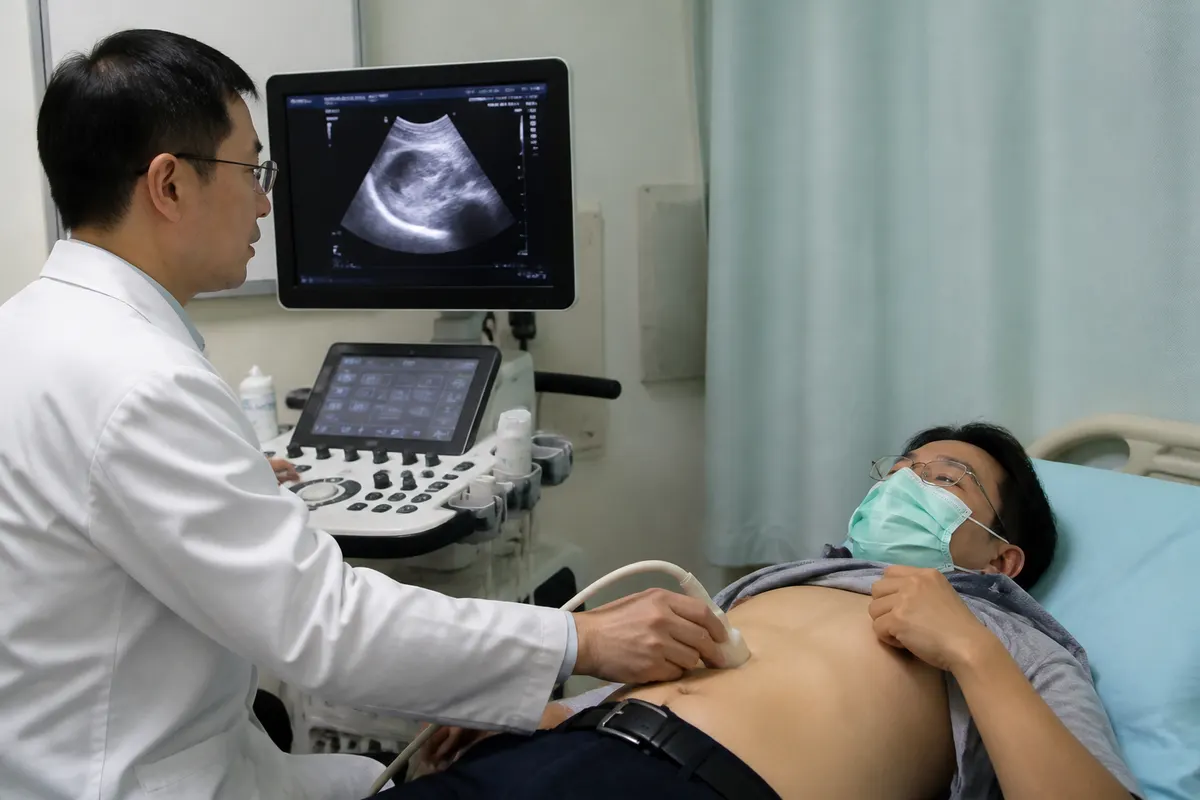
A 2026 analysis of three population cohorts found that lean adults with metabolic dysfunction-associated steatotic liver disease (MASLD) had higher relative rates of liver-related events and death than non-lean patients. The finding challenges the use of body weight as a shortcut for liver risk, but it does not show that being lean causes the disease or predicts an individual outcome.
Normal alanine aminotransferase (ALT) and aspartate aminotransferase (AST) results do not exclude fatty liver or advanced fibrosis. Current guidance uses metabolic risk, combined blood-test scores and, when indicated, liver stiffness imaging rather than a single enzyme result.
Vomiting blood, black stools or sudden confusion needs emergency care
Fatty liver often causes no acute symptoms. Vomiting blood, black tar-like stools, sudden confusion, faintness, cold clammy skin or rapid shallow breathing can indicate severe bleeding or advanced liver complications and needs immediate medical help. The United Kingdom's National Health Service says anyone vomiting blood with confusion, faintness, breathing changes, abdominal pain or black stools should call the emergency service or go to an emergency department.
New jaundice, a rapidly swelling abdomen or marked drowsiness also needs prompt clinical assessment. These signs have several possible causes and should not be attributed to MASLD without examination.

MASLD puts metabolic risk into the diagnosis
The terminology changed in June 2023 through a multinational liver-society process. The American Association for the Study of Liver Diseases says steatotic liver disease became the umbrella term, MASLD replaced nonalcoholic fatty liver disease, and MASH replaced nonalcoholic steatohepatitis. MASLD requires liver fat plus at least one of five cardiometabolic risk factors.
The new name does not mean alcohol has become irrelevant, and it does not turn MASLD into a diagnosis based on weight alone. Clinicians still need to consider alcohol exposure, medicines, viral hepatitis and other causes of liver fat or injury.
Lean fatty liver is common enough to miss
A 2020 meta-analysis of 53 studies estimated lean fatty liver prevalence at 11.2 percent in the general populations studied and found that lean adults accounted for 25.3 percent of fatty liver cases. The studies used the older NAFLD definition and different body mass index cutoffs, so those estimates should not be treated as a single worldwide rate under the newer MASLD criteria.
Compared with healthy lean adults, the lean fatty liver group had more insulin resistance and other metabolic abnormalities. Body mass index does not measure visceral fat, fat distribution or genetic susceptibility, which helps explain why a normal weight cannot rule out liver fat.
The longer-term prognosis is still being defined. A 2026 prospective analysis of 186,221 people with MASLD across the United Kingdom Biobank and two Chinese cohorts associated lean MASLD with hazard ratios of 2.14 for liver-related events and 2.31 for liver-related death compared with non-lean MASLD. The study used a body mass index below 25 kilograms per square meter in the United Kingdom cohort and below 23 in the Chinese cohorts.
Those are relative rates from an observational analysis. The data do not provide one person's absolute probability, and differences between the groups may remain even after statistical adjustment.
Normal liver enzymes do not settle fibrosis risk
ALT and AST rise when liver cells are injured, but their values can remain within a laboratory's reference range in people with clinically important disease. The 2024 European multisociety guideline says combined blood scores or blood tests paired with imaging are more accurate for fibrosis detection than standard liver enzyme tests alone.
The guideline recommends case-finding for adults with type 2 diabetes, abdominal obesity plus another cardiometabolic risk factor, persistently raised liver enzymes or incidentally found liver fat. It starts with a validated blood-based score such as the fibrosis-4 index (FIB-4), followed when needed by liver elastography or another validated second-line test.
The American liver society's practice guidance says FIB-4 has limited accuracy in people younger than 35, requires a different threshold after age 65 and should not be used during acute illness. A clinician should interpret the score in context; calculating it at home does not diagnose fibrosis.
Lifestyle targets depend on starting weight
For adults with MASLD and overweight, the European guideline recommends sustained weight loss of at least 5 percent to reduce liver fat, 7–10 percent to improve inflammation and at least 10 percent to improve fibrosis. These are treatment targets supported by group-level evidence, not guaranteed outcomes.
The same weight-loss prescription should not be imposed on a normal-weight adult. The guideline reports little evidence that diet or exercise changes improve liver histology, fibrosis or liver-related outcomes in this group. It nevertheless advises normal-weight adults with MASLD to improve diet quality and exercise to reduce liver fat, with a tailored plan rather than an arbitrary low target weight.
For adults generally, the guideline favors a dietary pattern similar to a Mediterranean diet, less ultra-processed food and avoidance of sugar-sweetened drinks. It recommends exercise adapted to ability and preference, preferably more than 150 minutes a week at moderate intensity or 75 minutes at vigorous intensity.
The World Health Organization's January 2026 guidance limits free sugars to less than 10 percent of daily energy and counts sugars in honey, syrups, fruit juice and fruit-juice concentrate as free sugars. Intact fruit remains part of a healthy dietary pattern; the free-sugar limit should not be read as an instruction to eliminate fruit.
One US-approved medicine does not replace risk reduction
The US Food and Drug Administration approved resmetirom in March 2024 for adults with noncirrhotic MASH and moderate to advanced fibrosis, to be used with diet and exercise. The accelerated approval relied on liver-biopsy surrogate outcomes at 12 months, and a continuing 54-month study must verify clinical benefit.
This is not a medicine for every person with liver fat. It has a defined US indication, warnings and drug interactions, and treatment requires a clinician's judgment. Availability and regulatory status vary by country, and APPI News did not verify approval in every market.
Children, pregnancy and chronic illness need separate plans
Children and adolescents
The adult weight-loss percentages, FIB-4 pathway and resmetirom indication should not be applied to children. Growth, puberty and family nutrition change assessment and treatment, so a pediatric clinician should set the plan.
Pregnancy and breastfeeding
Pregnant or breastfeeding people should not pursue an adult weight-loss target or start a supplement or medicine for fatty liver without obstetric and liver-care advice. Nutrition must account for pregnancy, fetal growth or milk production.
Diabetes, kidney disease and prescribed medicines
People using glucose-lowering drugs, taking statins or living with kidney disease need an individualized plan. Dietary changes and weight loss can alter medicine needs, while kidney disease may change what constitutes a safe diet. Prescription medicines should be changed only by the treating team.

Frequently asked questions
Can a lean adult have MASLD?
Yes. MASLD depends on liver fat and cardiometabolic risk, not obesity alone. Visceral fat, insulin resistance and genetic susceptibility can be present at a normal body mass index.
Do normal ALT and AST results rule it out?
No. Enzyme values alone cannot exclude liver fat or fibrosis. Current guidance uses metabolic risk and staged non-invasive testing when assessment is indicated.
Does everyone with MASLD need to lose 7–10 percent of body weight?
No. That target applies to adults with overweight and is intended to improve liver inflammation. Normal-weight adults need a tailored diet and activity plan because evidence for deliberate weight loss in that group is limited.
Is an ultrasound enough to measure fibrosis?
A conventional ultrasound can detect some liver fat but does not reliably stage fibrosis. Guidelines use combined blood scores and liver-stiffness methods in a staged pathway, with further assessment when results are uncertain or risk remains high.
Can a supplement reverse fatty liver?
The sources cited here do not establish that any supplement reverses MASLD fibrosis. Supplements should not replace dietary, activity and metabolic-risk management or a clinician's treatment plan.
Is resmetirom available for any fatty liver diagnosis?
No. The cited US approval covers adults with noncirrhotic MASH and moderate to advanced fibrosis, alongside diet and exercise. Approval and availability outside the United States vary by country.
Sources and further reading
- New MASLD Nomenclature(American Association for the Study of Liver Diseases)
- EASL-EASD-EASO Clinical Practice Guidelines on the Management of MASLD(Journal of Hepatology via PubMed Central)
- AASLD Practice Guidance on the Clinical Assessment and Management of NAFLD(Hepatology via PubMed Central)
- Prevalence and Profile of NAFLD in Lean Adults(Hepatology Communications via PubMed Central)
- Long-term Prognosis of Lean MASLD(Gut via PubMed)
- Healthy diet(World Health Organization)
- Vomiting blood(United Kingdom National Health Service)
- FDA Approves First Treatment for Patients with Liver Scarring Due to Fatty Liver Disease(US Food and Drug Administration)