Hong Kong's Court of First Instance convicted the now-disbanded Hong Kong Alliance in Support of Patriotic Democratic Movements of China, Lee Cheuk-yan and Chow Hang-tung of inciting subversion on August 21, 2026. The Alliance was the organization behind the city's annual candlelight vigil commemorating victims of China's 1989 Tiananmen crackdown; former Alliance leader Albert Ho, who was charged in the same case, pleaded guilty earlier.
Article 23 of Hong Kong's National Security Law sets a maximum 10-year prison term for incitement to subversion. The court has not imposed sentences and scheduled a mitigation hearing for August 28, 2026.
The ruling turned on a call to end one-party rule
Reuters reported that the judges identified the defendants' repeated, peaceful use of the phrase “end one-party dictatorship,” rather than their other political actions or beliefs, as the conduct that breached the law. The panel found that the phrase called for the end of China's ruling Communist Party leadership and encouraged supporters to pursue that goal by unlawful means.
The judges said the defendants intended to erode confidence in the party by stirring hostility and division, with the objective of undermining the state system established by China's Constitution. Article 22 covers specified acts carried out by force, threat of force or other unlawful means to subvert state power, while Article 23 covers inciting or assisting others to commit those acts.
Article 23 divides punishment into two tiers. A case classified as serious carries five to 10 years in prison, while a minor case carries up to five years and has no mandatory minimum prison term; the court has not said which tier it will apply to these defendants.
Lee and Chow disputed the prosecution's reading
At the trial's opening on January 22, RTHK reported that prosecutors treated the call to end one-party rule as incitement to subvert state power; Lee and Chow pleaded not guilty, while Ho pleaded guilty. Chow, a barrister, represented herself.
Lee told the court that the demand meant moving toward a democratic system in which people decide who governs, while Chow argued that it meant ending unrestricted power rather than calling for an unlawful overthrow. The judges rejected their contention that the advocacy remained within lawful freedom of expression.
The vigil had drawn tens of thousands for three decades
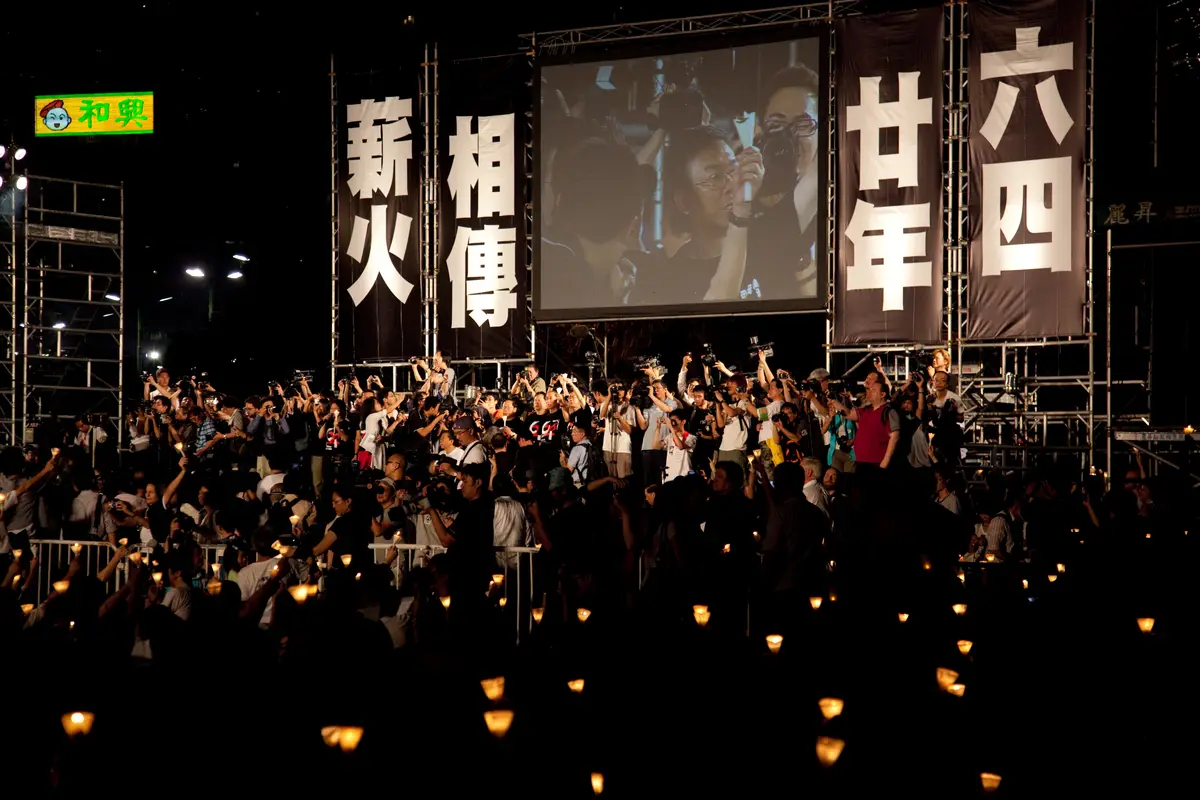
The Alliance organized a June 4 candlelight vigil in Hong Kong's Victoria Park for about three decades, drawing tens of thousands of people in some years. The gathering commemorated those killed when China's military suppressed pro-democracy protests in and around Beijing's Tiananmen Square in 1989.
Hong Kong police banned the organized vigil in 2020, citing public-health risks during the COVID-19 pandemic, weeks before China's central authorities applied the National Security Law to the territory. The Alliance dissolved in September 2021, and its mass vigil has not resumed.
Hong Kong and foreign governments take opposing positions
The Hong Kong Special Administrative Region government welcomed the convictions and said the court had decided the case on the law and evidence rather than the defendants' political views. Its account of the judgment said the defendants had encouraged others to act on the Alliance's political agenda.
The UK Foreign, Commonwealth & Development Office said the verdict showed that peaceful remembrance was being treated as a national-security threat and argued that use of the law undermined China's commitments under the 1984 Sino-British Joint Declaration. The foreign ministries of France and Germany said they deeply regretted Chow's conviction and called for her release.
Mitigation comes before sentencing
The court adjourned the case to August 28, 2026, for mitigation involving the Alliance, Lee, Chow and Ho. That hearing is not the sentencing itself, and no sentencing date had been announced at the time of writing.
APPI News could not locate the full reasons for verdict in Hong Kong's official public judgment database. The description of the court's reasoning above therefore relies on the Hong Kong government's published summary and courtroom reports from Reuters and the Associated Press.
Frequently asked questions
What were Lee Cheuk-yan and Chow Hang-tung convicted of?
They were convicted of inciting subversion under Article 23 of Hong Kong's National Security Law. The corporate defendant, the Hong Kong Alliance, was convicted of the same charge.
Have they been sentenced?
No. The court scheduled mitigation for August 28, 2026, and the law sets 10 years as the maximum rather than an automatic sentence.
Did the court rule that every Tiananmen commemoration is illegal?
The sources used for this report do not establish such a broad ruling. The judgment concerned the Alliance's political slogan and conduct attributed to these defendants after the National Security Law took effect.
Sources and further reading
- HK Alliance must face justice: CE(Hong Kong Special Administrative Region Government)
- Annotations of the Hong Kong National Security Law and sedition offences in the Crimes Ordinance(Hong Kong Department of Justice)
- Hong Kong court convicts Tiananmen vigil group leaders of inciting subversion(Reuters)
- 2 organizers of Hong Kong's Tiananmen vigils convicted in national security case(Associated Press)
- Subversion trial opens for alliance and ex-leaders(RTHK)
- Response to the Hong Kong Alliance leaders' national security law verdict(UK Foreign, Commonwealth & Development Office)
- Joint statement by the spokespeople for the foreign ministries of France and Germany concerning the verdict against Chow Hang-tung(France Diplomatie)