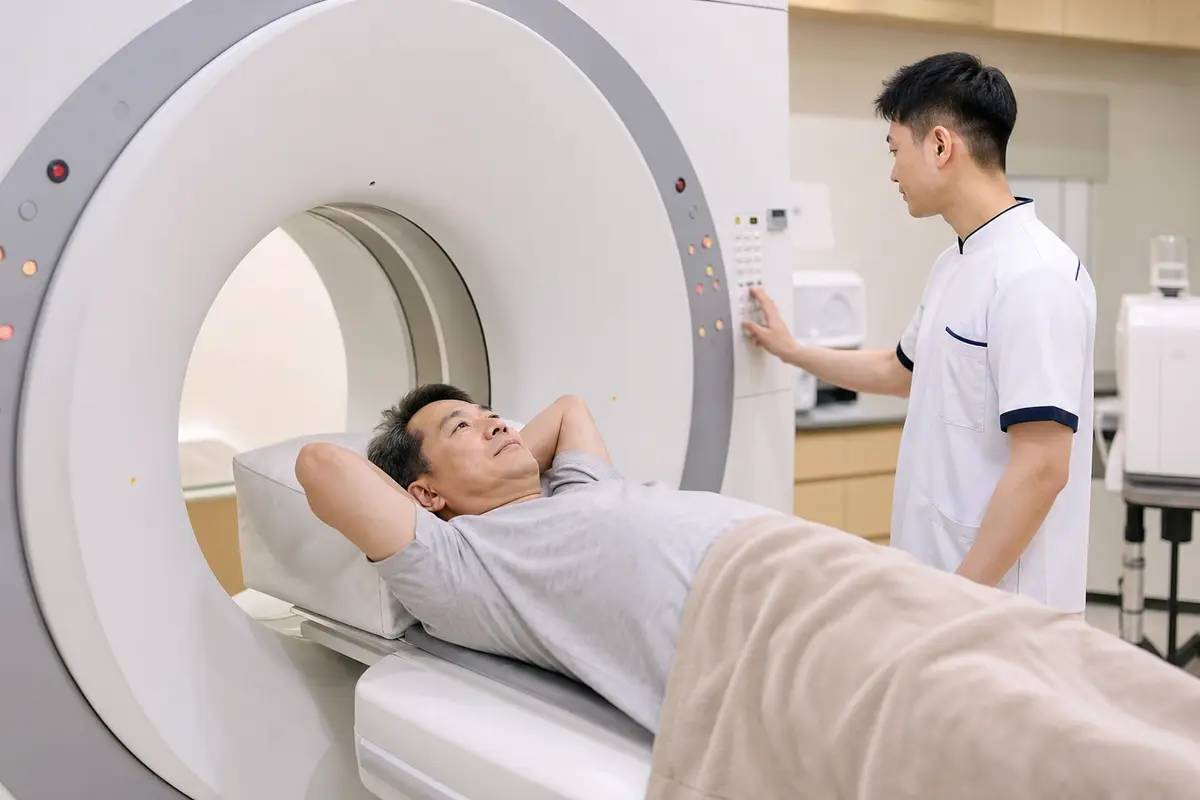
The fifth European Code Against Cancer recommends organized low-dose computed tomography (LDCT) screening for adults aged 55 to 74 who have a higher risk of lung cancer, typically because of a smoking history. It says annual screening is preferred and advises against intervals longer than two years.
The recommendation is not a worldwide eligibility rule. National programs use different ages, smoking thresholds and follow-up schedules, and the evidence of benefit must be weighed against false positives, repeat imaging, invasive procedures, radiation exposure and overdiagnosis.
Symptoms need diagnostic assessment rather than screening
Screening is intended for people without signs or symptoms of lung cancer. England's National Health Service advises medical assessment for a cough lasting more than three weeks, a long-standing cough that worsens, recurrent chest infections, coughing blood, persistent breathlessness, unexplained weight loss or pain when breathing or coughing. These symptoms have many possible causes and do not establish a cancer diagnosis.
Coughing blood with breathing trouble needs emergency care
England's National Health Service advises immediate emergency help when someone coughs up more than a few spots or streaks of blood, or coughs blood with difficulty breathing, a very fast heartbeat, chest pain or upper-back pain. Readers outside the United Kingdom should use their local emergency service; waiting for a screening appointment is not an appropriate response to these signs.
Programs draw the high-risk boundary differently
The US Preventive Services Task Force recommends annual LDCT for adults aged 50 to 80 with at least 20 pack-years of smoking who currently smoke or quit within the past 15 years. It advises stopping once 15 years have passed since quitting or when a health problem substantially limits life expectancy or the ability or willingness to undergo curative lung surgery.
A pack-year combines amount and duration. Under the US definition, one pack-year is an average of 20 cigarettes a day for one year, so one pack a day for 20 years and two packs a day for 10 years both equal 20 pack-years.
England's program identifies current and former smokers aged 55 to 74, applies a risk assessment and offers LDCT to those who cross its high-risk threshold. A person with no cancer sign or nodule on the scan is invited again after two years, while a nodule can trigger an earlier scan under the program's management protocol.
These differences mean that eligibility cannot be inferred from a foreign guideline or from age alone. The applicable program must define who is invited, how often screening is repeated, how results are categorized and whether the full diagnostic pathway is available.
The mortality benefit was measured in heavy smokers
The US National Lung Screening Trial (NLST) enrolled 53,454 current and former heavy smokers aged 55 to 74. Participants had at least 30 pack-years of smoking and no lung cancer symptoms or history, and they were randomly assigned to three annual rounds of LDCT or chest X-ray.
The US National Cancer Institute reported 15 percent to 20 percent fewer lung cancer deaths in the LDCT group, equivalent to about three fewer deaths per 1,000 people screened over an average 6.5 years. The relative reduction and the absolute reduction describe the same trial result; neither establishes the effect for people who would not have met the trial's smoking criteria.
A positive scan is not a lung cancer diagnosis
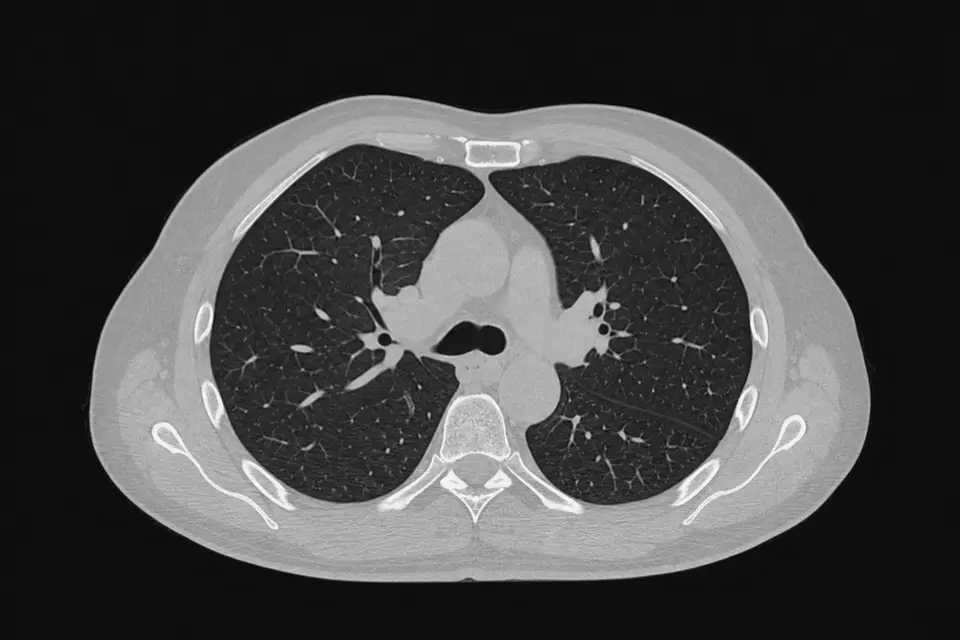
LDCT can find small nodules, but a nodule is an imaging finding rather than a pathology result. In the NLST, 24.2 percent of LDCT screens were positive across three rounds, and 96.4 percent of positive screens did not turn out to be lung cancer under the trial's definition. Most false positives were resolved by further imaging, and invasive procedures were uncommon.
The NLST figures came from an older trial protocol and should not be used as a forecast for every screening service. The US task force says screening's net benefit depends on experienced image interpretation and resolving most indeterminate findings with serial imaging instead of invasive procedures. England's program may schedule another scan after three, 12 or 24 months depending on the finding, while higher-risk results move to specialist assessment.

False positives and overdiagnosis are different harms
A false positive is an abnormal screen that proves not to be cancer. Overdiagnosis means a real cancer is found and treated even though it would not have caused symptoms or death during that person's lifetime. The second problem cannot be identified with certainty for an individual at the time of diagnosis.
The US National Cancer Institute lists false positives, invasive follow-up, overdiagnosis, radiation and findings outside the lungs among LDCT's possible harms. It also says extended NLST follow-up found little, if any, evidence of overdiagnosis, showing why older point estimates should not be treated as fixed rates for every program.
The institute estimates an effective dose of about 1.5 millisieverts for one low-dose chest CT, compared with about 6.1 millisieverts for a typical chest CT. Actual dose depends on the scanner, protocol and patient, and repeated screening adds exposure over time.
Never-smokers do not have one universal pathway
The US National Cancer Institute says the risk for people who have never smoked is generally too low for routine LDCT screening to provide a likely benefit. The mortality trials that established benefit enrolled current or former smokers, so their results cannot be transferred directly to average-risk never-smokers.
Family history, previous radiation, chronic lung disease and environmental or occupational exposures can raise risk. The European code allows organized programs to consider several of these factors, while the US task force says evidence is insufficient to replace its age-and-smoking rule with broader risk models in routine primary care. APPI News could not verify one international recommendation supporting routine LDCT solely because a never-smoker has a family history of lung cancer.
A never-smoker with symptoms belongs in a diagnostic pathway, not a screening pathway. A person without symptoms but with a strong family history or a documented exposure needs an assessment under the rules and validated risk tools used where care is received.
Children, pregnancy and major illness require separate decisions
The adult screening schedules in this guide do not apply to children. The US National Cancer Institute says children are more sensitive to CT radiation and have more remaining years in which a radiation-related cancer could develop, so pediatric imaging requires a clinical reason and an age-appropriate protocol.
England's National Health Service asks people to tell the imaging service if they are pregnant or may be pregnant, take regular medicines, or have asthma, kidney or thyroid problems, diabetes or relevant allergies. Pregnancy is not an adult screening indication, but a needed diagnostic scan for serious symptoms is a separate decision that the clinical and imaging teams should make.
Major chronic illness can change the balance even when age and smoking history meet a published threshold. The US task force advises stopping screening when health substantially limits life expectancy or the ability or willingness to receive curative surgery. The eligibility rules cited here do not use regular medicines as a screening criterion, but medicines may matter if follow-up later involves contrast, biopsy or surgery.
An organized pathway matters as much as the scan
A screening decision starts with the rule used where care is delivered. A proper assessment records age, cumulative cigarette exposure, time since quitting, symptoms, previous chest imaging and health conditions that could affect diagnostic procedures or treatment.
The discussion also needs to cover what happens after an indeterminate result, including access to comparison scans, specialist review and treatment if cancer is confirmed. Current smokers should be offered cessation support alongside screening because LDCT does not prevent most lung cancer deaths.
Availability, coverage and regulatory arrangements vary by country. A private scan outside an organized program may not provide the same reporting, reminders and tracked follow-up that produced the benefit seen in trials.
Frequently asked questions
Does a never-smoker need routine LDCT?
Routine screening is not supported for average-risk never-smokers by the evidence reviewed here. Some organized programs may consider family history, lung disease or documented exposures through validated risk assessment, and symptoms require diagnostic evaluation instead.
What does 20 pack-years mean?
It is cumulative cigarette exposure equal to an average of 20 cigarettes a day for 20 years, 40 a day for 10 years, or another equivalent combination. Programs may use a different threshold and a clinician may need to reconstruct an uneven smoking history.
Does a lung nodule mean cancer?
No. It is an imaging finding. Size, appearance, growth, previous scans and the program's reporting category determine whether the next step is routine screening, an earlier scan or specialist assessment.
Why not remove every nodule immediately?
Many nodules are not cancer, and invasive tests can cause harm. Structured programs use repeat imaging for many indeterminate findings and reserve biopsy or surgery for findings whose risk justifies those procedures.
How often is LDCT screening done?
There is no worldwide interval. The European code prefers annual screening for its higher-risk group, the US task force recommends annual screening under its criteria, and England repeats a clear scan after two years.
Sources and further reading
- European Code Against Cancer, 5th edition: Cancer screening fact sheet(International Agency for Research on Cancer)
- Recommendation: Lung Cancer: Screening(US Preventive Services Task Force)
- Equality impact assessment: screening for lung cancer(UK Government)
- National Lung Screening Trial: Questions and Answers(US National Cancer Institute)
- Computed Tomography (CT) Scans and Cancer(US National Cancer Institute)
- Lung cancer symptoms(National Health Service (England))
- Coughing up blood(National Health Service (England))
- CT scan(National Health Service (England))