A 2026 laboratory study found that freeze-dried platelet-rich plasma could be rehydrated after storage, but it did not test pain relief or tissue repair in patients. Published human evidence for the freeze-dried product remains too limited to borrow treatment claims from conventional platelet-rich plasma.
The product is sometimes called platelet-lyophilized treatment (PLT) in Taiwan. It is made from a patient's blood: platelet-rich plasma is separated, freeze-dried for storage and later reconstituted. The process differs from conventional platelet-rich plasma (PRP), which is generally prepared and used fresh.
The latest study measured storage, not treatment
The 2026 study used PRP from 15 healthy donors to compare conventional freeze-drying with spray freeze-drying at room temperature, 4 degrees Celsius and minus 80 degrees Celsius. Researchers examined the dried material after 42 days and 12 months and measured several growth factors after rehydration.
Those endpoints can show whether processing and storage alter a blood product. They do not show whether an injection reduces pain, restores function or repairs a tendon, ligament, nerve or joint.
When symptoms after an injection need urgent assessment
Any injection into or near a joint can be followed by a serious infection, even though the risk is uncommon. The United Kingdom's National Health Service advises urgent assessment for sudden severe pain in one joint, swelling, skin-color change, fever or feeling hot, cold or shivery. Symptoms that develop quickly over a few days should not be assumed to be a normal treatment reaction.
Freeze-drying may improve storage, but evidence is sparse
A 2020 systematic search identified 46 experimental or clinical papers on freeze-dried PRP or platelet-rich fibrin. Most work involved cells, animals, preservation methods or biomaterials. Among the musculoskeletal studies, the review listed one preliminary human study of an injection for osteoarthritis; the remaining entries were laboratory or animal experiments.
The review found that some freeze-dried preparations retained platelet function or measured growth factors during storage. It also identified unresolved questions about standardizing preparation, biological activity, sterility and national regulatory requirements. Different products may preserve intact platelets, platelet lysates or released proteins, so the label does not describe one uniform intervention.
A later human study remained small and addressed a different use. A 2021 pilot combined freeze-dried PRP with synthetic graft material during dental sinus-floor surgery in five patients. It had no control group, and its authors said further studies were needed before drawing conclusions about efficacy. That study cannot establish an effect on musculoskeletal pain.
PRP findings do not establish PLT efficacy
Conventional PRP has a larger clinical literature, but the results apply to particular preparations, injuries and procedures. A 2020 meta-analysis pooled seven randomized trials with 541 patients who received conventional PRP during arthroscopic rotator cuff repair. It reported a lower retear risk and small improvements in some short-term scores.
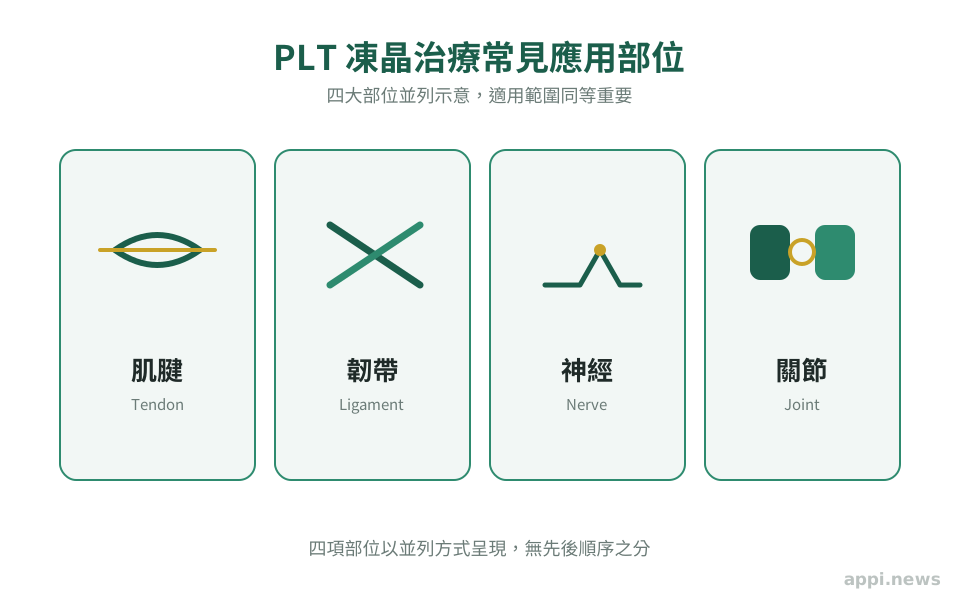
That evidence concerns PRP placed at the bone-tendon interface during surgery. It does not test freeze-dried PLT injections for chronic nerve pain, nonsurgical sports injuries or general joint maintenance. Processing can change the composition and release of biological signals, and a plausible mechanism is not proof of the same clinical outcome.
Guidelines also describe uncertainty even for conventional PRP. The United Kingdom's National Institute for Health and Care Excellence says evidence on PRP efficacy for knee osteoarthritis is limited in quality. Its guidance calls for special clinical-governance, consent and audit or research arrangements, along with randomized trials and medium- to long-term follow-up.
The available evidence leaves major groups untested
The published freeze-dried PRP literature does not establish safety or benefit for children or pregnant people with musculoskeletal pain. It also does not provide a general protocol for people with blood disorders, autoimmune disease, diabetes or long-term medication use. People in these groups should discuss an injection with a clinician who can review the diagnosis, medicines, bleeding risk and local product status.
Imaging or an injection should not replace diagnosis of unexplained swelling, a mass or new loss of function. A clinician must first identify the condition being treated and consider established options, including rehabilitation or surgery where appropriate.

What patients can ask before considering the procedure
A clinic should be able to identify the exact preparation, whether it contains intact platelets or a lysate, how it was processed and stored, and what clinical evidence supports the proposed use. Evidence from fresh PRP should be labeled as indirect when the offered product is freeze-dried.
Patients can also ask what other treatments were considered, what outcome would count as success, how adverse events are monitored and what the full cost covers. Availability, authorization and reimbursement vary by country; APPI News did not verify those questions market by market.
APPI News could not find a published randomized trial of freeze-dried PRP injections for musculoskeletal pain at the time of writing. The existing evidence supports continued research into storage and standardization, not broad claims that PLT relieves chronic pain or repairs sports and degenerative injuries.
Sources and further reading
- Effects of Different Freeze-Drying Methods on Platelet-Rich Plasma(PubMed)
- Freeze-Drying of Platelet-Rich Plasma: The Quest for Standardization(International Journal of Molecular Sciences)
- Clinical Safety Assessment of Autologous Freeze-Drying Platelet-Rich Plasma for Bone Regeneration in Maxillary Sinus Floor Augmentation(Journal of Clinical Medicine)
- Effects of applying platelet-rich plasma during arthroscopic rotator cuff repair(Scientific Reports)
- Platelet-rich plasma injections for knee osteoarthritis(National Institute for Health and Care Excellence)
- Septic arthritis(National Health Service)