The World Health Organization (WHO) advises moving to the coolest room at night and using air conditioning with a fan when available during a heatwave. Fans, bathing and bedding serve different purposes, and no single bedroom temperature suits every sleeper or climate.
Sleep and body temperature are closely linked. A review in Current Opinion in Physiology reports that core temperature falls during the transition to non-rapid eye movement sleep, while heat loss through the skin helps create the temperature gradient associated with sleep onset. Feeling cold at one patch of skin is therefore not evidence that a product has cooled the body as a whole or improved sleep.
Heat illness needs urgent care
Difficulty sleeping can be an early practical problem during a hot night, but faintness, dizziness, nausea, confusion, loss of consciousness or stopping sweating can signal a medical emergency. WHO says emergency medical help should be called immediately for suspected heatstroke and cooling should begin while help is on the way.
Move the person to shade or an air-conditioned place, loosen unnecessary clothing and apply cold, wet cloths while waiting for emergency services. WHO also says heat cramps lasting more than one hour need medical attention; symptoms that persist after moving to a cool place also require clinical advice.
Infants and children, adults older than 60, and people with heart, lung or kidney conditions need closer checks during a heatwave. People with chronic disease who take daily medicines should not change or stop treatment based on general cooling advice, because heat and dehydration can alter individual risks. Pregnant people should keep cool and contact their pregnancy care provider if fetal movement is lower than usual; WHO's European office identifies reduced fetal movement as a reason to contact a midwife or pregnancy care provider.
Cool the room before relying on skin sensation
WHO advises opening windows after dark when outdoor air is cooler than indoor air, then closing windows and blocking direct sunlight during the day when it is hotter outside. Electrical devices that are not needed can be switched off because they add heat indoors. If a home cannot be kept cool, WHO advises spending two to three hours in a cool place during the day.
For homes with air conditioning, WHO gives a heatwave setting of 27 degrees Celsius with a fan. The figure is a public-health measure for limiting indoor heat, not a universal prescription for sleep. Humidity, airflow, bedding, clothing, building design, health and acclimatization all affect how the same thermostat setting feels.
Light, loose bed linens can reduce heat accumulation. There is not enough evidence in the sources reviewed here to rank cotton, linen, synthetic cooling fabrics, mats or pillows by their effect on core temperature or sleep. A cool sensation from a pillow or sheet may improve comfort, but product claims should not be treated as proof of a measurable sleep benefit.
Fans have a heat limit
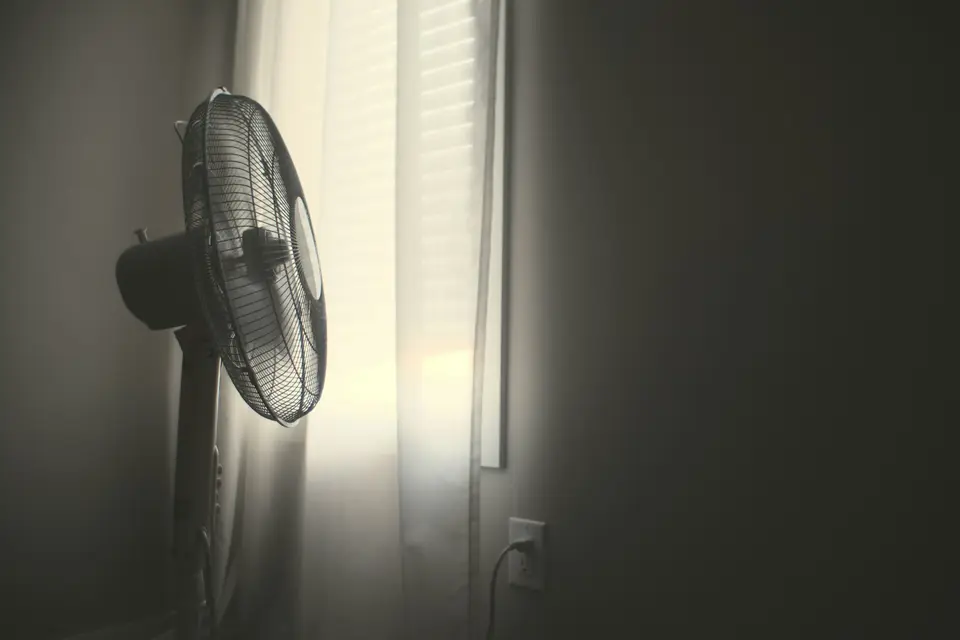
Fans move air and can increase sweat evaporation, but they do not lower room temperature. WHO says fans may provide relief when indoor temperature is above 35 degrees Celsius but may not prevent heat-related illness, and it advises using them only below 40 degrees Celsius because hotter air can heat the body.
That distinction matters on nights when a room remains extremely hot. A fan can be paired with air conditioning, used to draw in cooler outdoor air after dark, or used with damp cloths and wet skin as WHO describes. It should not delay moving to a cooler place or seeking help when warning signs appear.
Warm bathing has limited evidence for sleep onset
A 2019 systematic review in Sleep Medicine Reviews found that a warm bath or shower at 40 to 42.5 degrees Celsius was associated with better self-rated sleep quality and sleep efficiency. Bathing one to two hours before bed, for as little as 10 minutes, was also associated with a shorter time to fall asleep.
The timing result was not supported by a large clinical evidence base. The review identified 17 eligible studies and used comparable quantitative data from 13, while its conclusion about the one-to-two-hour window relied on two studies totaling 36 participants. The evidence does not show that hotter or longer bathing produces a larger benefit.
A cool shower has a different purpose during extreme heat: it can help remove heat from the body at that moment. WHO includes cool showers and baths in its heatwave advice. The reviewed evidence does not support a broad claim that every cold shower before bed worsens sleep, so water temperature can be chosen for immediate heat relief without assuming a proven sleep effect.
A practical sequence for a hot night
Start with the room: block daytime sun, release heat after dark only when outdoor air is cooler, and use air conditioning with a fan when available. Keep bedding light, move to the coolest room and check the indoor temperature rather than relying only on how the skin feels.
A fan remains a comfort tool, not protection from heat illness at every temperature. Warm bathing one to two hours before bed has some evidence for shortening sleep onset, while cool bathing can provide immediate heat relief. Neither replaces a cooler environment when indoor heat remains unsafe.
Frequently asked questions
Should windows stay open all night?
Open windows when outdoor air is cooler than indoor air and the opening is safe. Close them when the air outside is hotter, and use blinds or shutters to reduce daytime heat gain.
Is 27 degrees Celsius the best sleep temperature?
No universal optimum has been established. WHO's 27-degree setting with a fan is heatwave guidance for air-conditioned homes, not a sleep prescription for every person or country.
Can a fan protect someone during extreme indoor heat?
Not reliably. WHO says a fan may not prevent heat-related illness above 35 degrees Celsius and can heat the body above 40 degrees Celsius.
Does a cooling pillow lower core temperature?
The sources reviewed for this report do not establish that claim. A cooling surface may feel comfortable locally, but that is different from measured whole-body cooling or improved sleep.
Sources and further reading
- Heatwaves: How to stay cool(World Health Organization)
- Heat and health(World Health Organization)
- Before-bedtime passive body heating by warm shower or bath to improve sleep: A systematic review and meta-analysis(Sleep Medicine Reviews via PubMed)
- Sleep and thermoregulation(Current Opinion in Physiology via PubMed Central)
- How does hot weather affect pregnancy?(World Health Organization Regional Office for Europe)