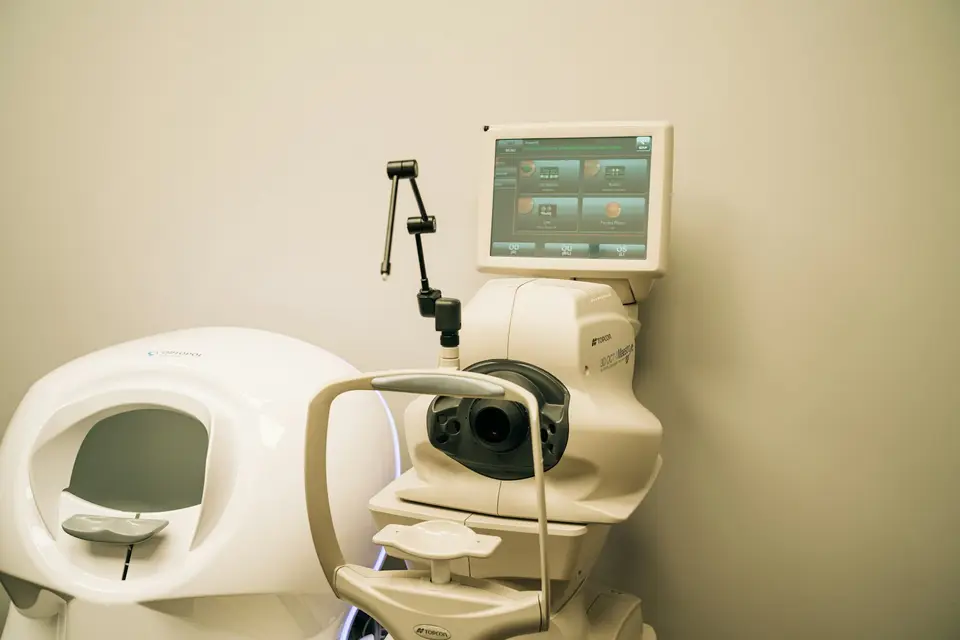
The US Food and Drug Administration (FDA) cleared AEYE-DS for use with the handheld Optomed Aurora retinal camera on April 23, 2024. The US regulator's database identifies the device as diabetic-retinopathy detection software and records the decision as a 510(k) substantial-equivalence clearance.
The decision did not introduce a wholly new algorithm. It expanded an earlier AEYE-DS clearance, which covered the desktop Topcon NW400 camera, by adding a portable camera. That distinction matters because “cleared” and “approved” are not interchangeable terms in the US medical-device system.
What the system does
A healthcare worker captures one macula-centered color image of each eye and submits the images through the AEYE-DS client. The software sends them over a secure internet connection to server-based analysis modules, then returns one of three outputs: more-than-mild diabetic retinopathy detected, not detected or insufficient image quality.
The FDA summary says the prescription-only system is authorized for automatic detection in adults with diabetes who have not previously been diagnosed with diabetic retinopathy. The output is a referral-screening result for that defined condition, not a complete assessment of the eye or a finding about every stage of retinal disease.
The handheld studies produced different error profiles
The FDA summary describes two prospective, multicenter, single-arm and blinded studies conducted in the United States. Both enrolled adults aged 22 or older who had diabetes, no prior diabetic-retinopathy diagnosis and no visual symptoms. Novice operators captured the images, while an independent reading center established the reference result from additional imaging.
One study reported sensitivity of 92 percent and specificity of 94 percent; the other reported sensitivity of 93 percent and specificity of 89 percent. Imageability was 99 percent in both. The lower specificity in the second study means more people without the target level of disease could receive a positive screening result, while sensitivity below 100 percent means the system can miss some cases.
Those figures do not establish identical performance in every clinic or country. Patient mix, disease prevalence, operator technique and image quality can alter real-world results. The studies also evaluated a narrow screening indication rather than every task performed during an eye examination.
Autonomous output changes the clinical workflow
Autonomous screening refers to who interprets the image at the screening step. AEYE-DS generates the defined result without requiring a clinician to grade the retinal photographs. A positive result still leads to evaluation elsewhere in the care pathway; autonomy at the screening step does not turn the software into a treatment system.
The World Health Organization's European office treats screening as a program rather than a stand-alone test. Its 2021 guide says diabetic-retinopathy screening is intended to identify people at higher risk of sight-threatening disease so that those who need further assessment and intervention can enter the next stage of care. A camera, trained operators, referral capacity, quality assurance and follow-up therefore remain part of the service around an autonomous result.

Taiwan's VeriSee DR follows an assisted model
VeriSee DR, developed by Acer with clinicians from National Taiwan University Hospital, illustrates a different allocation of responsibility. A peer-reviewed retrospective study used 1,875 retinal images for validation and reported sensitivity of 89.2 percent and specificity of 90.1 percent for referable diabetic retinopathy. The researchers concluded that the software could assist non-ophthalmologists, while noting that ophthalmologists achieved higher specificity in the comparison.
The product's registered study documents make that boundary explicit. The protocol says VeriSee DR supplies screening results for physicians' reference and is not intended to diagnose or treat diabetic retinopathy. Its assisted role is therefore not equivalent to the automatic output described in the US indication for AEYE-DS.
Taiwan's Ministry of Health and Welfare, which oversees the country's health system and medical-device regulator, is now studying how VeriSee works in practice. A ministry project page published on May 18, 2026 says VeriSee DR and a related macular-degeneration product hold Taiwan medical-device permits and are undergoing clinical-impact and cost-effectiveness evaluation. The page describes physician reference and final clinical decision-making, not an autonomous classification matching the US-cleared AEYE-DS configuration.
Authorization does not transfer across borders
The US and Taiwan records cannot be combined into a global approval claim. Each authorization applies to a named device, indication, workflow and jurisdiction. A performance result from one product also cannot be assigned to another merely because both analyze retinal photographs.
APPI News could not verify a publicly documented Taiwan authorization for an autonomous diabetic-retinopathy system equivalent to the US-cleared AEYE-DS configuration at the time of writing. That finding is limited to the public records reviewed for this report; it does not establish that no such application or evaluation exists.
Frequently asked questions
Did the FDA approve Aurora AEYE in 2024?
The FDA cleared AEYE-DS under the 510(k) pathway for use with the Optomed Aurora camera. The database records a substantial-equivalence decision, not a premarket approval.
Does AEYE-DS diagnose every diabetic eye problem?
No. Its US indication is automatic detection of more-than-mild diabetic retinopathy in a defined adult screening population. The authorized output does not cover every retinal condition or replace the rest of an eye-care pathway.
Are the US and Taiwan systems regulated for the same role?
The records reviewed here describe different roles. The US indication allows AEYE-DS to return the specified screening result automatically, while VeriSee DR's protocol describes results supplied to physicians as assistance for their assessment.
Sources and further reading
- 510(k) Premarket Notification K240058(US Food and Drug Administration)
- AEYE-DS 510(k) summary and indications for use(US Food and Drug Administration)
- Diabetic retinopathy screening: a short guide(World Health Organization Regional Office for Europe)
- Application of deep learning image assessment software VeriSee for diabetic retinopathy screening(Journal of the Formosan Medical Association via PubMed)
- VeriSee DR clinical study protocol(ClinicalTrials.gov)
- VeriSee AMD and VeriSee DR clinical impact evaluation(Taiwan Ministry of Health and Welfare)