
European Union rules set maximum concentrations for benzo[a]pyrene and three related polycyclic aromatic hydrocarbons in most oils and fats sold to consumers or used as food ingredients. The numbers define when a product complies with those rules; they do not predict whether a particular person will develop cancer after a single exposure.
The International Agency for Research on Cancer (IARC) classifies benzo[a]pyrene as carcinogenic to humans in Group 1. IARC explains that its categories identify whether an agent can cause cancer, not the probability of cancer at a particular exposure level.
Severe symptoms after a suspected poisoning need urgent care
Benzo[a]pyrene contamination does not provide a specific symptom checklist that can confirm exposure at home. A product name, lot code and notice from the authority responsible for the market are more useful for identifying whether an oil is covered by a recall.
The United Kingdom National Health Service advises emergency care after suspected poisoning if a person loses consciousness, stops breathing, has severe difficulty breathing or has a seizure. These are general poisoning warning signs, not symptoms shown to be specific to benzo[a]pyrene in cooking oil. People without emergency symptoms who are concerned about an exposure should contact a clinician or their local poison information service and retain the product packaging.
The reviewed sources do not give different post-exposure steps for children, pregnant people, people with chronic conditions or those taking medicines. People in these groups should seek individual advice rather than applying assumptions about risk from a general adult population.
Contamination can begin before oil reaches a refinery
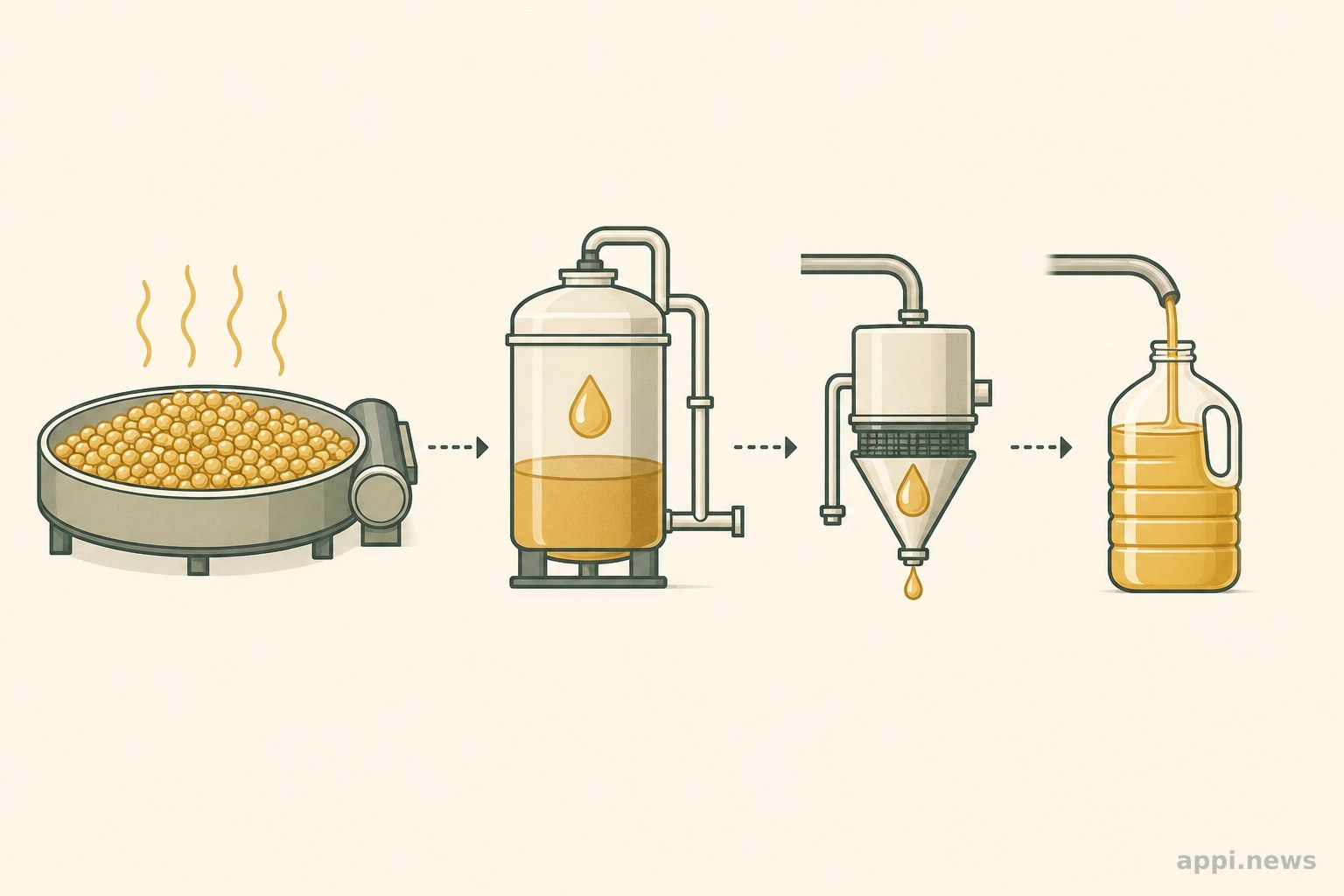
Polycyclic aromatic hydrocarbons (PAHs) form during incomplete combustion and other high-temperature processes. Oil crops can acquire them from the environment, while direct contact with combustion gases during seed drying can add contamination before extraction.
Hong Kong's Centre for Food Safety says smoking and direct drying can contaminate oilseeds when combustion products touch the food. It cites shorter drying times, complete fuel combustion and reduced contact with drying gases as production controls.
Refining can remove contamination, but results vary
A 2025 review in Current Research in Food Science found that extraction temperature and duration, refining steps, storage conditions and cooking methods can affect PAH4 concentrations in edible oils. The review reported that refining reduced PAH4 by 70.19 percent to 85.40 percent in one cited study, with bleaching and deodorization contributing to removal.
That range is not a guarantee for every plant or product. The review also found that some intermediate steps can increase measured concentrations and that performance depends on the oil, starting contamination and process settings. Activated carbon can aid removal during bleaching, but the finished oil still requires analytical testing.
Storage is another variable in the review, which cites increases in total PAH4 with longer storage at higher temperatures. This evidence concerns measured concentrations under particular study conditions and does not establish that every bottle kept for a long time will exceed a legal limit.
PAH4 gives a broader signal than one compound
PAH4 is the sum of benzo[a]pyrene, benz[a]anthracene, benzo[b]fluoranthene and chrysene. Regulators use the group because benzo[a]pyrene can be absent even when other carcinogenic PAHs are present.
A European Union regulation records the European Food Safety Authority's conclusion that benzo[a]pyrene alone was not a suitable indicator of PAHs in food and that a group of four or eight PAHs would be more suitable. The regulation says a four-compound system can control samples in which benzo[a]pyrene is not detectable but other PAHs are present.
European Union limits cover both measures
The October 8, 2025 consolidated version of Commission Regulation (EU) 2023/915 sets maximum levels of 2.0 micrograms per kilogram for benzo[a]pyrene and 10.0 micrograms per kilogram for PAH4 in most oils and fats sold to consumers or used as food ingredients. Cocoa butter and coconut oil have separate entries, and foods for infants and young children are subject to lower limits.
Those are European Union rules, not worldwide thresholds. Other countries may use different limits, product categories and recall procedures. A report that oil is “over the limit” is incomplete unless it identifies the market, the applicable rule, the measured concentration and the product lot.

Labels and appearance cannot replace a laboratory test
Benzo[a]pyrene concentration cannot be established from an oil's color, clarity, smell or price. Those features may reveal spoilage, damaged packaging or a labeling problem, but they do not show whether a sample meets a PAH limit.
Consumers responding to a recall should match the product, package size, lot or batch code and date details stated in the notice. An unaffected lot from the same brand is not automatically covered, while a recalled lot should not be judged safe because it looks or smells normal.
Cooking choices address only part of exposure
The 2025 review links higher temperatures and longer heating with PAH4 formation in several experimental settings. It also describes lower concentrations under some cold-pressing and lower-temperature conditions, but results differed by crop and process. This does not support treating “cold pressed” as proof that a finished product passed contaminant testing.
The Hong Kong Centre for Food Safety advises a varied diet, limiting smoked and charcoal-grilled foods and removing charred portions. These steps can reduce dietary exposure to combustion-related contaminants, but household cooking cannot remove contamination already present in a sealed bottle.

What a test result can establish
A laboratory result can compare the measured benzo[a]pyrene and PAH4 concentrations with the rules for a particular market. It cannot, by itself, calculate an individual's lifetime cancer risk without information about the amount consumed, duration of exposure, background diet and other sources.
The evidence supports controls across seed drying, extraction, refining, storage and finished-product testing. For consumers, the actionable information comes from a lot-specific recall or test notice issued for the country where the product was sold, rather than sensory checks or a cancer-hazard label alone.
Sources and further reading
- IARC Monographs Volume 92: Summary of Data Reported and Evaluation(International Agency for Research on Cancer)
- IARC Monographs Programme(International Agency for Research on Cancer)
- Commission Regulation (EU) No 835/2011 on polycyclic aromatic hydrocarbons in foodstuffs(EUR-Lex)
- Commission Regulation (EU) 2023/915, consolidated version of October 8, 2025(EUR-Lex)
- A comprehensive review on the formation and mitigation of PAH4 in edible oils(Current Research in Food Science via PubMed Central)
- Benzo[a]pyrene in Edible Fats and Oils(Hong Kong Centre for Food Safety)
- Poisoning(United Kingdom National Health Service)