
The World Health Organization (WHO) estimated in June 2026 that unsafe food causes about 866 million illnesses and 1.5 million deaths annually. The estimate covers biological and chemical hazards, while the household controls discussed here address the growth and transfer of disease-causing microorganisms.
Warm conditions reduce the time available to cool, serve or store perishable food safely. The practical decision is based on measured temperature and elapsed time, not whether a dish still looks or smells normal.
Warning signs require prompt medical assessment
Bloody diarrhea, diarrhea lasting more than three days, fever above 39°C, or vomiting so frequent that liquids will not stay down call for prompt medical assessment. So do signs of dehydration, including very little urination, a dry mouth or throat, or dizziness on standing. The US Centers for Disease Control and Prevention lists these as signs of severe food poisoning.
The US CDC identifies children under five, pregnant people, adults aged 65 and older, and people with weakened immune systems as groups at higher risk of severe foodborne illness. Children can lose fluid quickly, and pregnant people with fever and flu-like symptoms should contact a clinician. People in these higher-risk groups, those with chronic illness and anyone taking regular medicines should seek individual advice rather than applying general adult self-care guidance.
A related APPI News guide gives a fuller account of dehydration, bloody diarrhea and other warning signs after suspected food poisoning.
The global rule uses cold, hot and time controls
WHO advises keeping refrigerators below 5°C, holding cooked food above 60°C and leaving cooked food at room temperature for no more than two hours. Chilling slows microbial growth but does not stop it, so refrigeration does not provide indefinite storage.
The interval between cold and hot holding is often called the temperature danger zone. The phrase is useful, but the exact lower boundary differs between authorities: WHO uses below 5°C as its preferred refrigeration target, while United States consumer guidance uses 4°C or below. A single universal range would conceal that difference.

Bacterial growth can accelerate under favorable conditions, but the rate is not fixed. It depends on the organism, food, moisture, acidity, starting contamination and temperature. The two-hour limit is therefore a public-health control point, not a calculation showing that every bacterial population grows at the same rate.
Heat can shorten the time available
WHO says hot and humid weather improves the conditions in which germs multiply and warns that contaminated food may not look, taste or smell different. That makes outdoor meals, food carried in vehicles and dishes left on a serving table harder to control during hot weather.
FoodSafety.gov, the United States government food-safety portal, says perishable food should be refrigerated within two hours, or within one hour when it is exposed to temperatures above 32°C. That one-hour threshold is US guidance rather than a worldwide standard. Local public-health instructions take priority when they are more restrictive.
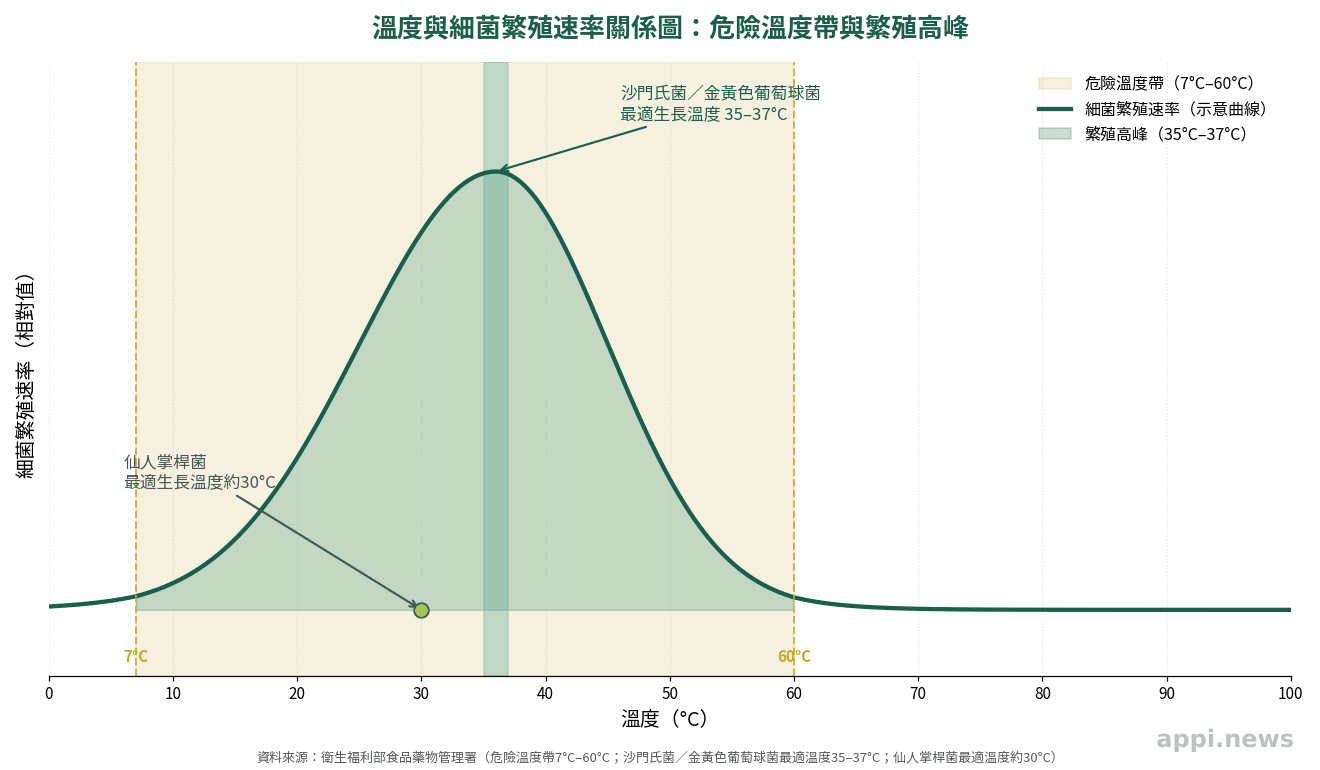
A hot room is not the only concern. A parked car, picnic table in direct sunlight or crowded buffet can expose food to temperatures above the reported air temperature. Cold dishes need ice or refrigeration, while hot dishes need equipment that can hold them above 60°C rather than merely keep them warm.
Cooling starts with smaller portions
Prompt refrigeration matters most for cooked food that will be kept. Large pots and deep containers cool slowly at the center, even after they enter a refrigerator. Dividing food into shallow containers increases the surface area and allows heat to leave more quickly.
United States guidance sets household refrigerators at 4°C or below and freezers at -18°C or below. WHO recommends refrigeration below 5°C. An appliance thermometer can reveal whether a refrigerator reaches the selected target, especially when it is full or opened frequently.
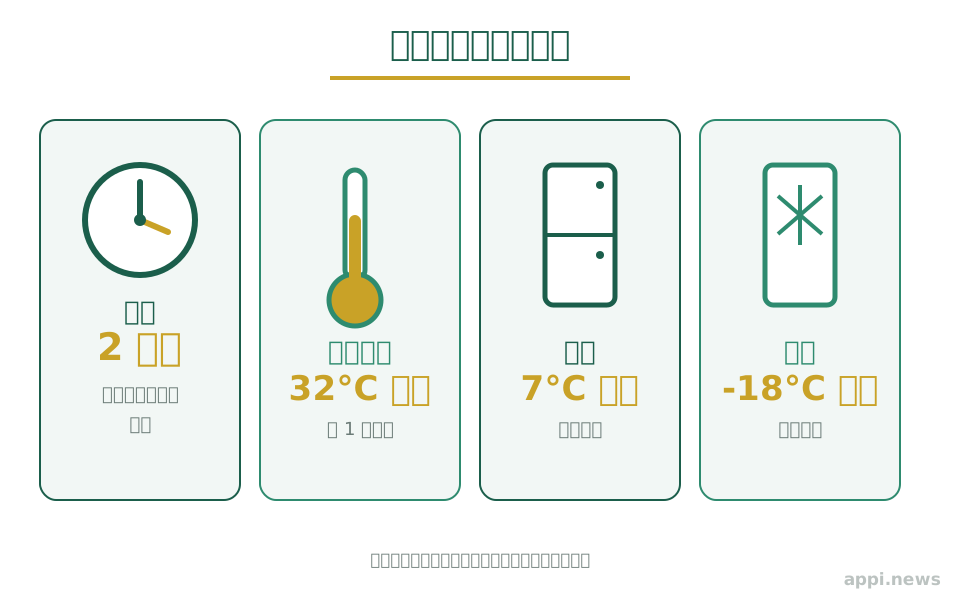
Freezing pauses growth but does not reliably destroy harmful germs. Food still needs safe thawing and preparation after it leaves the freezer. WHO advises thawing in a refrigerator, cold water or a microwave instead of on a counter at room temperature.
Reheating cannot correct every earlier failure
Thorough cooking kills almost all dangerous microorganisms, and WHO uses at least 70°C as a general benchmark for foods such as soups, stews, meat and poultry. Reheating leftovers until steaming hot can reduce hazards from live organisms, but it does not establish that food mishandled earlier is safe.
WHO describes cereulide, a toxin produced by some strains of Bacillus cereus, as stable at temperatures up to 121°C. There is no household test that can reconstruct an unknown time-and-temperature history. Perishable food that has exceeded the applicable room-temperature limit should be discarded rather than sampled or reheated as a safety test.
Temperature control is only one layer
Food can acquire microorganisms from hands, cutting boards, utensils, raw meat, seafood, eggs, water or other ingredients. WHO's five basic controls are to keep clean, separate raw and cooked food, cook thoroughly, keep food at safe temperatures, and use safe water and raw materials.
Raw food should be stored in sealed containers away from ready-to-eat dishes. Separate utensils or thorough washing between tasks reduces cross-contamination, while covering prepared food protects it during serving and storage.
Time and temperature provide usable limits, but they cannot prove that a meal is safe. When the storage history is unknown, when refrigeration failed, or when a perishable dish has remained outside the applicable limit, discarding it avoids relying on smell, appearance or a final round of heating.
Sources and further reading
- Unsafe food causes 866 million illnesses and 1.5 million deaths annually, young children at highest risk(World Health Organization)
- Public health advice on food safety during summer(World Health Organization Regional Office for Europe)
- 4 Steps to Food Safety(FoodSafety.gov)
- Food Poisoning Symptoms(US Centers for Disease Control and Prevention)
- People at Increased Risk for Food Poisoning(US Centers for Disease Control and Prevention)
- International food safety event: Infant formula and products containing arachidonic acid oil contaminated with cereulide toxin(World Health Organization)