Taiwan-listed Bionime secured a local medical-device license for its iFree2 continuous glucose monitor in April 2026, but the public notice did not identify an artificial intelligence forecasting feature. Abbott introduced that kind of prediction in the United States three months earlier through Libre Assist, creating a gap between the AI function it promotes and the products documented in Taiwan.
The gap is not simply a difference in app design. Continuous glucose monitoring (CGM) combines a wearable sensor, software and country-specific regulatory authorization. A feature shown in one market does not establish that the same app and compatible sensor are available through official channels elsewhere.
Libre Assist predicts a meal's possible effect
Abbott announced Libre Assist on January 5, 2026 as a US feature within its Libre app that uses generative AI to estimate how a food choice could affect glucose levels. A user takes a photograph or enters a text description of a meal. The software identifies ingredients, assigns a color-coded estimate and later compares that estimate with readings from a Libre sensor.
The announcement describes a consumer-facing prediction layer rather than a new sensing method. The sensor still measures glucose in interstitial fluid, while the AI processes information about the meal and the user's later readings. Abbott says the feature is intended to inform food choices before eating, but its safety note says generative AI may be inaccurate and should not be used for treatment decisions.

The company release does not provide a peer-reviewed study, accuracy rate or clinical-validation dataset for the prediction feature. It also presents Libre Assist as a US launch and does not set out a country-by-country release schedule. The evidence available at launch therefore supports a description of how Abbott says the feature works, not a conclusion about its clinical accuracy or international availability.
Taiwan's documented products follow a different path
The Taiwan Stock Exchange's company record for Bionime says the manufacturer announced a Class II medical-device license from the Taiwan Food and Drug Administration for the RIGHTEST iFree2 CGM on April 29, 2026. The Taiwan Food and Drug Administration is the health ministry agency that registers medical devices for the Taiwanese market. The exchange record establishes the license announcement, but it does not describe a generative AI component.
Abbott's own Taiwan storefront points to a different generation of its product. The current Taiwan product page describes the FreeStyle Libre 2 sensor, a 14-day device that sends glucose readings to a phone app and can issue high- and low-glucose alerts. The page does not list Libre Assist or present meal-impact forecasting as a local feature.
Those records do not prove that no other CGM can be obtained in Taiwan through every possible route. They show what the manufacturers and the exchange publicly document through official local channels. APPI News did not treat overseas retail listings or cross-border sellers as evidence of Taiwan authorization.
A sensor recall sets a separate safety boundary
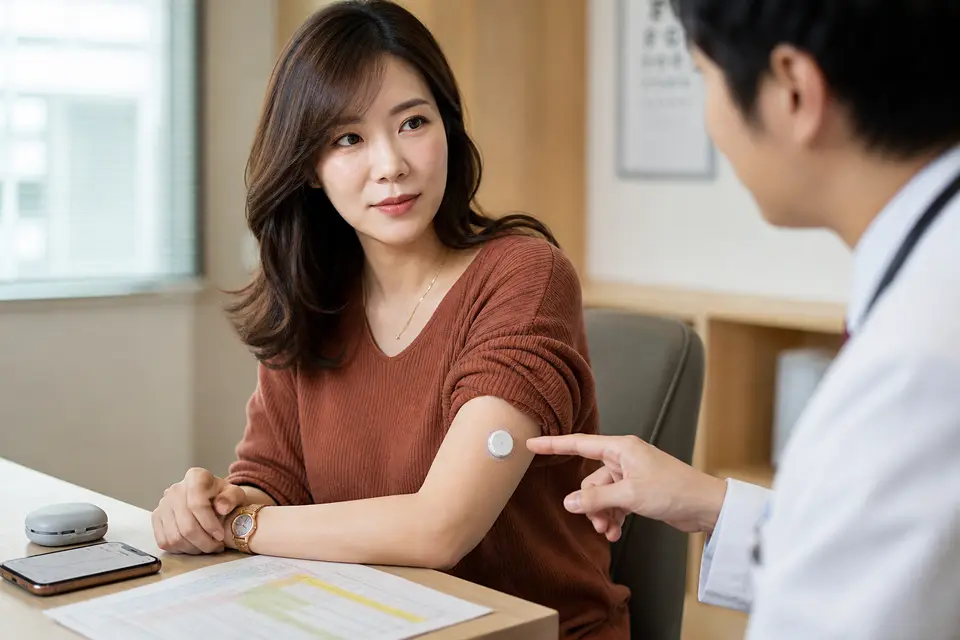
The distinction between software and sensor hardware also matters because specified newer Abbott sensors were already under a US device correction when Libre Assist was announced. The US Food and Drug Administration classified the removal of specified FreeStyle Libre 3 and Libre 3 Plus sensor lots as a Class I recall and reported 860 serious injuries and seven deaths associated with the issue as of January 7, 2026.
The affected sensors could report glucose readings lower than the actual level. The FDA says Abbott traced the problem to specified products and lots. The agency also states that Libre 3 readers and mobile apps were not affected, and that other Libre products were outside the recall.

The recall does not demonstrate a failure in Libre Assist's AI model. It does show why a forecast feature cannot be assessed apart from the sensor and distribution system around it. A meal estimate may be generated by software, but the later comparison depends on readings from regulated hardware and on the manufacturer reaching customers when particular lots require correction.
The missing evidence is as important as the feature list
Three questions remain separate in this market: whether a sensor has authorization in a country, whether the compatible app feature is offered there, and whether the AI prediction has published validation. The public records reviewed for this article answer only parts of those questions. Taiwan has documented CGM options, while Abbott's January announcement locates Libre Assist in the United States and supplies no clinical-performance dataset.
That makes “AI-enabled CGM” an incomplete description on its own. The label can refer to a sensor paired with an AI feature rather than intelligence inside the sensing hardware. It also says nothing about where the combination is authorized, whether it is supported through official distribution or how accurately the software predicts an individual's response to a meal.
Sources and further reading
- Abbott's new Libre Assist app feature tackles a top need for people living with diabetes: in-the-moment food decisions(Abbott)
- Glucose Monitor Sensor Recall: Abbott Diabetes Care Removes Certain FreeStyle Libre 3 and FreeStyle Libre 3 Plus Sensors(US Food and Drug Administration)
- FreeStyle Libre 2(Abbott Taiwan)
- Bionime company information(Taiwan Stock Exchange)