
Kidney Disease: Improving Global Outcomes (KDIGO) defines chronic kidney disease as an abnormality of kidney structure or function that persists for at least three months and affects health. Its 2024 guideline says clinicians should not infer chronic disease from one abnormal estimated glomerular filtration rate (eGFR) or urine albumin-to-creatinine ratio (ACR).
An eGFR result estimates how much blood the kidneys filter each minute, adjusted to a standard body surface area. It is useful for detecting and monitoring reduced filtration, but it is not a percentage of kidney function and does not determine a diagnosis by itself.
Warning signs need prompt medical assessment
The United Kingdom's National Health Service advises urgent medical help for possible acute kidney injury, whose symptoms can include passing much less urine than usual, vomiting, swollen feet or legs, confusion, unusual sleepiness and breathlessness. Severe breathlessness, collapse or rapidly worsening symptoms require emergency care through the local emergency service. An eGFR guide cannot determine the cause or severity of these symptoms.
Children need pediatric equations and age-specific assessment. Pregnancy, frailty, very high or low muscle mass, serious illness and rapidly changing kidney function can also make a creatinine-based estimate less reliable, so people in these groups need a clinician to interpret the result rather than applying the adult categories alone.

What eGFR measures
Laboratories usually estimate GFR from serum creatinine, a waste product influenced by kidney filtration and by factors outside the kidneys. The US National Institute of Diabetes and Digestive and Kidney Diseases (NIDDK) describes the 2021 CKD-EPI creatinine equation as using age, sex and serum creatinine. The result is reported in milliliters per minute per 1.73 square meters.
The equation converts creatinine into a standardized estimate, but it does not remove every source of error. NIDDK says creatinine can be affected by muscle mass and may miss mild or moderate kidney injury; estimates are also less reliable when creatinine is unstable or body size, muscle mass or diet is far from the populations used to develop the equation.
Some laboratories use a different validated equation, and the exact calculation may therefore differ between reports. NIDDK says a combined creatinine-cystatin C equation can improve accuracy when cystatin C is available, particularly when the creatinine estimate may mislead a clinical decision.
One low result does not establish chronic disease
KDIGO requires evidence that the abnormality has lasted at least three months. Earlier laboratory records, repeat measurements beyond the three-month point, imaging, pathology and a clinical history can help establish that timeline. A new low result can instead reflect acute kidney injury or another recent change that requires separate assessment.
Follow-up timing cannot be set from the number alone because the urgency depends on the size of the change, symptoms, prior results and other clinical findings. A result that falls sharply from a known baseline calls for faster assessment than a stable result that has changed little over years.
GFR categories are not percentages
KDIGO classifies GFR as G1 at 90 or higher, G2 at 60 to 89, G3a at 45 to 59, G3b at 30 to 44, G4 at 15 to 29 and G5 below 15 mL/min/1.73 m². These labels describe filtration ranges. They should not be restated as a claim that a person has a matching percentage of kidney function remaining.
G1 is described as normal or high filtration and G2 as mildly decreased, but neither category qualifies as chronic kidney disease without another marker of kidney damage. Albumin in urine, abnormal urine sediment, structural findings, kidney pathology or a history of kidney transplantation can supply that evidence when persistent.

Urine albumin supplies the second axis
ACR compares albumin with creatinine in a urine sample. NIDDK says more than 30 milligrams of albumin per gram of creatinine may indicate kidney disease and that a positive result may be repeated once or twice for confirmation. A lower eGFR and a higher ACR together generally indicate more risk than either measure considered alone.
KDIGO groups ACR below 30 mg/g as A1, 30 to 300 mg/g as A2 and above 300 mg/g as A3. The same report may use milligrams per millimole instead of milligrams per gram, so the unit must be checked before comparing a value with a threshold.
Urine albumin matters even when eGFR is in G1 or G2 because filtration can remain in those ranges while kidney damage is present. It also helps clinicians monitor risk and response over time, which is why an eGFR result should not be interpreted without checking whether urine testing was done.
Medicines and supplements belong in the review
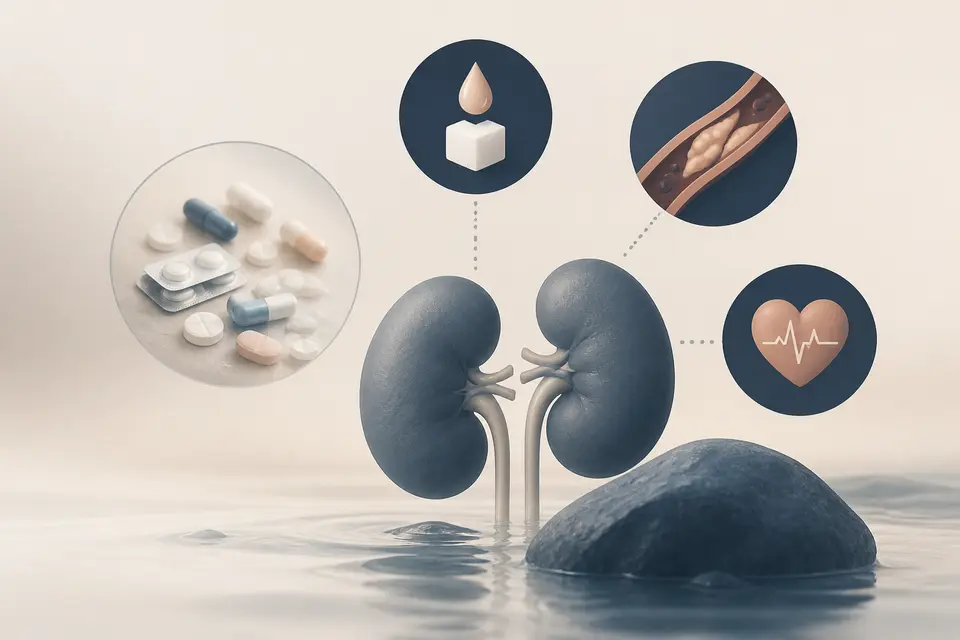
NIDDK warns that nonsteroidal anti-inflammatory drugs (NSAIDs) found in some pain and cold medicines can harm the kidneys and cause acute kidney injury, especially in people with kidney disease, diabetes or high blood pressure. The risk depends on the medicine, health status and circumstances, so the finding does not mean every short exposure causes permanent damage.
A clinician or pharmacist needs the full list of prescription medicines, nonprescription medicines, vitamins and supplements when reviewing an abnormal kidney result. Starting, stopping or changing a medicine without that review can create a different risk, and availability and regulatory status vary by country.
When specialist assessment enters the picture
KDIGO lists eGFR below 30 mL/min/1.73 m², a sustained fall in GFR of more than 20 percent, uncertain cause, hereditary kidney disease and several severe or persistent urine abnormalities among reasons for referral to specialist kidney care. It also allows a validated five-year kidney-failure risk of 3 to 5 percent to help guide referral in people with G3 to G5 disease.
Those criteria do not replace urgent assessment for acute symptoms, and they do not create one global referral route. Local service capacity, national guidance and the patient's other conditions affect who manages follow-up and how quickly specialist care is available.
Frequently asked questions
Does one eGFR below 60 mean chronic kidney disease?
No. KDIGO requires an abnormality to persist for at least three months, and it specifically cautions against assuming chronicity from one abnormal eGFR or ACR result. A new abnormal result still requires clinical follow-up because it may reflect an acute change.
Does eGFR above 90 rule out kidney disease?
No. G1 filtration can coexist with kidney damage, including persistent albuminuria. eGFR and urine ACR provide different information and need to be read together.
Why can the result change between tests?
eGFR is calculated from filtration markers rather than measured directly. Changes in creatinine, acute illness, muscle mass, diet, laboratory methods and the equation used can affect the estimate, while a true change in filtration may also be responsible.
Is a low eGFR reversible?
The number may improve when a temporary cause resolves, but a repeat result cannot show the cause on its own. Chronic kidney disease and acute kidney injury require different evaluation, and neither should be inferred from a self-calculated trend.
What information helps interpret the report?
Prior eGFR and creatinine results, urine ACR, current symptoms, medical history and a complete medicine and supplement list provide context. The laboratory's equation and units also matter when results from different services are compared.
Sources and further reading
- KDIGO 2024 Clinical Practice Guideline for the Evaluation and Management of Chronic Kidney Disease(Kidney Disease: Improving Global Outcomes)
- eGFR Equations for Adults(US National Institute of Diabetes and Digestive and Kidney Diseases)
- Clinical Measurements and eGFR Accuracy(US National Institute of Diabetes and Digestive and Kidney Diseases)
- Chronic Kidney Disease Tests and Diagnosis(US National Institute of Diabetes and Digestive and Kidney Diseases)
- Managing Chronic Kidney Disease(US National Institute of Diabetes and Digestive and Kidney Diseases)
- Acute Kidney Injury(United Kingdom National Health Service)