The World Health Organization recommends brushing twice daily with toothpaste containing 1,000 to 1,500 parts per million (ppm) fluoride. For young children, the amount placed on the brush matters as much as the concentration because they are more likely to swallow toothpaste while learning to brush.
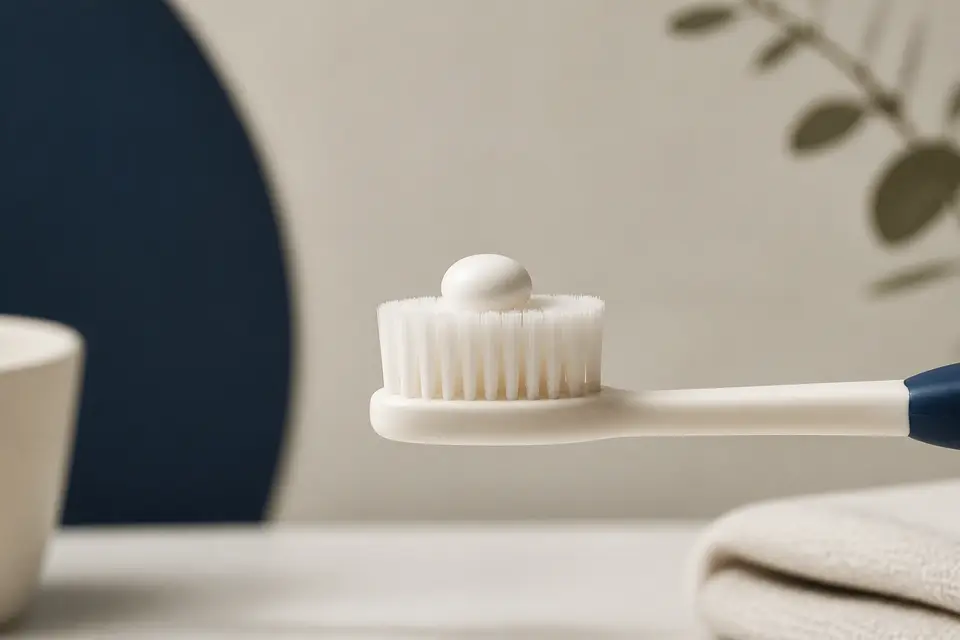
A rice-grain smear for a child younger than 3, or a pea-sized amount from ages 3 to 6, provides topical fluoride while limiting what can be swallowed. Large accidental ingestions require prompt assessment, while repeated excess intake during tooth development can cause dental fluorosis.

Large or uncertain ingestions need prompt advice
Contact a local poison service or emergency medical provider promptly if a child swallows a large amount of fluoride toothpaste, the amount is unknown, or the product is a high-fluoride prescription formulation. Stomach pain, vomiting, diarrhea, weakness, breathing difficulty, tremors or convulsions after ingestion require urgent medical care.
The US National Library of Medicine lists gastrointestinal, neurologic and cardiac symptoms after a large fluoride-toothpaste overdose and says not to induce vomiting unless poison-control staff or a clinician instructs it. The correct response depends on the child's weight, the product concentration, the possible amount swallowed, the time since exposure and current symptoms.
The United Kingdom's Specialist Pharmacy Service says ingestion above 5 milligrams of fluoride per kilogram of body weight requires urgent medical assessment. It says amounts below that level are unlikely to cause symptoms, but this clinician-facing threshold should not be used to delay help when the product or amount is uncertain or a child is unwell.
Fluoride toothpaste reduces new decay
Fluoride helps prevent tooth decay by supporting remineralization at the tooth surface and making enamel more resistant to acid attack. The World Health Organization recommends twice-daily brushing with toothpaste containing 1,000 to 1,500 ppm fluoride as part of oral-disease prevention.
A 2019 Cochrane review included 96 studies and found less new decay with toothpastes containing 1,000 to 1,250 ppm or 1,450 to 1,500 ppm fluoride than with fluoride-free toothpaste. Most of the evidence concerned the permanent teeth of children and adolescents, and many direct comparisons between concentrations remained uncertain.
The review found a dose-response pattern in children and adolescents, but it did not support treating the strongest available toothpaste as the default for every child. The authors said concentration choices for young children must balance decay prevention against fluorosis risk.
A smear or pea-sized amount is enough
The United Kingdom's National Health Service advises starting brushing when the first tooth appears, using a smear of toothpaste with at least 1,000 ppm fluoride for children younger than 3. Children aged 3 to 6 should brush twice daily for about two minutes with 1,000 to 1,500 ppm toothpaste, using no more than a pea-sized amount.
An adult should put the toothpaste on the brush and supervise or help with brushing. The child should spit out the excess rather than swallow it and should not rinse immediately with water, because rinsing removes fluoride left on the teeth. Toothpaste should be stored where a young child cannot eat or lick it from the tube.
National recommendations and product labels can differ, particularly for children younger than 2 and for high-fluoride formulations. A dentist can adjust advice for a child with a high risk of decay, difficulty swallowing, complex medical needs or exposure to fluoride from supplements or other prescribed products.
The 5-milligram threshold is not a brushing target
Fluoride concentration and the mass of toothpaste determine the dose swallowed. A concentration of 1,000 ppm means one gram of toothpaste contains about one milligram of fluoride. Under the United Kingdom assessment threshold, a child weighing 20 kilograms would require urgent assessment after ingesting more than 100 milligrams of fluoride.
For a 1,000 ppm toothpaste, 100 milligrams of fluoride corresponds to about 100 grams of toothpaste. That example explains why a correctly measured smear or pea-sized amount is far below the assessment threshold, but it is not a home triage formula: products may contain different concentrations, and a partly used tube makes the swallowed amount hard to establish.
The threshold also describes a single acute ingestion, not an acceptable daily intake. A child can have gastrointestinal symptoms below it, and repeated exposure raises a different question from swallowing a large quantity at once.
Fluorosis reflects excess intake while teeth are forming
Dental fluorosis is a change in enamel appearance caused by consuming too much fluoride while permanent teeth are developing under the gums. The US Centers for Disease Control and Prevention says children can develop fluorosis only while teeth are forming, generally through about age 8.
Mild fluorosis may appear as faint white flecks, spots or lines. The US agency says most fluorosis in the United States is mild and cosmetic, while moderate or severe disease can cause more extensive enamel changes. That US pattern cannot be assumed in places with different natural fluoride levels in drinking water.
Using the age-based amount and supervising brushing reduce swallowed toothpaste without removing fluoride's topical benefit. Fluoride supplements, mouth rinses, professional varnish and high-fluoride toothpaste add other sources of exposure and require a separate decision based on age, decay risk, local water and a clinician's assessment.
Parents should not copy a fluoride-supplement or high-strength-toothpaste plan from another child. Availability, recommended ages and regulatory status vary by country.

Daily brushing still requires dental follow-up
Fluoride toothpaste lowers decay risk but does not repair every cavity or replace dental assessment. Tooth pain, a visible hole, swelling, fever, pain on biting or a bad taste needs dental care rather than a change in toothpaste amount.
Brief pain from cold can have several causes, including exposed dentin, decay or a crack. APPI News has a separate guide to why cold sensitivity needs assessment when it persists or occurs without a trigger.
Whitening toothpaste also serves a different purpose from decay prevention and may rely more heavily on abrasives that remove surface stains. The evidence and risks are covered in our guide to tooth whitening, sensitivity and enamel wear.
Frequently asked questions
How much fluoride toothpaste should a young child use?
Use a rice-grain smear for a child younger than 3 and no more than a pea-sized amount from ages 3 to 6. An adult should dispense the toothpaste and supervise brushing.
What concentration should the label show?
The World Health Organization recommends toothpaste containing 1,000 to 1,500 ppm fluoride for twice-daily brushing. Country guidance and dental advice may narrow that range for a child's age and decay risk.
Should a child rinse after brushing?
The United Kingdom's National Health Service advises spitting out excess toothpaste without rinsing immediately. This leaves fluoride on the teeth while reducing the amount swallowed.
Does swallowing a normal brushing amount cause poisoning?
A small accidental swallow from a measured smear or pea-sized amount is far below the United Kingdom's urgent-assessment threshold for most children. Large or uncertain ingestions, high-fluoride products or any symptoms require prompt advice from a local poison service or medical provider.
Can fluoride toothpaste cause fluorosis?
Repeated excess fluoride intake while permanent teeth are forming can cause fluorosis. Using the correct amount, supervising brushing and keeping the tube out of reach limit that risk.
Sources and further reading
- Oral health(World Health Organization)
- Fluoride toothpastes of different strengths for preventing tooth decay(Cochrane)
- Children's teeth(United Kingdom National Health Service)
- Considering fluoride and accidental ingestion of toothpaste(United Kingdom Specialist Pharmacy Service)
- Toothpaste overdose(US National Library of Medicine)
- About dental fluorosis(US Centers for Disease Control and Prevention)