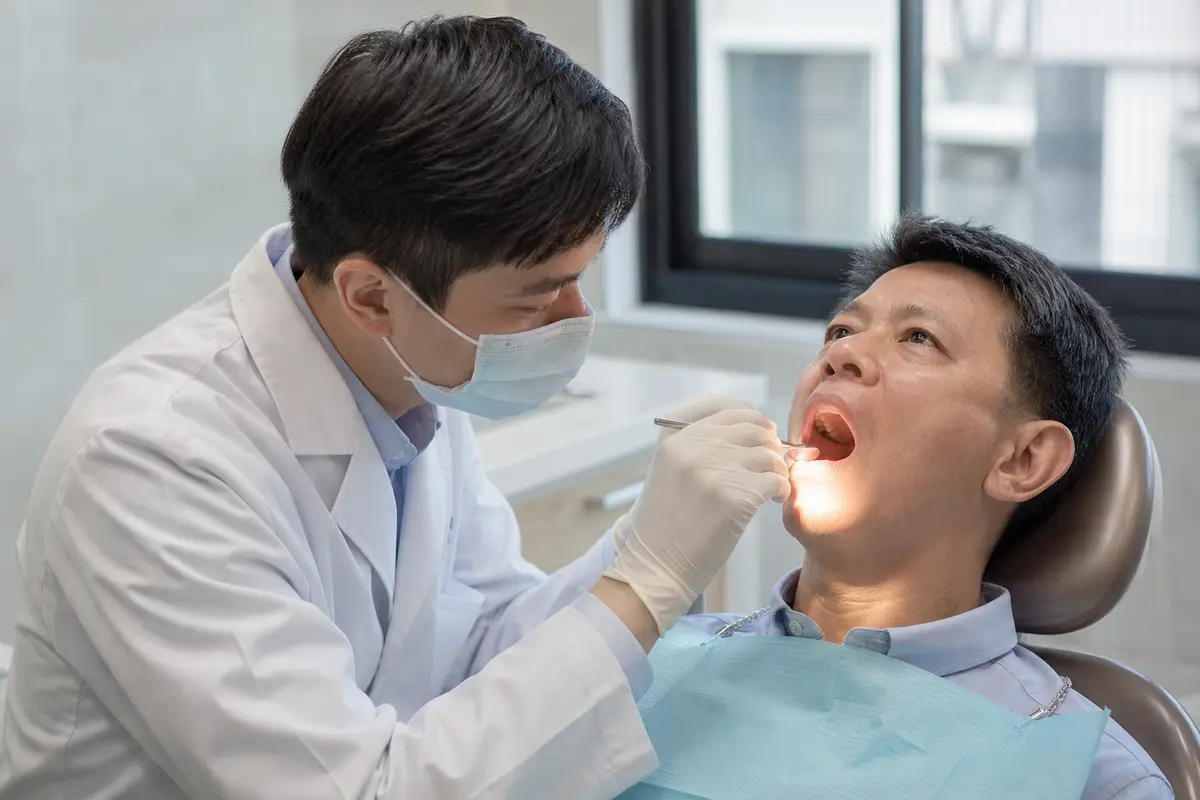
The International Agency for Research on Cancer's 2023 handbook concludes that clinical oral examination may reduce oral cancer mortality among people at high risk because of tobacco, areca nut or alcohol exposure. The working group could not establish a mortality effect in the general population and said the small number of studies in a few settings limits how widely the results can be applied.
The World Health Organization identifies tobacco, alcohol and areca nut, including betel quid, among the leading causes of oral cancer. Screening looks for tissue changes that may already be present; it does not remove the risk created by continued exposure.
Breathing trouble or inability to swallow needs emergency care
England's National Health Service advises emergency care for difficulty breathing, inability to swallow, drooling caused by an inability to swallow, a high-pitched breathing sound or severe symptoms that are worsening quickly. People outside the United Kingdom should use their local emergency service rather than wait for a dental or screening appointment. These signs have many possible causes and do not establish an oral cancer diagnosis.
Persistent mouth changes need diagnostic assessment
England's National Health Service advises assessment by a doctor or dentist for a mouth ulcer lasting more than three weeks, a red or white patch, a lump in the mouth or neck, persistent mouth pain, difficulty swallowing or speaking, or a hoarse voice that does not go away. These findings are common in conditions other than cancer, but a screening schedule should not delay assessment of a new symptom.
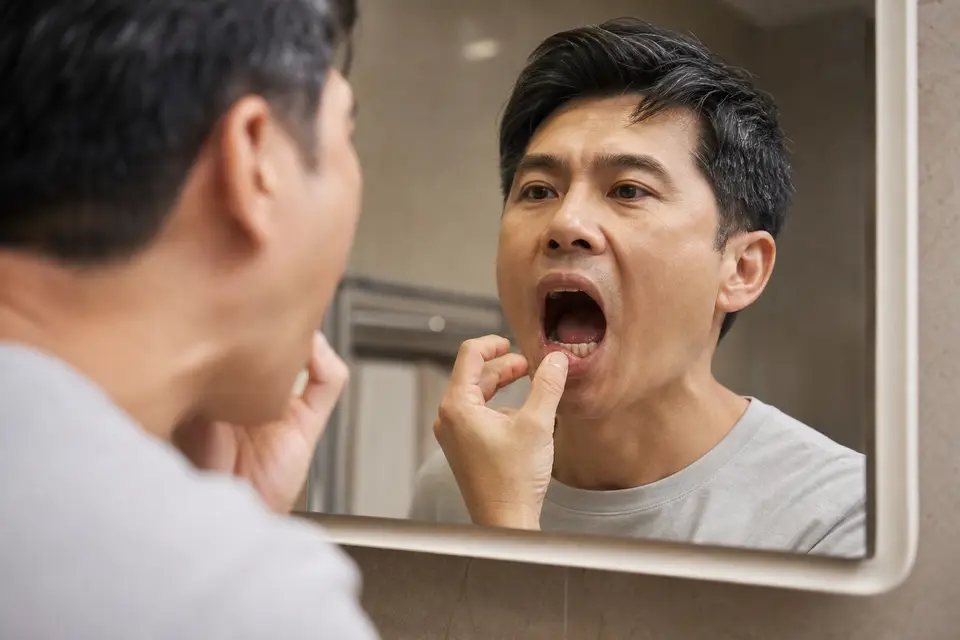
A 2021 Cochrane review rated the evidence for mouth self-examination and remote screening as very low certainty and found no high-certainty evidence supporting screening tests in the general population. Looking in a mirror can draw attention to a change, but it cannot clear a suspicious lesion or replace examination by a trained professional.
What a clinical oral examination checks
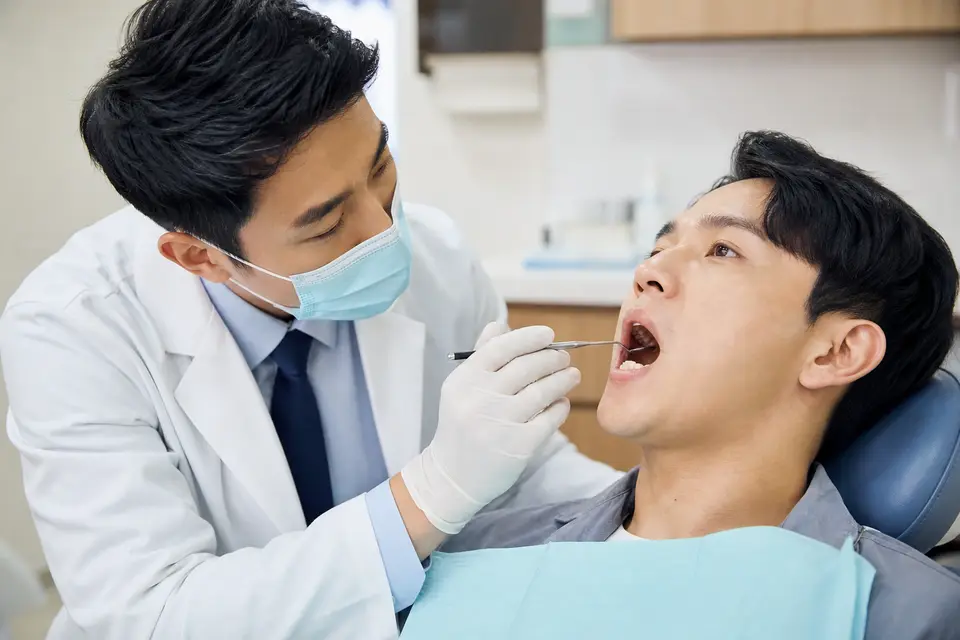
IARC describes the standard clinical oral examination as white-light inspection and palpation of the oral cavity, external face and neck. A systematic exam can cover the lips, inner cheeks, gums, hard and soft palate, floor of the mouth, tongue and tonsils. The clinician also feels for enlarged lymph nodes or masses in the neck.
The screen is intended to flag abnormalities such as persistent white or red areas, ulcers, thickening, an unusually firm area or a mass. It does not determine from appearance alone whether a lesion is benign, an oral potentially malignant disorder or cancer.
The US National Cancer Institute says a diagnostic assessment may include a physical examination, endoscopy, imaging and a biopsy, in which cells or tissue are examined by a pathologist. A positive screen therefore means that further evaluation is needed, not that cancer has been diagnosed. The appropriate specialist and timing depend on the finding and the care pathway in the country where the examination takes place.
Positive and negative screens both have limits
The US National Cancer Institute warns that an oral cancer screen can appear normal when cancer is present or abnormal when no cancer is present. A false-negative result can delay care for symptoms, while a false-positive result can cause anxiety and lead to tests such as biopsy. New or persistent warning signs still require assessment after a normal screen.
IARC found no studies that directly measured harms from clinical oral examination, false results or overdiagnosis. It identified possible harms from extra investigations and treatment, and it noted that the course of an oral potentially malignant disorder cannot always be predicted for an individual.
Mortality evidence is concentrated in high-risk groups
In a cluster-randomized trial in Kerala, India, four screening rounds were associated with 24 percent lower oral cancer mortality and 21 percent lower incidence of stage III or IV oral cancer among tobacco or alcohol users in a per-protocol analysis. The 12 percent mortality reduction across the full study population was not statistically significant. Only 59 percent of people with a positive screen completed physician assessment, one of several limitations identified by the IARC working group.
The source article's 21 percent and 26 percent figures came from a different type of evidence. IARC reviewed a 2004–2009 cohort from Taiwan's nationwide oral cancer screening program, a public program aimed at people exposed to cigarette smoking or betel quid. Screened participants had 21 percent lower incidence of advanced oral cancer and 26 percent lower oral cancer mortality than nonparticipants, but IARC flagged selection and nonresponse bias; those observational estimates are not a worldwide efficacy rate.
No worldwide age or screening interval applies
IARC says the studies behind its evaluation used two- or three-year screening intervals and did not establish an optimal age range. Eligibility, payment, the type of professional performing the examination and the referral route vary by country. People with current or past tobacco, areca nut or heavy alcohol exposure can ask a local dentist or clinician whether a targeted program or risk-based examination is available.
APPI News could not independently verify the source article's current 2026 Taiwan funding eligibility or its two-month referral deadline through a current international source. Those details are not presented as current rules for Taiwan or as a schedule for readers elsewhere.
The studies reviewed by IARC do not establish a screening schedule for children or a separate interval during pregnancy. Children, pregnant people, people with chronic conditions and those taking regular medicines should discuss a persistent lesion or a planned diagnostic procedure with a clinician instead of applying an adult exposure-based schedule on their own.
How this plays out outside Taiwan
Access depends on whether a country treats a mouth check as a symptom assessment, an opportunistic part of dental care or an organized screening service. The evidence does not support copying Taiwan's public eligibility rules into another health system. A reader should first separate two situations: a new or persistent mouth change needs diagnostic assessment, while a person with no symptoms is asking whether a routine examination is useful.
In the United States, the US Preventive Services Task Force says evidence is insufficient to assess the balance of benefits and harms of screening asymptomatic adults for oral cancer. Its recommendation describes the main test as a systematic clinical examination, including inspection and palpation, and says a suspected cancer or precursor requires confirmation by tissue biopsy. That is not a recommendation to ignore a lesion. It means a US reader should ask a dentist or clinician to assess a persistent change, rather than assume that a nationwide, age-based oral-cancer screening program or a fixed screening interval exists.
The practical US question is therefore where the examination fits into care. A dentist may notice an abnormal area during a regular examination, while a primary-care clinician may assess symptoms and arrange referral. The USPSTF recommendation does not decide insurance coverage or set a price; those details depend on the insurer, the dental practice and the state or local care pathway. Before booking a paid test marketed as an oral-cancer screen, a reader can ask what professional performs it, what happens after an abnormal finding and whether biopsy or specialist referral is included. A light, dye, brush or saliva test should not be treated as a diagnosis without a validated follow-up pathway.
In England, the National Health Service gives a concrete symptom route rather than a population-wide oral-cancer screening schedule. A mouth ulcer lasting more than three weeks, a red or white patch, a lump, persistent mouth pain, or difficulty swallowing or speaking should be assessed by a GP or dentist. If a clinician suspects cancer, the NHS describes referral for further tests, which can include biopsy and imaging. Emergency care is a different route: difficulty breathing, an inability to swallow, drooling because swallowing is impossible, a high-pitched breathing sound or quickly worsening severe symptoms should not wait for a routine dental appointment.
In Australia, the national cancer-screening system is more explicit about what it does not include. The Australian Government lists population-based programs for breast, bowel, cervical and lung cancer; oral cancer is not one of those national programs. Australian healthdirect advises people to report mouth changes to a dentist or doctor and says regular dental check-ups can help diagnose mouth cancer early. Cancer Council Australia material on head and neck cancer also describes opportunistic checks during general health examinations and dental visits, rather than a formal national oral-cancer screening program. An Australian reader with no symptoms can therefore ask a dentist to examine the mouth during ordinary care, but should not expect a government-issued oral screening kit or a nationwide two-year invitation.
Singapore illustrates another model. HealthHub's Project Silver Screen is a nationwide community program for Singapore citizens and permanent residents aged 60 and above who have not been screened in the previous year. The program includes basic oral, vision and hearing checks, and HealthHub says that from September 1, 2026, screening is fully subsidized for Singapore citizens and permanent residents; follow-up care or assistive devices may cost extra. This is a general functional screen, not evidence that every older resident receives a dedicated oral-cancer examination at a fixed interval. A Singapore reader with a persistent ulcer, patch, lump or swallowing problem should use a dentist or doctor for diagnostic assessment instead of waiting for the community screen.
Across these markets, the useful local questions are concrete: Is the visit a screening examination or a diagnostic appointment? Which professional will inspect and palpate the mouth and neck? Where will a biopsy be done if the finding is abnormal? What fee, insurance rule or subsidy applies to the first visit and to follow-up? Government health portals, a national health service, a public hospital or a registered dental practice can answer those questions more reliably than an advertisement for a stand-alone test. The absence of a national program does not make a persistent symptom safe to watch indefinitely, and the presence of a community check does not turn a normal result into a guarantee.
Exam accuracy varies with population and training
Across studies summarized by IARC, clinical oral examination sensitivity ranged from 50 percent to 99 percent and specificity ranged from 75 percent to 99 percent. Results varied because study populations, disease prevalence and screener training differed. That spread does not support one fixed claim that the examination detects 75 percent of early cancers or potentially malignant disorders in every setting.
Red and white lesions can overlap in appearance with benign mouth conditions, so training and a working referral pathway are part of screening quality. Light-based devices, dyes, brush cytology and salivary biomarkers have not shown a validated added benefit for mortality when used as stand-alone population screening tests.
Stopping exposure remains the preventive step
IARC found sufficient evidence that stopping tobacco smoking, alcohol consumption and use of areca nut products reduces oral cancer risk, with risk generally declining over time after cessation. The review did not support treating a screening visit as a substitute for stopping exposure. Former exposure can still matter when a clinician or program assesses risk.
Frequently asked questions
What happens during a clinical oral examination?
A trained professional inspects the lining of the mouth under white light and feels oral tissues, the face and the neck. The examination looks for suspicious changes and enlarged lymph nodes; it does not by itself diagnose cancer.
Does a positive result mean oral cancer?
No. It means an abnormality needs further evaluation. A specialist may recommend observation, imaging, endoscopy or biopsy depending on the lesion and the local pathway.
Can a mirror check replace professional screening?
No. A mirror check may reveal a persistent ulcer, patch or lump, but self-examination has weak accuracy evidence and cannot examine every area reliably. A concerning change needs assessment even when the rest of the mouth looks normal.
How often should screening be repeated?
There is no worldwide interval. IARC evaluated studies using two- or three-year intervals but could not establish an optimal age range, so a local program or clinician must set eligibility and follow-up.
Does screening remain relevant after quitting tobacco or areca nut?
Risk falls over time after stopping exposure, but it does not necessarily fall immediately to the level of someone who was never exposed. Past exposure should be included when a clinician or program assesses risk.
Sources and further reading
- Oral Cancer Prevention: Evaluations, Statements, and Considerations(International Agency for Research on Cancer via NCBI Bookshelf)
- Oral Cancer Prevention: Screening and Early Diagnosis of Oral Cancer(International Agency for Research on Cancer via NCBI Bookshelf)
- Oral health(World Health Organization)
- Symptoms of mouth cancer(National Health Service in England)
- Sore throat(National Health Service in England)
- Oral Cavity and Nasopharyngeal Cancers Screening(US National Cancer Institute)
- Lip and Oral Cavity Cancer Treatment(US National Cancer Institute)
- Clinical assessment for the detection of oral cavity cancer and potentially malignant disorders in apparently healthy adults(Cochrane)
- Recommendation: Oral Cancer: Screening(US Preventive Services Task Force)
- Mouth cancer (oral cancer)(Healthdirect Australia)
- Screening for cancer(Australian Government Department of Health, Disability and Ageing)
- Project Silver Screen(Singapore HealthHub)