Pain in the groin, outer hip or buttock can point clinicians toward different structures, but location alone cannot identify the cause. Sudden severe pain, inability to bear weight, fever or a hot swollen hip requires prompt assessment before home care.
The hip joint sits beneath layers of muscle and shares nerve pathways with the lower back and pelvis. Pain may therefore come from the joint, nearby tendons or bursae, bone, a nerve, or a problem referred from outside the hip. A history and physical examination determine which explanation is plausible and whether imaging is needed.
Warning signs come before a pain-location checklist
England's National Health Service advises urgent assessment for severe hip pain that starts suddenly without an injury, or when the hip is hot and swollen, the surrounding skin changes color, or pain occurs with fever or feeling systemically unwell. Severe pain after a fall, inability to walk or bear weight, or tingling or loss of feeling after an injury calls for emergency care.
These signs can accompany a fracture, joint infection or another condition in which waiting may cause harm. Pain that repeatedly interrupts sleep, progressively restricts normal activity or persists despite initial care also warrants a clinical assessment, even without an emergency sign.
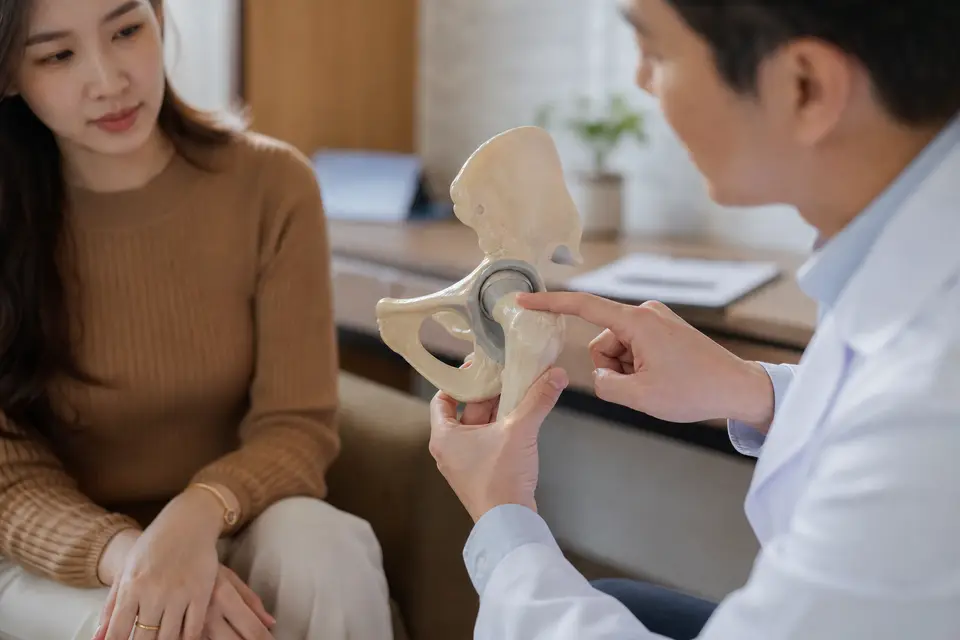
A pain map helps organize the examination, but it does not replace one (illustrative image).
Groin, outer-hip and buttock pain suggest different starting points
Groin or front-of-hip pain
Deep groin pain makes a problem inside the hip joint more likely than pain centered over the outer bony prominence. Osteoarthritis, femoroacetabular impingement (FAI), a labral injury and osteonecrosis can all produce pain in this region. Their symptoms overlap, so age, injury history, medicines, movement pattern and examination findings matter more than any single pain description.
The American Academy of Orthopaedic Surgeons (AAOS) describes FAI as abnormal extra bone around the femoral head or hip socket that can damage the labrum and cartilage over time. People may report groin pain with turning, twisting or squatting, but a clinician must distinguish FAI from other joint and soft-tissue causes.
Outer-hip pain
Pain and tenderness over the outside of the hip, particularly when lying on that side, climbing stairs or walking for a long period, can fit greater trochanteric pain. The term covers problems around the bursa and gluteal tendons rather than a single proven lesion.
AAOS says trochanteric bursitis typically causes pain at the point of the hip that may extend down the outer thigh and worsen at night, when lying on the affected side, or during prolonged walking, stair climbing and squatting. Examination looks for local tenderness; imaging may be used to exclude another cause rather than to confirm every case.
Buttock or back-of-hip pain
Deep buttock pain, sometimes extending down the back of the thigh and worsening with sitting, can arise from the lumbar spine, sacroiliac region, hamstring origin or sciatic nerve in the deep gluteal space. Calling every such episode “piriformis syndrome” can close the assessment too early.
A 2020 systematic review defined deep gluteal syndrome as non-disc-related entrapment of the sciatic nerve in the deep gluteal space and described ambiguity in its definition and diagnostic pathway across published studies. Posterior pain therefore needs an examination that also considers spinal and pelvic causes.
Five diagnoses illustrate why symptoms overlap
Hip osteoarthritis
Osteoarthritis commonly produces activity-related pain and reduced movement, often with groin discomfort. Symptoms do not track perfectly with an image, and the condition does not account for every painful hip in an older adult. The United Kingdom's 2022 National Institute for Health and Care Excellence (NICE) guideline permits a clinical diagnosis without imaging in people aged 45 or older who have activity-related joint pain and no morning stiffness, or stiffness lasting no more than 30 minutes. It advises imaging when atypical features suggest another or additional diagnosis.
Labral injury and FAI
The labrum is a ring of fibrocartilage around the hip socket. A tear can occur with injury or structural impingement and may be accompanied by catching, clicking or pain with rotation. These symptoms are not specific: painless labral abnormalities can appear on scans, while similar sensations can come from tendons outside the joint. Treatment decisions must connect the history, examination and imaging rather than rely on a scan label alone.
Osteonecrosis
Osteonecrosis results from disrupted blood supply to bone and most often affects the hip. The US National Institute of Arthritis and Musculoskeletal and Skin Diseases says symptoms may be absent at first, then progress to groin or buttock pain with weight bearing and later pain at rest; recognized risk factors include hip injury, prolonged high-dose corticosteroid use and excessive alcohol use. Some people have no known risk factor.
The same US institute says clinicians use X-rays or magnetic resonance imaging (MRI) to diagnose the condition. A person taking corticosteroids should not stop them abruptly because of hip pain; the prescribing clinician should review the symptoms and medicine history.
Greater trochanteric pain
Problems involving the bursa or gluteal tendons commonly produce outer-hip pain. Initial management is usually non-surgical and can include modifying aggravating activity and a clinician-directed rehabilitation plan. Persistent pain should prompt reassessment because lumbar disorders, hip-joint disease and other soft-tissue problems can mimic the same pattern.
Deep gluteal or referred pain
Buttock pain with symptoms down the leg may reflect nerve irritation in the spine or, less commonly, entrapment farther along the sciatic nerve. There is no symptom or home maneuver that reliably separates these explanations. New weakness, spreading numbness, bladder or bowel dysfunction, or numbness around the genitals or anus requires urgent assessment rather than stretching or massage.
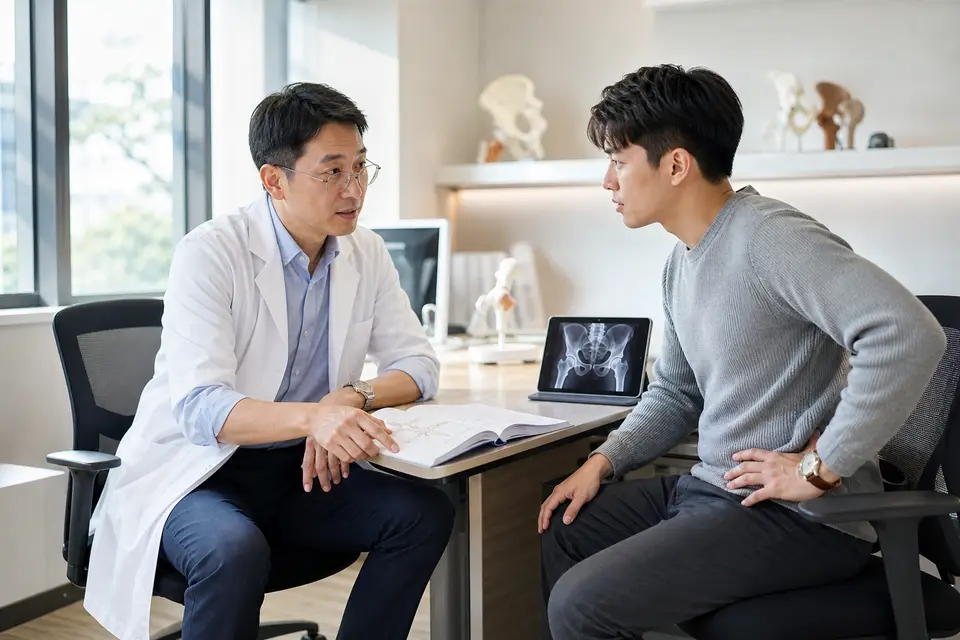
The history and examination determine which diagnosis and imaging pathway fits (illustrative image).
Imaging starts with a clinical question
The American College of Radiology rates pelvic or hip radiography as usually appropriate initial imaging for chronic hip pain. It does not rate MRI, computed tomography or ultrasound as routine first tests when the cause has not yet been narrowed.
Later imaging depends on the suspected structure and what the first images show. The same US radiology criteria rate MRI without intravenous contrast as usually appropriate when radiographs are negative or unclear and clinicians suspect tendon or bursa disease, impingement, dysplasia or a labral tear. Those recommendations concern chronic pain; acute injury, possible infection and suspected fracture use different pathways.
Treatment follows the diagnosis, not a universal ladder
Reducing a clearly aggravating activity for a short period can be reasonable, but prolonged inactivity can reduce strength and function. For confirmed osteoarthritis, the NICE guideline recommends therapeutic exercise tailored to the person's needs, including local strengthening and general aerobic fitness. It also recommends support with weight management for people living with overweight or obesity.
Manual therapy should not be presented as a stand-alone osteoarthritis treatment. NICE says it should be considered only alongside therapeutic exercise because evidence does not support using it alone. Medicine choices require a clinician or pharmacist to account for age, pregnancy, kidney or gastrointestinal disease, cardiovascular risk and other medicines; this guide does not specify a drug or dose.
Surgery is not the automatic next step for persistent pain. NICE recommends considering referral for joint replacement when osteoarthritis symptoms substantially affect quality of life and non-surgical management is ineffective or unsuitable. Labral repair, treatment for osteonecrosis and operations for nerve entrapment have different indications and cannot be inferred from the osteoarthritis pathway.
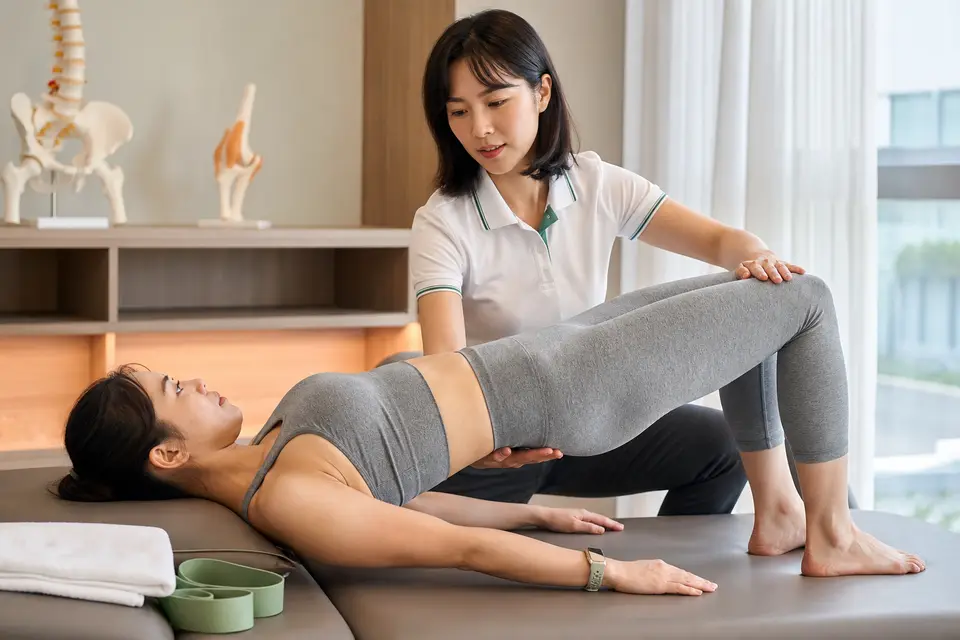
Exercise should match the diagnosed condition, current function and symptom response (illustrative image).
Children, pregnancy and chronic illness need separate assessment
Adult symptom patterns should not be applied to children. England's NHS advises urgent assessment when a child develops sudden hip, thigh or knee pain, starts limping or cannot bear weight on one leg; worsening pain or fever also requires renewed clinical review. Exercise, imaging and medicine decisions should be made with a pediatric clinician.
Pregnancy changes the range of possible pelvic and hip pain causes and affects medicine and imaging choices. England's NHS advises urgent help when a person who is pregnant or may be pregnant has pelvic pain, and emergency care when pain is severe or worsening or occurs with fainting, breathing difficulty or heavy vaginal bleeding. Medicine use and imaging should be discussed with a maternity clinician.
Older adults, people with osteoporosis, cancer, immune suppression or recent surgery, and those taking corticosteroids or blood-thinning medicines may need a lower threshold for assessment. They should give the clinician a complete medicine and medical history rather than applying a general exercise or pain-relief routine.
Frequently asked questions
Which clinician should assess hip pain first?
A primary-care, musculoskeletal, sports-medicine or orthopedic clinician can begin the history and examination; access routes vary by country. Suspected inflammatory arthritis may require rheumatology, while rehabilitation clinicians help plan function and exercise after the working diagnosis is clear.
Does groin pain prove the hip joint is damaged?
No. It raises suspicion for an intra-articular source but cannot distinguish osteoarthritis, FAI, a labral injury, osteonecrosis or referred pain by itself.
Is MRI always needed?
No. Chronic hip pain usually starts with examination and, when imaging is indicated, radiographs. MRI is chosen when a specific question remains after the initial assessment or when a condition that may not appear on early radiographs is suspected.
Can massage or manipulation treat hip pain?
The answer depends on the cause. NICE does not support manual therapy alone for osteoarthritis, and manipulation should not delay assessment of trauma, infection signs, progressive neurological symptoms or suspected osteonecrosis.
Sources and further reading
- Hip pain in adults(National Health Service in England)Urgent and emergency warning signs for adults with hip pain
- Osteoarthritis in over 16s: diagnosis and management(National Institute for Health and Care Excellence)Clinical diagnosis, exercise, weight management and referral for joint replacement
- ACR Appropriateness Criteria: Chronic Hip Pain(American College of Radiology)Initial and subsequent imaging choices for chronic hip pain
- Osteonecrosis(US National Institute of Arthritis and Musculoskeletal and Skin Diseases)Symptoms, risk factors and diagnostic imaging for osteonecrosis
- Hip Bursitis(American Academy of Orthopaedic Surgeons)Outer-hip pain pattern, assessment and non-surgical management
- Femoroacetabular Impingement(American Academy of Orthopaedic Surgeons)Hip impingement, labral damage, examination and imaging
- Deep gluteal syndrome is defined as a non-discogenic sciatic nerve disorder with entrapment in the deep gluteal space: a systematic review(PubMed)Definition and limitations of the diagnostic pathway for deep gluteal syndrome
- Hip pain in children(National Health Service in England)Urgent assessment for sudden hip pain, limping or inability to bear weight in children
- Pelvic pain(National Health Service in England)Urgent and emergency warning signs for pelvic pain, including during pregnancy