
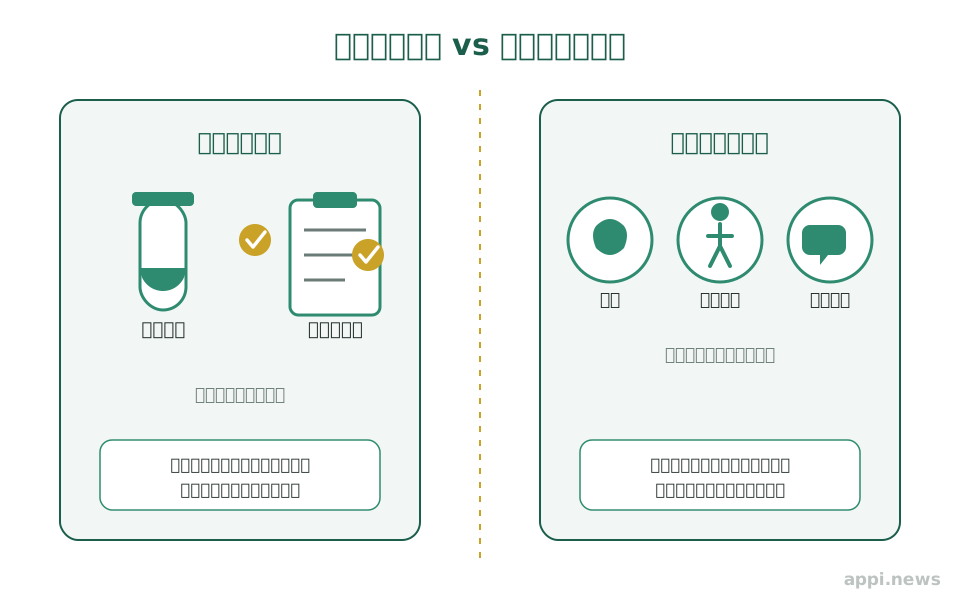
The World Health Organization's updated care framework asks primary-care teams to assess changes in older adults' physical and mental capacities alongside their medical conditions. Walking speed, chair rises and grip strength can inform that review, but none provides a diagnosis or proves what caused a decline.
The approach broadens an assessment beyond laboratory values and disease lists. It does not imply that a normal screening result rules out illness, or that a functional test can replace standard medical evaluation.
WHO links assessment to a care pathway
The WHO's Integrated Care for Older People (ICOPE) approach covers locomotor, cognitive, psychological, sensory and vitality capacities, then connects identified changes with a personalized care plan. The second-edition handbook is intended for health and care workers in primary and community care.
The framework also considers a person's living environment, need for social support and the goals that matter to that person. That structure differs from a stand-alone screening package: measurement is followed by further assessment, a plan and reassessment rather than treated as an answer by itself.
ICOPE is aimed at older people and must be adapted to local health and social-care systems. It does not establish a universal schedule for testing every adult, and the WHO page does not say that each country routinely offers every part of the pathway.
Strength and mobility are measured in different ways
Functional assessment can include handgrip strength, timed chair rises and walking speed. Each captures a different part of performance, and results can be affected by pain, recent illness, neurological or cardiovascular conditions, the testing protocol and the equipment used.
The Asian Working Group for Sarcopenia's 2019 consensus uses low grip strength or low physical performance to identify possible sarcopenia in community settings, but requires low muscle mass for a confirmed diagnosis. Its algorithms differ between community and hospital settings, and its cutoffs were developed for Asian populations.
That distinction matters when a test is offered outside a clinical assessment. A slower walk or more difficult chair rise can flag a need for review, but it cannot show on its own whether the explanation is loss of muscle, joint pain, medication effects, heart or lung disease, balance problems or another condition.
Long-term evidence identifies association, not causation
A systematic review covering 34 studies of people aged 60 or older found that higher baseline grip strength was generally associated with better later mobility, functional status, cognition or survival. The included evidence was longitudinal and observational, so the review describes grip strength as a marker of vulnerability rather than proof that grip strength itself determines those outcomes.
A separate systematic review and meta-analysis found that weaker grip, slower walking, longer chair-rise times and shorter standing-balance times were each associated with higher all-cause mortality in community-dwelling populations. The authors reported substantial variation among the grip-strength studies, and the walking, chair-rise and balance evidence largely came from older populations.
These studies support using physical performance as one source of prognostic information. They do not demonstrate that changing a score will change survival, and they do not turn a research association into a diagnosis for an individual.
Social context is part of functional ability
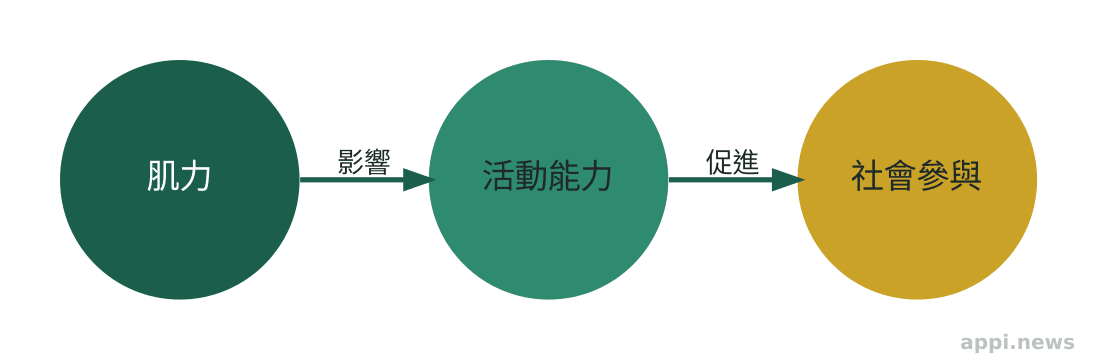
The WHO framework defines function in relation to everyday life, not physical performance alone. Whether a person can obtain food, manage daily tasks, communicate, maintain relationships and move safely depends on both individual capacity and the surrounding environment.
Reduced participation therefore warrants inquiry, but it has no single medical meaning. Transport, finances, caregiving duties, accessibility, bereavement and personal preference may change how often someone leaves home or sees other people. Treating reduced social activity as proof of physical decline would confuse a broad assessment domain with a diagnostic test.
Functional assessment supplements disease screening
Laboratory tests, imaging and disease-specific screening answer different questions from walking, strength or daily-activity assessments. One set cannot be used to declare the other unnecessary. A functional change can prompt a broader clinical review, while an abnormal laboratory result may require attention even when daily activities remain unchanged.
The practical value of the WHO model lies in combining those sources of information and linking them to follow-up. Its evidence base supports structured assessment of older adults; it does not support branding vague symptoms as a single condition or selling an isolated performance test as a comprehensive health check.
Sources and further reading
- Integrated care for older people: guidance for person-centred assessment and pathways in primary care, second edition(World Health Organization)
- Asian Working Group for Sarcopenia: 2019 consensus update on sarcopenia diagnosis and treatment(Journal of the American Medical Directors Association via PubMed)
- Prognostic value of handgrip strength in people aged 60 years and older: a systematic review and meta-analysis(Geriatrics & Gerontology International via PubMed)
- Objectively measured physical capability levels and mortality: systematic review and meta-analysis(BMJ via PubMed)