As of August 29, 2026, Disney+ said a subscription could not be shared outside the account holder's Household unless the service tier permitted it. The company ties that Household to a primary residence and offers different account routes for home-device checks, travel, relocation and long-term use elsewhere.
APPI News could not find one official English page that describes a worldwide interface or price. The sharing procedures reviewed here come from the United Kingdom Help Centre, while detailed Extra Member eligibility comes from the United States Help Center; subscribers elsewhere need to use the options and prices shown for their own account and market.

How this plays out outside Taiwan
The same Household language does not produce one worldwide price or one worldwide account screen. Disney's United States plans page currently lists standalone Disney+ at US$11.99 a month with ads and US$18.99 a month for Premium, while its United States Extra Member add-on is listed at US$6.99 a month for the ad-supported plan and US$9.99 a month for Premium. Those prices are for the United States offer shown on the page dated September 23, 2026, and Disney says third-party billing partners can charge differently. A reader in another country should therefore treat a US dollar figure as a US reference, not as a conversion of the local price.
The United States page also gives a concrete rule for plan selection: Extra Member is unavailable with the Disney+, Hulu, ESPN Unlimited bundles, their Premium version, Disney+, Hulu, HBO Max bundle plans and bundles with NFL+ Premium. It is listed as available with the other plans shown on that page. That is a product rule attached to the US catalog, not proof that a similarly named bundle in Australia, Singapore or the United Kingdom has the same eligibility. A subscriber who pays through Apple, a mobile carrier or another platform must check the billing partner's account page as well as Disney's help page, because the partner may control the available plan change and charge.
The United Kingdom Help Centre gives a different kind of useful local detail: it tells UK subscribers what the device prompts can say and separates a temporary trip from a move. A TV outside the Household can show an option to use Away from Home, while Update Household makes the current location the new Household. A TV that really belongs to the Household can be cleared with a one-time passcode sent to the account email, and a mobile device can be verified by connecting to home Wi-Fi or requesting a code. Disney says the number of Household updates or Away from Home selections may be limited, but the UK page does not state a universal number.
That UK workflow is useful for readers elsewhere because it identifies the decision they need to make, but it does not establish that every market displays the same labels. In the United States, the official plans page shows the Extra Member feature and prices in the US catalog; in the United Kingdom, Disney's pricing page lists the local plan names and says an Extra Member can stream on one device and use one profile. Neither page proves that a subscriber in Singapore or Australia has the same add-on, price or bundle exclusions. For those markets, the reliable check is the local Disney+ sign-up or account page after the subscriber is signed in, not a price copied from a US or UK article.
There is also a practical difference between a local price question and a Household question. A subscriber in the United States can compare the Extra Member line with the plan and bundle restrictions on Disney's US pricing page. A subscriber in the United Kingdom can use the UK Help Centre's sharing guide and local pricing page to check the available route, then confirm the charge on the account page. A subscriber in another market should record the country or region shown in the account, identify whether Disney or a billing partner collects the payment, and save the exact prompt before contacting support. Disney's public pages reviewed for this guide do not publish a single table covering every market, so APPI News could not verify a universal price or availability rule for Singapore, Australia or other countries.
This matters when a family crosses borders. The US Extra Member rule requires the added person to live in the same country or region as the account holder, while the UK sharing guide describes the Household as the primary personal residence and allows a travel route for temporary absence. A person who permanently lives in another country should not assume that a US account, a UK account or a shared password satisfies either condition. The account page, the local Disney+ help center and the billing partner's terms are the documents that can establish what is offered for that particular subscription.
Disney+ links the Household to a primary residence
Disney's United States subscriber agreement says an account cannot be shared outside the account holder's household unless the service tier permits it. The United Kingdom Help Centre defines a Household as devices associated with the account holder's primary personal residence and used by the people who live there.
The published definition focuses on residence and devices rather than a user's surname or the number of profiles stored in the account. A separate profile organizes one person's viewing activity, but it does not appear in Disney's definition as a way to extend the Household to another address.
Disney says its Household logic considers whether devices regularly share the same internet-connection details and whether the same device shows regular account activity over time; it also says it does not collect and use precise geolocation data to establish a Household. Those statements identify categories of information, not a complete detection formula.
Disney's sharing guide says it automatically establishes a Household from subscription activity, linked devices, internet connections and other factors. APPI News could not find published weights, thresholds or a rule showing that one changed connection or one new device will always trigger a warning.

The prompt determines the verification route
For a television-connected device that belongs to the Household, Disney's United Kingdom guide says the account holder can select Continue and verify the device with a one-time passcode sent to the account email address. If the device does not belong to the Household, the same prompt offers a logout or a new subscription instead.
A second television prompt offers Away from Home for a temporary trip and Update Household when the current location should become the subscription's new Household. Updating changes the Household location, so the travel option and relocation option serve different situations.
On a mobile device, Disney lists home Wi-Fi verification, a one-time code, Connect to Household and Away from Home among the possible routes. The exact buttons depend on the message shown, and the reviewed page does not promise that every account or market displays every route.
Disney says limits may apply both to Household updates and to Away from Home selections. The company does not publish a universal number, so APPI News could not verify claims that either option can be used a fixed number of times.

Extra Member is not a universal entitlement
Disney's United Kingdom sharing page says a person outside the Household can use a separate subscription or, where the account supports it, an Extra Member add-on. The account page remains the relevant place to determine whether the add-on is available for a particular plan.
Disney's United States Help Center says a Disney+ or eligible bundle subscription can have one Extra Member, who must be at least 18, live in the same country or region as the account holder and have no active Disney+, Hulu or ESPN subscription. Those conditions describe the United States offer reviewed for this guide and should not be treated as a worldwide product specification.
The United States page gives an Extra Member a separate email address, password and profile, with streaming and downloads limited to one device at a time. It also says the Extra Member receives the same video and audio quality as the account holder but cannot change the service tier or other account options.
The United States invitation instructions apply to an account holder billed directly by Disney+, who adds the seat from the account page and sends an email invitation. The reviewed page does not establish Extra Member eligibility for accounts billed by another company.
Disney says an eligible profile can move to a new subscription with its viewing history and settings, but the primary profile, a profile for a viewer under 18 and a Junior Mode profile cannot be transferred. A profile transfer and an Extra Member purchase are separate account operations.

Removing the person does not cancel the United States add-on
Disney says the United States Extra Member add-on is billed monthly to the account holder, who can remove the add-on at the end of its current monthly billing period. The Extra Member keeps access until that period ends when the add-on itself is canceled.
Removing or replacing the person takes effect immediately but does not remove the paid add-on, so billing continues until the account holder separately cancels the add-on. An empty seat can therefore remain a recurring charge.
APPI News did not identify one Extra Member price or eligibility statement that applies across all Disney+ markets. A price published in one country does not establish the charge in another, and this guide does not convert one market's price into another market's offer.

Unrecognized devices require an account-security check
Disney's United Kingdom device-management page says the account holder can view signed-in devices and see the device type, general location, last activity and the last adult profile that used each device. The account holder can then log out individual devices from the Access and Security section.
Disney's United States security page tells an account holder who suspects unauthorized use to reset the password and log out all devices. A Household mismatch and an unfamiliar login can appear together, but they require separate checks.
Disney warns that logging out everywhere affects services associated with the same MyDisney account, deletes downloaded videos from signed-out devices and can take up to four hours to reach the remaining devices. That broader effect should be considered before a full-session logout.

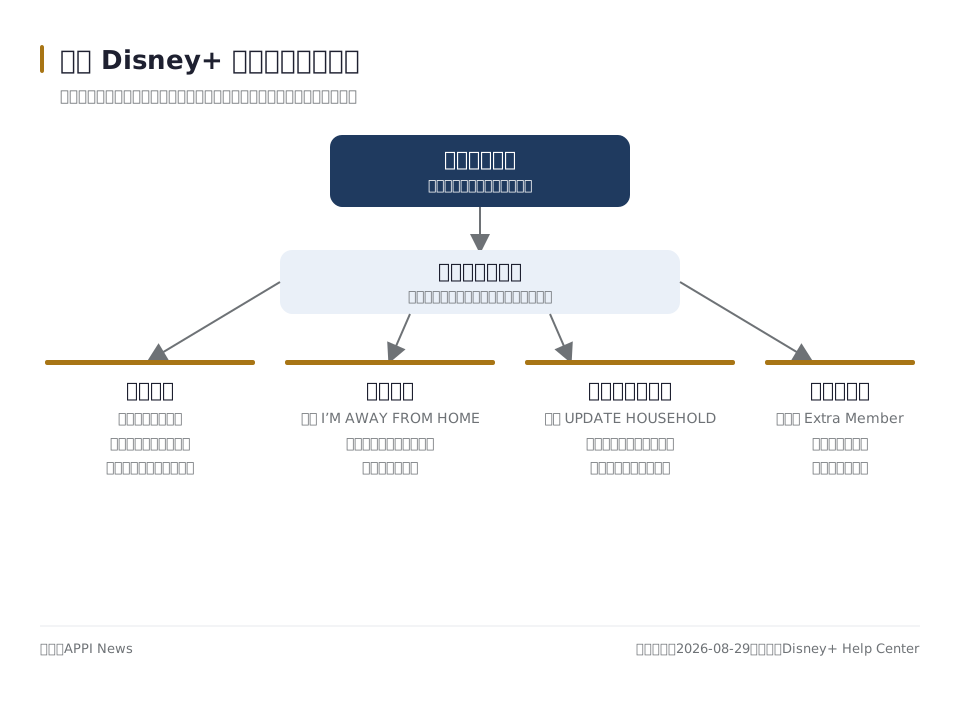
Three account routes cover most Household messages
A device at the primary residence: The account holder can connect it to the home internet, stream and follow the displayed device-verification route. A one-time passcode confirms access when Disney offers that option.
A temporary trip or a move: Away from Home keeps the existing Household for temporary use, while Update Household assigns the current location as the new Household. Disney says both choices may be limited, although it does not publish the allowance.
Long-term use from another home: The person outside the Household needs a separate subscription or an eligible Extra Member place where Disney offers one. An unfamiliar device instead belongs on the security route, beginning with the device list and account credentials.
Disney's signals do not explain another platform's checks
Disney publishes internet-connection and device-activity factors for its Household, but those disclosures do not establish what another streaming service collects. APPI News's review of YouTube found a published 30-day electronic address check but no public list of its verification signals.
A warning on one service should therefore be matched to that service's current account page and help document. A household definition, travel option or extra-member product from Disney+ cannot be used to predict the result on YouTube or another platform.

Frequently asked questions
Can a Disney+ subscription be shared across two permanent homes?
Disney's reviewed pages tie the Household to one primary personal residence. A long-term user elsewhere needs a separate subscription or an eligible Extra Member place where the product is offered.
Should a traveler select Update Household?
Disney's United Kingdom guide assigns temporary travelers to Away from Home and uses Update Household when the current location should become the new Household. The company says usage limits may apply to both options but does not publish a number.
How many Extra Members can an account add?
Disney's United States Help Center says one Extra Member for a Disney+ or eligible bundle subscription. Availability and eligibility vary by market, so that United States limit does not prove that the add-on exists for every country or plan.
Does removing an Extra Member stop the charge?
Not on the United States page reviewed for this guide. Disney says removing or replacing the person leaves the add-on active until the account holder separately removes it.
Sources and further reading
- Disney+, ESPN, and Hulu Subscriber Agreement(Disney+ United States)
- What is a Disney+ Household?(Disney+ Help Centre, United Kingdom)
- Sharing your Disney+ subscription(Disney+ Help Centre, United Kingdom)
- Extra Member on Disney+(Disney+ Help Center, United States)
- Disney+ plans and prices(Disney+ Help Center, United States)
- Disney+ plans and prices(Disney+ Help Centre, United Kingdom)
- Managing devices(Disney+ Help Centre, United Kingdom)
- Account security on Disney+(Disney+ Help Center, United States)